
How fractional executives find clients on LinkedIn: your posts, founders' problems and hiring signals
How fractional CMOs, CFOs and CROs find clients on LinkedIn: your posts and profile viewers, founders posting the problem, hiring signals and outreach.
TL;DR: Fractional executives find clients on LinkedIn by reaching founders and CEOs right after they show the problem the executive solves: when they engage with the executive's posts or view their profile, post about the problem themselves, engage with other fractional leaders and growth-stage content, or start hiring for the full-time role. A short note that names what the person did, sent from the executive's own account, starts the conversation.
traxy runs this whole loop end to end. It finds high intent leads from social intent (posts, comments, likes, profile views and the engagers on profiles you track), keeps only people with a 50%+ ICP match, enriches and researches each one, then runs relevant, personalized LinkedIn and email outreach to them from your own connected accounts on autopilot. Autopilot starts after you approve: you test the campaign on sample leads and approve the launch, then it sends on its own, or you approve every message.
This guide is for individual fractional leaders: CMOs, CFOs, CROs, COOs, heads of people and CTOs who sell part of their week to a few companies at a time. If you run a consulting firm with several partners and offers, signal-based outbound for consulting firms covers how to map LinkedIn situations to one clear offer. For how traxy's outreach works, see LinkedIn outbound with traxy.
traxy wrote this guide and is one of the tools compared. Competitor details come from each vendor's own pages, linked and checked November 2026, and each entry says where that tool fits better. Customer results are quoted from case studies or public posts.
How do fractional executives find clients on LinkedIn?
They find clients by spotting the moment a founder or CEO shows the gap they fill, and starting a conversation about it. On LinkedIn, that moment shows up as activity: a like, a comment, a profile view, a post about the problem or a job post for the role.
Most fractional work still starts with people you know. Fractional Jobs says 84% of fractional leaders find their first client from their network, based on its own survey data (Fractional Jobs, checked November 2026). LinkedIn activity is how you reach past the people you already know without buying a cold list.
Work through four sources, closest to you first, then reach out:
Your own posts and profile viewers. Founders who like or comment on your posts, or look at your profile, already know your name. For a fractional leader, this is often the warmest list there is.
Founders and CEOs posting about the problem. "Our marketing isn't bringing in demos." "We need our numbers ready for a raise." "Founder-led sales has stopped scaling." Search LinkedIn activity for the problem in the buyer's words.
Engagers with other fractional voices and growth-stage content. Founders who engage with other fractional CMOs or CFOs, or with investors and operators writing about scaling, care about the topic you sell.
Hiring signals for the full-time role. A company hiring a full-time CMO is a fractional CMO lead. It has already decided it needs the role, and the seat is empty today.
Outreach to all four, from your own account. Research each lead first, so the message is about them, then reach out on LinkedIn and email.
Selling fractional work is different from selling software in a few ways, and each one changes how you use these sources:
You need a few clients, not hundreds. A handful of clients can fill your week. Fifty of the right founders beat five thousand names.
Your buyer is the CEO. Founders and CEOs hire fractional leaders, often before they can justify the full-time cost. Write to them, not to HR.
Trust decides the deal. The buyer is hiring a person. Your posts, your profile and the reason you give for reaching out carry more weight than any pitch deck.
Timing beats volume. The gap you fill opens at a moment: a raise, a launch, a leader leaving, a hire that isn't filled. Reach out close to it.
Example: Outcome Catalyst. This one shows the founder's side. Zach Shapiro, founder of Outcome Catalyst, tracks the people engaging with his own content and his competitors' content in traxy and filters hard on ICP fit. A healthcare sales exec who surfaced through traxy flew out to meet him and is becoming the company's outsourced head of healthcare sales (Outcome Catalyst case study). The LinkedIn activity that tells a founder who to talk to also tells you which founders to talk to.
How do fractional CMOs find clients?
Fractional CMOs find clients among founders and CEOs of growing B2B companies that have no senior marketing leader yet, or recently lost one. The best signals are a founder posting that marketing isn't working, engagement with other marketing leaders' posts about positioning or launches, a company hiring a CMO or VP of Marketing, and a launch, a raise or a new market that marketing has to carry.
What to look for, as a fractional CMO:
Founder posts about the problem. Spending more on ads with no more demos, a product launch coming up, "we need to fix our positioning", or a founder asking who to hire for marketing.
Engagement with marketing leaders. Founders who like or comment on posts by other fractional CMOs, B2B marketing creators and growth investors.
Hiring for the full-time role. Open roles for CMO, VP of Marketing, Head of Marketing or a first marketing hire.
Moments marketing has to carry. A new funding round, a new product or a new region. These come from research on each lead, not from the post itself.
Set traxy up for it in three parts:
Lead criteria. Founders, CEOs and co-founders at B2B companies of the size, industry and funding you serve, in your regions. Add exclusions for other marketers, agencies and recruiters, so the peers who engage don't become leads.
Signals. Describe the problems above in plain English under Targeting > Signals, or add a custom signal such as "B2B companies preparing a product launch without a senior marketing leader".
Research. Ask each campaign to check whether the company has a marketing leader today, whether it is hiring one, and when it last raised.
The same method works for every fractional role. Only the problems, the job titles and the facts you check change:
Fractional role | Founder posts to look for | Full-time roles that signal the gap | Facts to research on each lead |
|---|---|---|---|
CMO | Marketing not bringing in demos, a launch coming, positioning, "who should we hire for marketing?" | CMO, VP of Marketing, Head of Marketing, first marketer | Current marketing leader, recent raise, new product or region |
CFO | Getting ready to raise, cash runway, board reporting, messy books | CFO, VP of Finance, Head of Finance, controller | Recent or planned raise, size of the finance team, open finance roles |
CRO or sales leader | Founder-led sales stalling, the first sales hire, missed targets | CRO, VP of Sales, Head of Sales, first account executive | Size of the sales team, open sales roles, recent raise |
COO | Processes breaking as the team grows, too many direct reports | COO, Head of Operations, chief of staff | Headcount growth, open operations roles, new locations |
Head of people | Hiring fast, first HR policies, keeping culture as the team grows | CHRO, Head of People, first HR hire | Headcount growth, number of open roles, hiring in new countries |
CTO | Rebuilding the product, looking for a technical co-founder, scaling the engineering team | CTO, VP of Engineering, Head of Engineering | Size of the engineering team, open engineering roles, tech stack |
How do you turn your own posts and profile viewers into clients?
Track your own LinkedIn profile, so the people who like or comment on your posts become leads when they match your ICP, and turn on profile views, so the founders who look you up do too. Then post about your buyer's problem, not your availability, so the people who engage are the ones who have it.
Your posts. In traxy, track your own profile under Targeting > People > Track profile. Only people with a 50%+ ICP match become leads. Each one is labeled Warm, Related or Activity and shows the post or comment behind it (signals docs).
Your profile viewers. Switch on Profile views under Targeting > Signals > LinkedIn activity, then filter Leads by who viewed your profile, any time or in the last 7, 30 or 90 days. Save that filter as a shared view and a campaign can use it as its audience. A view says someone looked, not why, so keep the first message light. Which profile viewers to contact has a checklist.
Posts that draw buyers. Write about what you see inside companies at the stage you serve: the first marketing hire that didn't work out, the board deck that took three weeks, the sales process that lives in the founder's head. A post announcing you're available draws peers. A post about the problem draws founders who have it.
Example: a three-month client from one like. Ben Buaron at traxy shared a user's result: traxy surfaced a qualified lead who had liked one of the user's posts, the user sent a DM, and the lead signed a three-month plan at $2,995 a month without a sales call, 4 days after the user started on traxy (Ben's post).
Speed helps too. When traxy flagged that the GTM lead of a $4B AI video company had engaged with Ben's post, Ben messaged him within about 10 seconds, and 30 minutes later the lead had replied and booked a meeting (Ben's post). For the full profile views setup, see how to turn profile views into leads.
How do you find founders posting about the problem you solve?
Describe the person and the need in plain English, such as "founders of B2B software companies looking for a fractional CMO", and traxy's Social Intent Search returns the people who posted, commented on or liked posts about it, from 71M+ scanned LinkedIn likes, posts and comments. Each result comes with the post or comment behind it, so you see the problem in the founder's own words before you write.
Searches that work for fractional leaders, each in the buyer's words:
The request: "founders asking for a fractional CFO recommendation" or "CEOs looking for a part-time head of sales".
The complaint: "B2B founders saying their marketing isn't bringing in demos".
The trigger: "founders getting ready to raise a Series A" or "CEOs hiring their first VP of sales".
Adam Salmanov, traxy's founder, uses the same kind of search through the traxy MCP to find people asking for what he sells, such as "founders in the US looking for help with LinkedIn outbound" (his post). You can search in traxy, ask trax (the agent inside traxy) to find posts on a topic, or ask Claude or ChatGPT through the traxy MCP. To keep finding these people, add the problem as a signal under Targeting > Signals, or describe a custom signal to trax.
Recommendation requests are the strongest version of this signal: a founder asking their network who to hire. How to find people asking for recommendations on LinkedIn covers them, including a fractional CFO example. More on the search itself: Social Intent Search.
How do you find clients in other fractional leaders' audiences?
Track the LinkedIn profiles of other fractional leaders in your function, and of the investors, operators and creators that founders at your target stage follow. traxy checks the people who like and comment on their posts against your ICP, so you get the founders in those audiences, not the peers.
Other fractional voices. Fractional CMOs, CFOs or CROs who post often and draw founders. Tag them Competitor or Custom. A founder commenting on a post about when to bring in a fractional CFO is weighing that decision.
Growth-stage content. Investors and operators who write about scaling from seed to Series B. Tag them Investor or Influencer. Their audiences are broad, so expect the ICP check to filter out more people.
Company pages. Add an accelerator, a VC firm or a founder community by domain, and traxy reads its LinkedIn page posts for engagers who fit.
One post. When a single post hits your topic dead on, paste its URL and get the engagers who fit your ICP.
Peers engage with these posts too. Add exclusions to your lead criteria for roles like other fractional leaders, consultants, coaches and recruiters, so the founders and CEOs come through. When you write, talk about the topic of the post, not the fact that they liked someone else's content. For how to choose the profiles, see who to track on LinkedIn for leads.
How do you use hiring signals for the full-time role?
Treat a company hiring for the full-time version of your role as a lead. A company hiring a CMO is a fractional CMO lead: it has decided it needs senior marketing, the seat is empty today, and a full-time search takes time. Some companies will take fractional help while they search, and some will decide fractional suits their stage better.
In traxy, hiring signals come from research on each lead in a campaign, not from a live job feed. Find the founders and CEOs first, from your posts, Social Intent Search and the profiles you track. Then have the campaign check each company for the role:
"Check whether this company has an open role for CMO, VP of Marketing or Head of Marketing. Return the job title, location, link and date posted, and who the role reports to if the posting says. Mark verified only if it was posted in the last 60 days. Otherwise mark not verified and say why."
Make the date a rule, because old job posts stay online after hiring stops. Write to the CEO or founder, who usually owns a senior hire, not to the recruiter running the search. Keep the message about the gap, not the job ad: help while they search lands better than "I saw your job post".
Other hiring-side signals work the same way, through the same research step: the leader in your function recently left, the company is hiring several people under a role that has no leader yet (three SDRs and no head of sales, say), or it is opening in a new country. If you pitch founders who are entering a new market, our consulting guide has the fractional CMO steps, and the hiring signals guide shows how to treat local job openings as dated proof.
Adam runs traxy's own LinkedIn outbound this way: the signal picks the template, so a lead whose company is hiring for a specific role gets one message, and someone who posted 2+ times in 30 days gets another. Over 4 weeks, traxy's own and client campaigns sent 9,930 connection requests to warm ICP fits only: 3,902 were accepted, 603 people replied and 251 were interested (Adam's post).
How can a fractional CFO find founders engaging with fundraising posts and check for a new round before pitching?
Use traxy for both halves. It finds the founders and finance leaders who like, comment on or write LinkedIn posts about fundraising, runway and scaling finance, keeps only people with a 50%+ ICP match, and a research-only campaign then checks each lead's company for a new round or relevant hires and keeps the source on the lead. When the evidence holds up, a campaign runs the LinkedIn and email outreach from your own connected accounts on autopilot after you approve the launch, or you approve every message.
Five steps, in order:
Set the signals. Under Targeting > Signals, describe the posts in plain English: founders and finance leaders posting or engaging about raising a round, cash runway, board reporting and scaling the finance team. Track startup finance and fundraising voices, tagged Investor or Influencer, or paste the URL of one post about preparing for a Series A. To start with people who already engaged, search Social Intent Search for "founders engaging with posts about raising a Series A".
Set the lead criteria. Under Targeting > Lead criteria, set the roles to founders, CEOs and finance leaders such as a head of finance, VP of Finance or controller, and set the company size, industry and funding you serve. Add exclusions for other fractional CFOs, accountants and recruiters, so the peers who engage with the same posts don't become leads. Only people with a 50%+ ICP match become leads, each with the post or comment behind it.
Run a research-only campaign first. Create a campaign in Outbound > Campaigns, or ask trax, and keep it research-only, which records findings without sending anything. You can also describe the checks as custom signals, such as "announced a funding round" and "hiring for finance roles or many roles at once". Ask for the evidence with its source:
"Check whether this company announced a funding round in the last 6 months, and whether it has open finance roles (CFO, VP of Finance, Head of Finance, controller, FP&A) or several open roles across teams. Return each finding with the source link and the date. If you find nothing, write not found. Don't guess."
Read the evidence on each lead before you pitch. Open the lead's Signals tab and check the source and date. Leads with a dated round, leads with open roles and leads with only the engagement each go in their own group, with their own message variant, so you never mention a round the research didn't find.
Then run the outreach after you approve it. Point a sending campaign at the leads that passed, with your LinkedIn account and a mailbox connected as senders. Test on sample leads (nothing is sent), then approve the launch. From there it runs on autopilot, or you approve every message in the review queue. A reply, unsubscribe or hard bounce stops the sequence. LinkedIn outbound with traxy covers the sending side.
What the evidence does and doesn't prove. Engagement with a fundraising post is a reason to look, not proof of need: founders read about raising long before they raise, and peers engage with the same posts. One open role is not proof of rapid hiring either. Look for several open roles, or roles across teams, before you say a company is scaling fast. Research finds what is published, so a private round or an unlisted role won't show up, and "not found" is not the same as "no". Mention only what you can link.
Illustrative opener, with a made-up lead. For a founder who commented on a Series A post and whose company research found a dated seed round announcement: "Saw your comment on the post about getting ready for a Series A. Congrats on the seed round. I work as a fractional CFO for startups at that stage, mostly on forecasts and board reporting before the next raise. Who owns the model today?" For a full worked version with an illustrative lead, research findings and a draft, see the fractional CFO example on our signal-based outbound page.
How does traxy run the outreach after you approve it?
You build one campaign per signal, tell it what to research on each lead and what your offer is, test it on sample leads and approve the launch. After that it sends the personalized LinkedIn and email sequence from your own connected accounts on autopilot, or holds every message for your approval. Replies, unsubscribes and hard bounces stop the sequence, and every reply lands in one inbox.
Save each source as a shared lead view. For example "Engaged with my posts", "Viewed my profile", "Posted about the problem" and "Hiring the full-time role". Campaigns use shared views as their audience, and the views update as new leads come in.
Create a campaign for each view. In Outbound > Campaigns, or by asking trax. Give it the audience, your offer and the facts to research on each lead (create a campaign). You can run several campaigns at once; they run in priority order, so one lead never gets two campaigns at once.
Pick research facts that decide fit. For fractional work: whether the company has a leader in your function today, whether it is hiring one, its team size, and recent news such as a raise, a launch or a new market. The campaign researches each lead for those facts, filters out leads that don't fit and groups the rest by signal, with a personalized message variant prepared for each group. If you only want the check, run a research-only campaign, which records findings without sending.
Connect your senders. Sending needs connected sender accounts: your LinkedIn account and a mailbox, under Settings > Sender accounts. Each sender has its own limits, active hours and ramp-up controls (senders docs).
Test on sample leads. The test prepares research and drafts and sends nothing. Check that the research supports every claim in each message (review and launch).
Approve the launch. You see who joins, who is skipped (held by another campaign or contacted before), the sender, the steps and the delivery mode. With a short list of high-value prospects, you may want to approve every message in the review queue at first. Once the wording works, let the approved campaign send on its own.
Take the replies yourself. Each lead has one conversation across LinkedIn and email, and you can pause a lead's sequence to take over. The buyer is hiring you, so the call should be with you.
Three openers for a fractional CMO, one per signal. They are made up. Each names what the person did, makes one point and asks one question:
Commented on your post: "Thanks for the comment on my post about launches that stall after the first month. You mentioned a new product going out in Q1. I work with a few B2B teams at a time as a fractional CMO for exactly that stretch. Who owns the launch plan today?"
Posted about the problem: "Your post about spending more on ads and getting the same number of demos stuck with me. At your stage that is often a positioning problem, not a budget one. Want the five questions I'd ask first?"
Hiring the full-time role: "Saw you're hiring a VP of Marketing. While the search runs, I step in as a fractional CMO, so the new hire inherits a plan and a channel that works, not a blank page. Worth a short call?"
Keep the sequence short: a connection request, a first message after they accept, one follow-up, and an email step for leads with a work email (sequences docs). The numbers stay small, and that's fine. For an agency offer, Adam sent 439 connection requests to traxy leads from one LinkedIn account over about 4 weeks: 151 were accepted, 33 replied and 11 calls were booked (his post).
You can run the same steps from Claude, ChatGPT, Codex, Cursor or Grok through the traxy MCP: search social intent, research leads, draft, test and launch the campaign, and reply in the inbox, with a yes in chat before anything sends or launches. If you already work in Clay, traxy can also send leads to a Clay table. For more first lines by signal, see how to turn a LinkedIn signal into a message. To check a campaign before it goes out, see how to test an outbound campaign on a few leads.
Which tools help fractional executives find clients on LinkedIn?
Pick by where the names come from, whether each one comes with a reason to reach out, and who does the sending. traxy finds founders showing social intent on LinkedIn and runs the outreach from your accounts. Sales Navigator is LinkedIn's own search across its members. Embers ranks LinkedIn engagers for you to message by hand. lemlist is an outbound platform with its own contact database. Well Met is a done-for-you service that runs your LinkedIn activity. Fractional Jobs is a job board for posted fractional roles.
Five things to check, in this order:
Where the names come from: activity on LinkedIn, a search by title, or a posted role.
A reason you can mention: does each lead come with what they did?
Research: is each lead checked for the facts that decide fit, such as an open role?
Sending and approval: does it send from your own accounts, and can you test and approve before anything goes out?
Your time: how much do you run yourself, and how much do you hand off?
Tool | Where clients come from | Outreach | Fits better when |
|---|---|---|---|
traxy (our product) | People who post, comment, like or view your profile on LinkedIn; engagers on the profiles, posts and company pages you track; and Social Intent Search over 71M+ scanned LinkedIn likes, posts and comments. Only 50%+ ICP matches count, each with the activity behind it | LinkedIn and email in one campaign from your own connected accounts, with research on each lead, a test on sample leads, launch after your approval and optional approval of every message | You want founders who recently showed the problem, and the outreach to them, in one tool. Weaker fit if your buyers rarely use LinkedIn |
Search across "1+ billion members" with "50+ filters like function, seniority level, years at company" | Alerts when saved leads have updates "like a job or role change", and "50 monthly InMail credits" to message people outside your network | You have a named list of target companies and want to search all of LinkedIn by title, or reach people outside your network by InMail | |
Four sources it calls "Post Engagement", "Comment Engagement", "Watchlist Tracker" and "Keyword Tracker", matched to your ICP and ranked by fit | Draft messages only: "you review them and send manually". It "never sends connection requests, messages, comments, or reactions on LinkedIn"; a connected sending tool can take the leads | You want a ranked queue and plan to send every message by hand, and you want replies and reactions to comments you leave as a source | |
The "600M+ lemlist database and smart filters", plus "Intent signal agents" | "Launch automated campaigns across email, LinkedIn, calls, WhatsApp, and SMS from one workflow" | You want a large contact database and email at volume, or calls, WhatsApp and SMS in the same sequence | |
A done-for-you team that leaves "~100 real comments a day on your buyers' posts" before it connects | "100–200 connection requests a week, per profile", with "Every conversation handled" | You would rather have a team run your LinkedIn presence and first conversations than run a tool yourself | |
A job board for fractional roles: "We launch new fractional roles every single week" | You apply to posted roles; there is no outreach to run | You want roles where the company has already decided to hire fractional. Its own guide treats job boards as a supplement once your network is working |
Competitor details checked November 2026 on the pages linked in the table.
What mistakes cost fractional executives clients?
Announcing availability instead of naming the problem. "Now taking on fractional clients" draws peers. A post about the problem draws buyers.
Pitching every engager. Other fractional leaders, coaches and recruiters engage with the same posts. Check fit first.
Writing to the recruiter about a CMO search. The CEO usually owns a senior hire. Write to them.
Treating an old job post as proof. Check the date. A role posted months ago may be filled or frozen.
One campaign for every role you could fill. Pick one function, one company stage and one signal per campaign.
Automating before the message works. With a short list of high-value prospects, approve every message until replies show the wording is right.
FAQ
How do fractional executives find clients on LinkedIn?
They reach founders and CEOs right after those people show the problem they solve on LinkedIn: by engaging with the executive's posts or viewing their profile, posting about the problem, engaging with other fractional leaders and growth-stage content, or hiring for the full-time role. Then they send a short note from their own account that names what the person did. traxy finds these high intent leads, researches each one and runs the LinkedIn and email outreach after you approve the campaign.
How do fractional CMOs find clients?
From founders and CEOs of growing B2B companies with no senior marketing leader: people posting that marketing isn't working, engaging with other marketing leaders' posts, hiring a CMO or VP of Marketing, or facing a launch, a raise or a new market. Check fit and a dated reason, then write to the CEO about that gap.
Do I need to post on LinkedIn every day to get fractional clients?
No. Your posts help, and the founders who engage with them are your warmest leads, but Social Intent Search, the profiles you track and hiring signals don't depend on your audience. Search 71M+ scanned LinkedIn likes, posts and comments for the problem in your buyer's words, or track the people your buyers already follow.
Is a company hiring a full-time CMO a lead for a fractional CMO?
Often, yes. It shows the company has decided it needs the role and that the seat is empty today. Check that the posting is recent, write to the CEO and offer help while the search runs. Some companies will only want a full-time hire, so treat the job post as a reason to start a conversation, not a sure deal.
Should I use Sales Navigator to find fractional clients?
It helps when you know the exact titles and companies you want: it searches over a billion members with 50+ filters, and InMail reaches people outside your network. It tells you who fits, not who is dealing with the problem right now. traxy gives you both the high intent leads, with the post or comment behind each one, and the outreach to them.
What tool helps a fractional CFO find founders who are raising or hiring?
traxy finds founders and finance leaders who engage with LinkedIn posts about fundraising, runway and scaling finance, keeps the 50%+ ICP matches, and checks each lead's company for a new round or open finance roles through research that keeps the source and date on the lead. Engagement is a reason to look, not proof of need, and one open role is not proof of rapid hiring. After you approve the launch, traxy runs the LinkedIn and email outreach from your own accounts.
Does traxy send messages without my approval?
No. You test a campaign on sample leads with nothing sent, then review and confirm the launch. After that, approve every message in a review queue, or let the approved campaign send on its own from your connected LinkedIn account and mailbox. Replies, unsubscribes and hard bounces stop the sequence.
Can I run this from Claude or ChatGPT?
Yes. Connect the traxy MCP to Claude, ChatGPT, Codex, Cursor or Grok, and from chat you can search social intent, research your leads, draft, test and launch campaigns, manage sequences and senders, and reply in the inbox. The AI asks for your yes before anything sends or launches. Setup is in the AI clients docs.
Related reading
Try it: see how LinkedIn and email outreach runs in traxy, from the first high intent lead to the reply in your inbox.
Keep reading
All LinkedIn Lead Generation guides
LinkedIn Lead Generation (2026): What It Is, Strategy, Tips and Tools for B2B
What LinkedIn lead generation is, a 7-step B2B strategy, the 5 main tactics, tips, tools and metrics, plus every LinkedIn lead generation guide we publish.
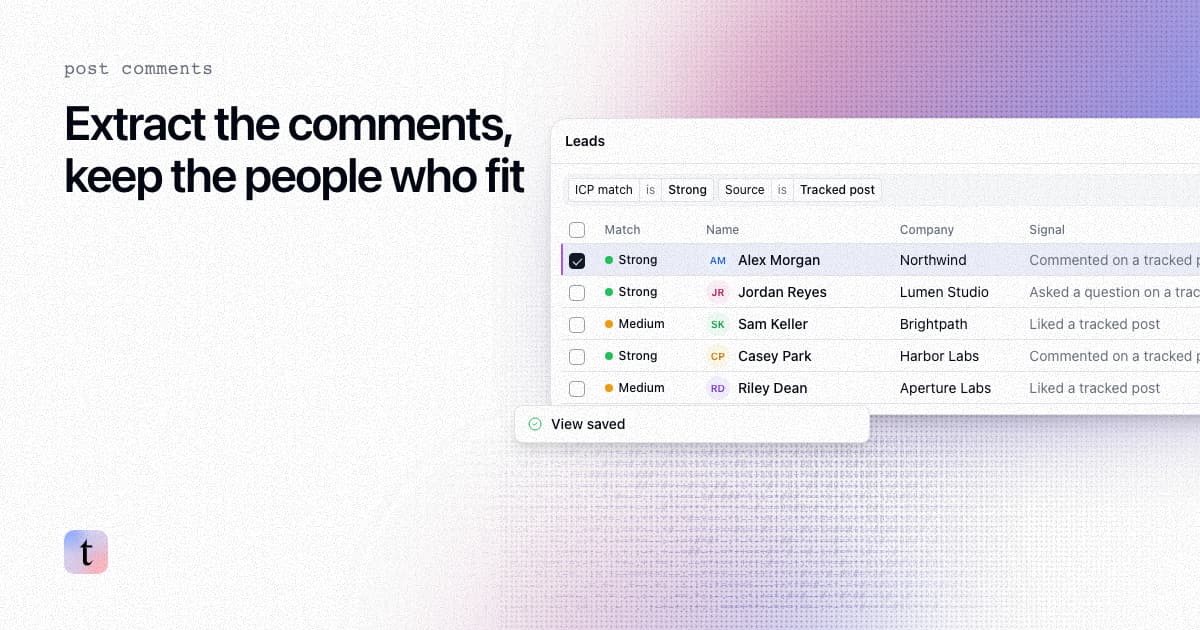
How to extract comments from a LinkedIn post, and keep only the commenters who fit your ICP
Four ways to extract comments from a LinkedIn post, what each returns and risks, and how to keep only the commenters who fit your ICP.
How to find leads from the people who engage with a LinkedIn company page
Most company page engagers are employees, job seekers and peers. How to find the ones who fit your ICP, with the post that brought each one in.