
LinkedIn says founders are up 70%. How to find the ones who fit your offer
LinkedIn reports founders on the platform are up 70%. How to find the founders who fit your offer with company traits, recent activity and three checks.
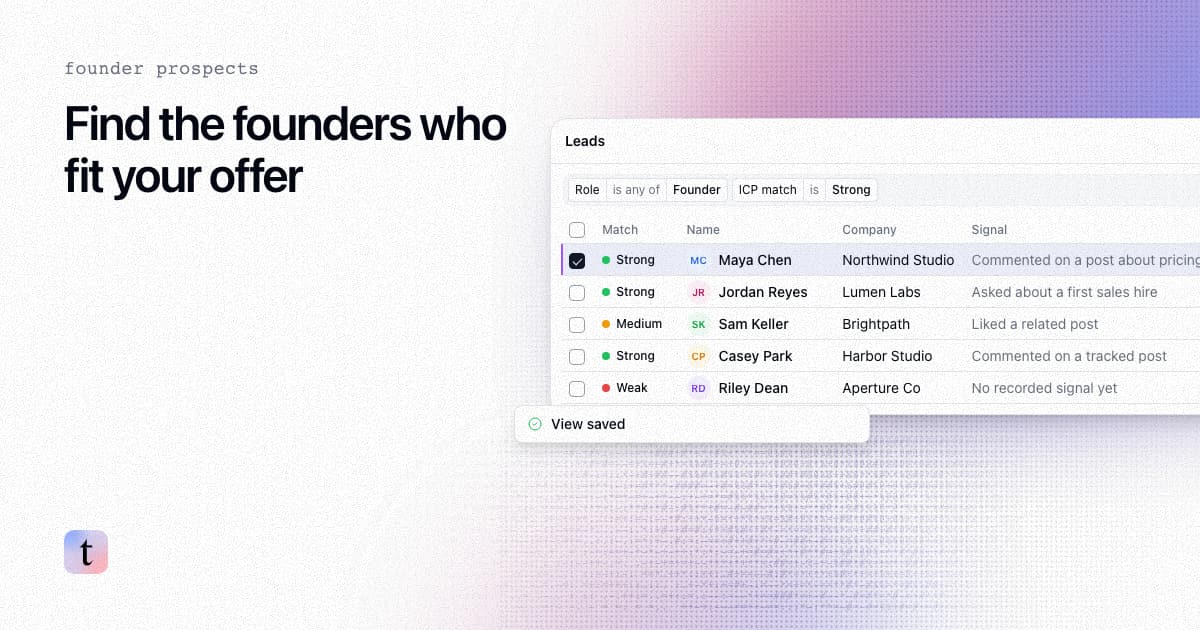
TL;DR: To find founders on LinkedIn who fit your offer, rely less on the title. LinkedIn reports that the number of founders on the platform is up 70 percent and that more members hold more than one position at once, which suggests a "Founder" title search now returns a wider mix of people. Add the company traits of your best clients, then look for recent activity on topics tied to your offer. In traxy, that is your lead criteria plus your signals, and each qualified founder comes with the activity behind them.
Last checked: November 9, 2026.
What did LinkedIn report about founders?
Two LinkedIn announcements in October point the same way.
On October 15, LinkedIn said more people are "pursuing something of their own alongside their careers," with the number of founders up 70 percent and the share of members reporting more than one ongoing position up 26 percent since 2019 (LinkedIn News).
On October 27, LinkedIn relaunched its economic research site as LinkedIn Pulse. Its launch announcement says that from July through September 2026, founder ranked among the 10 fastest-growing roles in the United States, the United Kingdom, Germany, France and India (LinkedIn News).
If you sell to founders, as agencies, consultants and B2B software companies do, that likely changes what a founder title search returns.
Why does a "Founder" title search work less well now?
This next part is our reading of the numbers, not a conclusion LinkedIn drew. When more people list a founder role and more people hold two positions at once, a search for "Founder" brings back more people for whom that role is a side project, a solo consultancy or an early idea. Some of them are good prospects. Many are not buying what you sell.
A title match also leaves out two things you need to know:
Fit. Whether the company is the size, industry and stage your offer serves.
Activity. Whether the person is active on LinkedIn and paying attention to the problem you solve.
Sending to everyone with "Founder" in their headline spends connection requests on many people who will not care about your message. LinkedIn limits the number of invitations you can send (LinkedIn Help), so each wasted request is one you could have sent to someone who fits.
What makes a founder a good prospect?
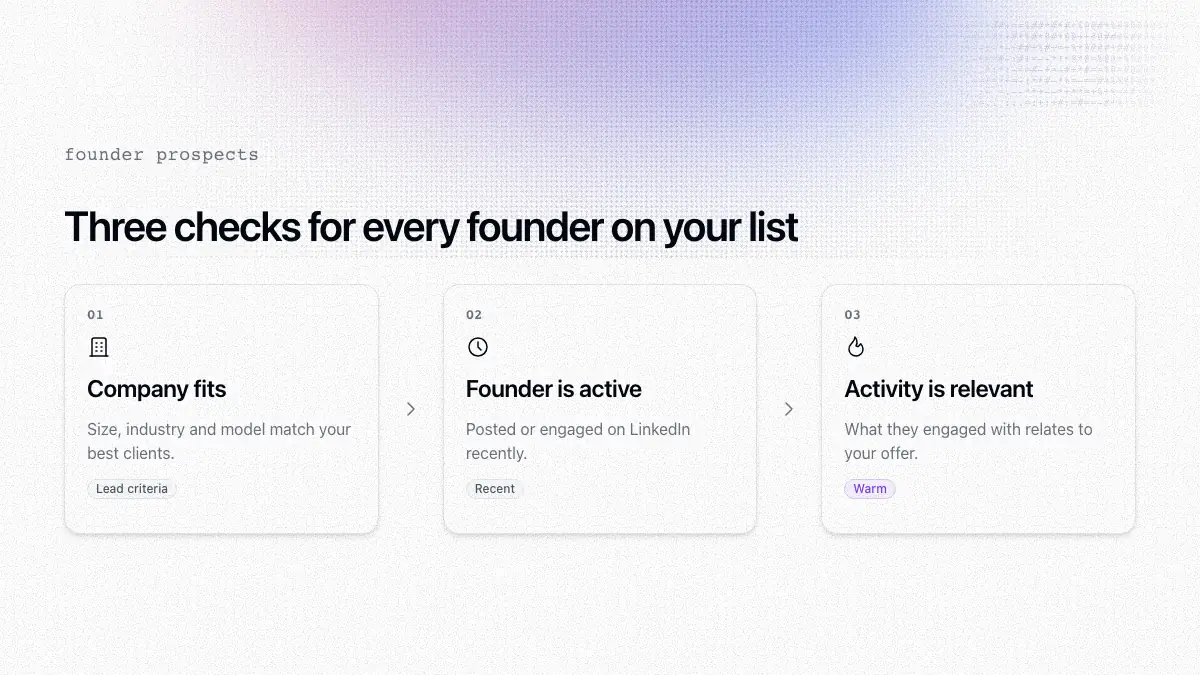
Use the same three checks for every founder on your list:
The company fits. Size, industry and business model match the clients you serve best.
The founder is active. They have posted or engaged with something on LinkedIn recently.
The activity is relevant. What they engaged with relates to your offer. A like on a post about hiring a first salesperson matters to a sales consultancy. A like on a holiday photo does not.
When all three line up, you have a reason to reach out and something true to say in the first line. The same idea, applied to any buyer, is in what makes a lead warm.
How do you find founders who fit in traxy?
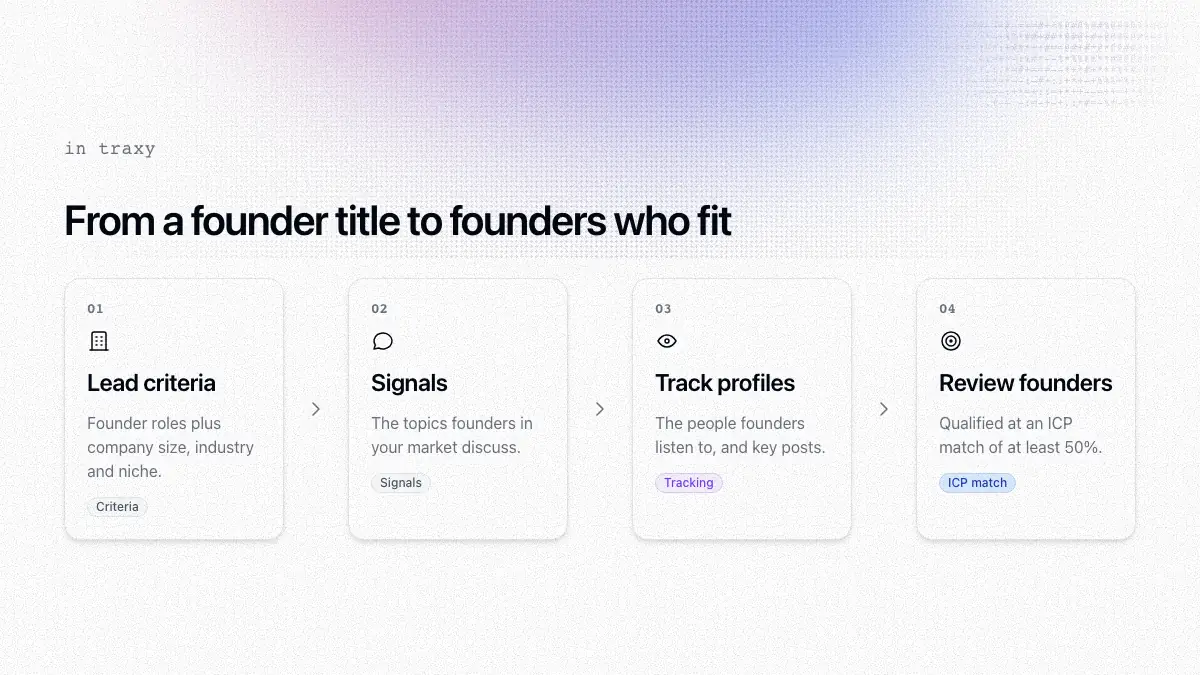
1. Write lead criteria that describe the company, not only the title
Open Lead criteria. Add the founder roles you sell to, such as Founder, Co-Founder, Owner or CEO, and then the company traits that separate your buyers from everyone else: company size, industry and relevant keywords or niches (lead criteria). "Founders of 11-to-50-person marketing agencies in the US and UK" finds a different list than "Founders."
A fictional example prompt for trax, the traxy assistant:
"Review our lead criteria. We sell bookkeeping services to founders of design studios with 11 to 50 employees. Suggest changes that would exclude solo side projects."
2. Describe the topics that matter in Signals
Open Signals and describe the problems and buying situations connected to your offer, specific enough to recognize in public activity (signals). For a founder audience, these are often operating topics: their first sales hire, finding clients, outbound, pricing their service or switching tools.
3. Follow the people founders listen to
Founders engage with other founders, operators and creators in their market. Choose Track profile to add those people, and track specific posts that drew the right crowd. People who engage are checked against your criteria. For an active profile, ongoing monitoring follows the five most recent posts published after you added it (Tracking). For ideas, see who to track on LinkedIn for leads.
4. Review the founders traxy qualifies
Open Leads. A lead qualifies when it meets your criteria with an ICP match of at least 50% (qualification). Filter to a higher ICP match for a shorter list; filtering narrows what you see without changing who qualifies. Open a lead to check its signals and the source and date of the evidence before you write (leads).
5. Mark side projects you do not serve
When a founder fits on paper but runs a side project or a one-person shop you do not serve, give feedback such as Bad fit and explain why. Feedback records your judgment and does not directly rewrite the person's score, so review any criteria changes separately (qualification).
How do you message a founder you found this way?
Start from what they did. Use the post or topic behind their signal as your observation, say why it matters to someone in their position, offer something useful, and ask for a one-word yes. The personalized LinkedIn outbound guide breaks this into four parts: observation, implication, value offer and a low-friction ask.
Two fictional examples:
"Hi Maya, saw you in the thread on hiring a first salesperson. We have helped a few design studio founders with that step. Want me to send over what worked?"
"Maya, quick one. If pricing retainers is on your plate at Fernhill Studio, I put together a one-page checklist for founders at your stage. Want a copy?"
Keep the wording in proportion to the evidence. A reaction to a post shows interest in the topic. It does not mean the founder is looking for a vendor. More first lines by signal type are in from a LinkedIn signal to a message.
What are the limits?
LinkedIn's numbers describe the whole platform. They say nothing about your market in particular. Look at your own list to see how many side projects it contains.
Fit depends on public data. Company size and industry come from what is available, so check the lead before you contact them.
Quiet founders have no signal. traxy works from visible activity, so founders who read without engaging can still match on fit but will carry no recorded signal.
A missing signal is not a no. It means no signal was recorded.
FAQ
How do I find startup founders on LinkedIn?
Combine a founder role with company traits such as size, industry and niche, plus recent activity on topics related to your offer. A title search alone returns a mixed list.
Why are there so many founders on LinkedIn now?
LinkedIn reports that the number of founders on the platform is up 70 percent and that more members hold more than one position. LinkedIn describes many of them as people pursuing something of their own alongside their careers.
Is Sales Navigator enough to find founders?
It can filter by title and company. It does not tell you whether a founder engaged with a relevant topic recently, so a common split is filters for fit and engagement for timing. See traxy vs Sales Navigator and LinkedIn Boolean search vs social intent search.
What should I say in the first message to a founder?
Refer to the topic they engaged with, offer something useful, and ask a question they can answer in one word.
How many founders should I contact per week?
There is no fixed number. Stay within LinkedIn's invitation limits and spend them on founders who pass all three checks.
Next step
Write the company traits of your three best founder clients, then compare a plain "Founder" search with a list built from those traits plus recent activity. Start with traxy and see which founders in your market are already active.
Keep reading
All LinkedIn Lead Generation guides
LinkedIn Lead Generation (2026): What It Is, Strategy, Tips and Tools for B2B
What LinkedIn lead generation is, a 7-step B2B strategy, the 5 main tactics, tips, tools and metrics, plus every LinkedIn lead generation guide we publish.
How to extract comments from a LinkedIn post, and keep only the commenters who fit your ICP
Four ways to extract comments from a LinkedIn post, what each returns and risks, and how to keep only the commenters who fit your ICP.
Can ChatGPT find leads? What it can and can't do on its own, and what changes with a connected lead source
What ChatGPT can and cannot do for B2B lead generation on its own, and what changes when a connected lead source supplies real engagement data.