
What makes a lead warm? Four checks before you contact anyone
What a warm lead is, and four checks to run before you contact anyone: fit, recent activity, relevance to your offer, and enough context to write.
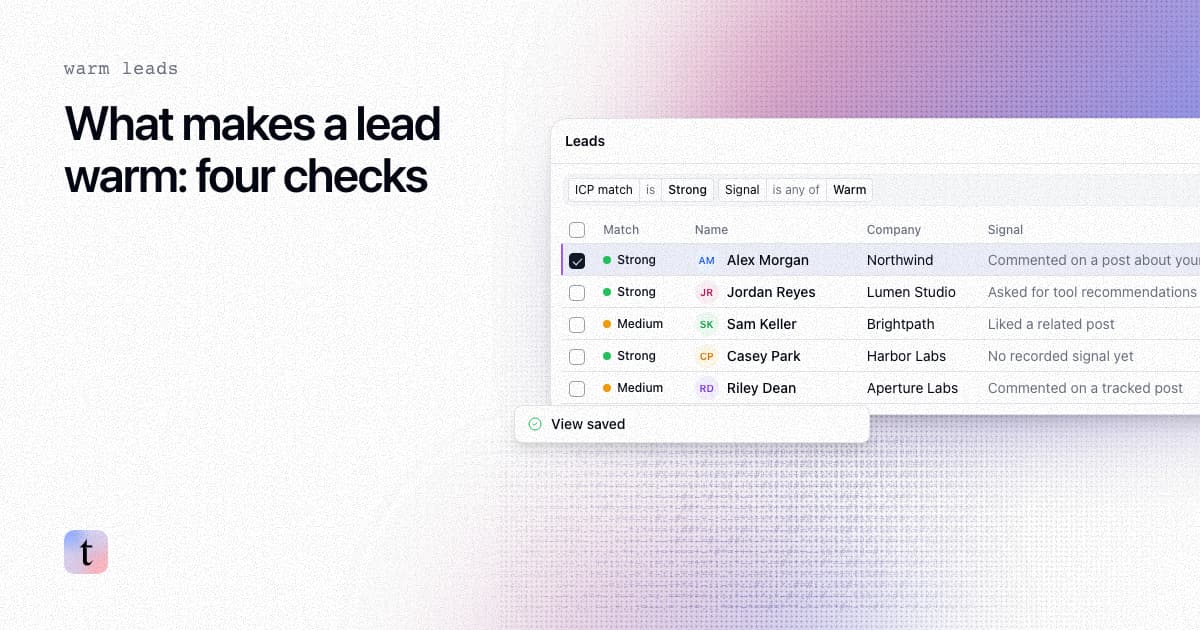
TL;DR: A warm lead is a person who matches your ideal customer profile and has done something recent and relevant to what you sell. Before you contact anyone, run four checks in order: does the person fit, did they do something recently, is that activity relevant to your offer, and can you see enough to write a first message that makes sense. Warm gives you a better reason to start a conversation. It does not mean the person is ready to buy.
What is a warm lead?
A warm lead is a person you have a specific reason to contact now. The reason comes from something they did, not from a guess about their job title.
A cold lead is a name on a list. The person matches a filter such as job title, company size and industry, and nothing else is known. A warm lead matches the same filter and has also done something that points at your offer.
Warm does not mean ready to buy. A warm lead may have no budget, may be months from a decision, or may have posted a comment out of curiosity. It does not tell you the person will say yes.
What are the four checks for a warm lead?
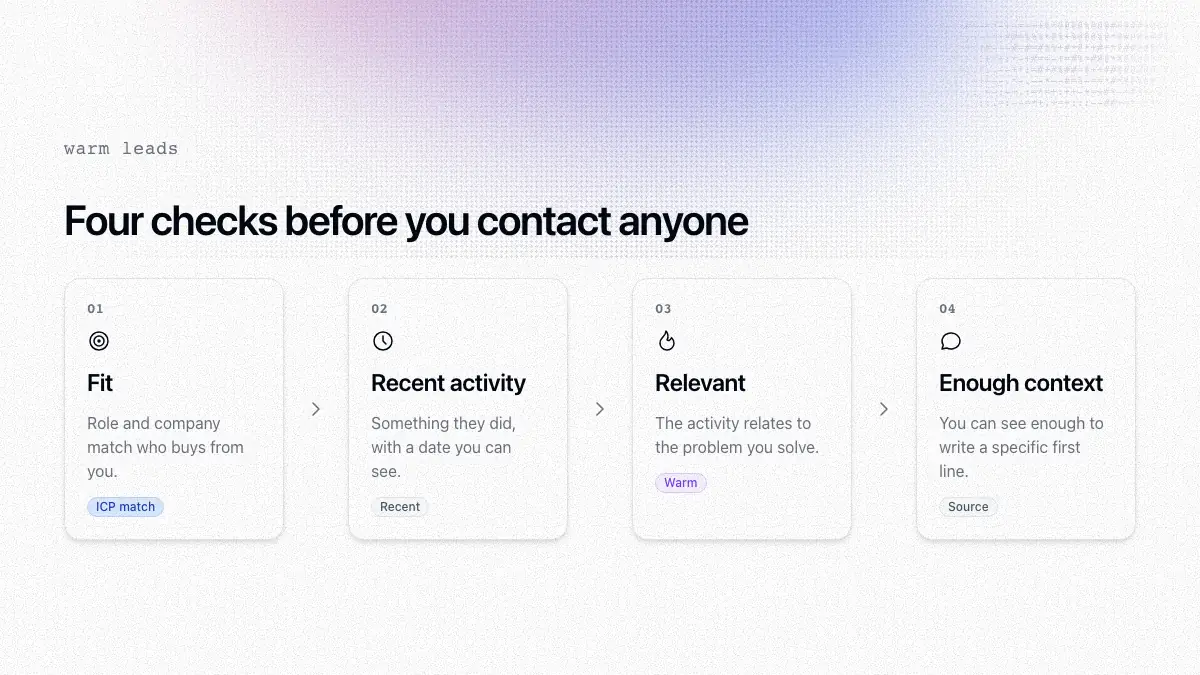
Run these in order. A lead that fails the first one does not need the other three.
Does the person fit?
Fit comes first. A strong signal from the wrong person is noise. Check the role, the company and whether the person plausibly buys what you sell.
In traxy, fit appears as an ICP match, and qualification requires your lead criteria and an ICP match of at least 50% (qualification). That threshold is a minimum, not a verdict. Read the role and company yourself on anyone you plan to contact.
Did they do something recently?
Activity should be observable and recent. A contact record that says "marketing director" is not activity. A comment on a post last week is.
Recency matters because attention moves. A person who engaged with a topic this week is more likely to still be thinking about it. Someone who liked something eight months ago may have moved on. Check the date of the evidence before you write.
Is the activity relevant to your offer?
This is the check that is easiest to skip. A reaction only counts if it relates to the problem you solve.
If you sell outbound services to B2B agencies, an agency owner commenting on a post about getting clients from LinkedIn is relevant. The same owner liking a vacation photo is not. Both are activity. Only one is a reason to write.
traxy labels this directly. The signal labels (signals):
Label | How to interpret it |
|---|---|
Warm | A direct signal relevant to your offer |
Related | Contextual evidence related to your offer |
Activity | Observed activity with a weaker connection to your offer |
ICP match | Fit information without a recorded signal of the other types |
The labels describe signal strength, and they are separate from the ICP match score. A person can have a strong signal and a poor fit, or a strong fit and a weak signal. You want both for your best first messages. For more on the difference, see ICP match score vs signal strength.
Can you see enough to act?
The last check is practical. Can you tell what happened, and do you have enough context to write a message that refers to it?
A lead you cannot explain should not be contacted. If you can see the person's role, their company, what they engaged with and the source, you can write a specific first line. If all you have is a name and an email address, you are back to a cold message.
In traxy, open the lead to review its signals and check the source and date of the recorded evidence before you reference it in outreach (leads). Where a source link is available, open it and confirm it supports the signal.
What does a warm lead look like in practice?
Suppose you sell outbound services to B2B agencies. You find three people. They are fictional.
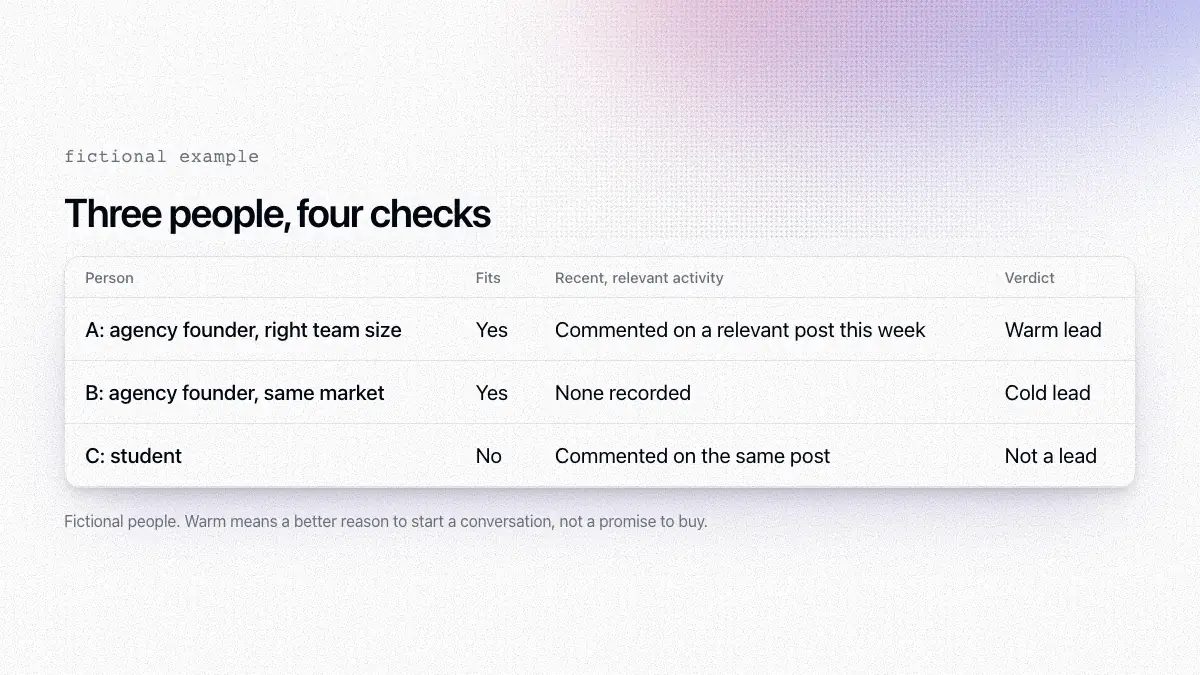
Person A is an agency founder with a team of the right size. She commented on a post about booking calls from LinkedIn three days ago. She passes all four checks.
Person B is an agency founder in the same market with no recorded activity. He passes fit and fails the next three checks. He is a cold lead.
Person C is a student who commented on the same post. He fails fit, so the signal does not matter.
Only Person A should get your best first message. You can still contact Person B, but expect a colder reply and say less about what you know. Person C should not get a message.
For how comments, reactions and reposts differ in strength, see LinkedIn engagement signals explained.
Why start with warm leads instead of a bigger list?
Fit alone gives you a large pool and no way to rank it. If you contact everyone who matches the filter, you send the same message to people at different moments.
Relevant activity gives you an order. You contact the people with a reason first, and you can say something specific to them. A specific message is more likely to read as a message for them, which gives them a reason to reply.
Results depend on your offer. To find out, run a test: keep the same offer, message and sender, and change only the list.
What mistakes should you avoid?
Treating every like as a signal. An unrelated like is not enough. Look for activity connected to your offer.
Ignoring fit. A relevant comment from the wrong person is a distraction.
Contacting too late. Signals cool. Work the newest ones first.
Overclaiming in the message. Refer to what the person did, plainly. Do not suggest you know their budget or their plans.
Confusing engagement with consent. Engagement is not a request for outreach. Keep the first message short and easy to ignore.
Counting engagement pods as interest. Pods produce engagement that is arranged, not earned. See LinkedIn engagement pods.
How do you find warm leads on LinkedIn?
You can do it by hand. Read the comments on posts in your market, open the profiles, check fit and write down what you find. It works at a small scale and takes time. Our guide to extracting comments from a LinkedIn post covers the manual route.
In traxy, you describe your ideal customer, track the people, posts and companies whose audiences matter to you, and review the leads it qualifies, each with its ICP match and signal label. When you are ready to write, LinkedIn follow-up messages after post engagement covers timing and wording.
FAQ
What is the difference between a warm lead and a hot lead?
There is no single standard. In this article, warm means fit plus recent, relevant activity. Hot is usually used for someone who has asked to talk. A warm lead has not asked yet.
Is a LinkedIn like enough to make a lead warm?
Only if the person fits and the post relates to your offer. A like is weak evidence. A comment that shows an opinion about your topic is stronger.
How recent should the activity be?
Recent enough that the topic is still current for the person. Start with the newest signals and work backwards.
Does a warm lead mean they will buy?
No. It means you have a better reason to start the conversation.
How is a warm lead different from a qualified lead in traxy?
In traxy, a qualified lead meets your criteria with an ICP match of at least 50%. The signal label then tells you how strong the evidence is, so a qualified lead can still have a weak signal. The Warm label is narrower than this article's definition: a lead labeled Related can still pass the four checks.
Try it on your market
Book a demo and bring a description of your ideal customer, or start with traxy and review who it finds in your market.
Keep reading
All Buyer Intent & Signals guides
Buyer Intent Signals (2026): What Buying Signals Are, Examples by Type and How Sales Teams Act on Them
Buyer intent signals explained: what buying signals are, examples by type, how reps act on each one and a simple scoring framework to prioritize accounts.
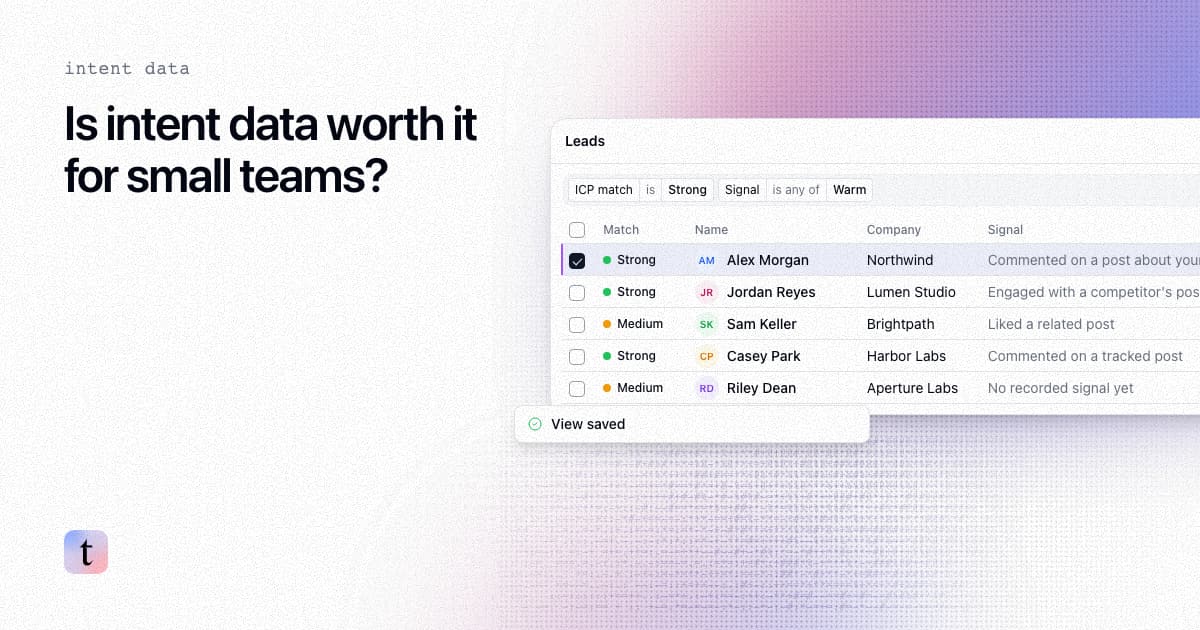
Is B2B intent data worth it for small teams? When enterprise platforms do not fit, and a lighter LinkedIn path
When B2B intent data is worth it for solo and small teams, what enterprise platforms assume, and a lighter contact-level LinkedIn path you can keep up.

Firmographic, technographic and engagement data: what each tells you about a B2B lead, and what it misses
Firmographic data describes a company, technographic data its tools, engagement data what a named person did. How to use all three to pick who to contact.