
Signal-based outbound for consulting firms: from LinkedIn situations to one clear offer
How consulting firms can turn public LinkedIn situations into outreach for one clear offer: ICP and signals, discovery, campaign tests and first lines.
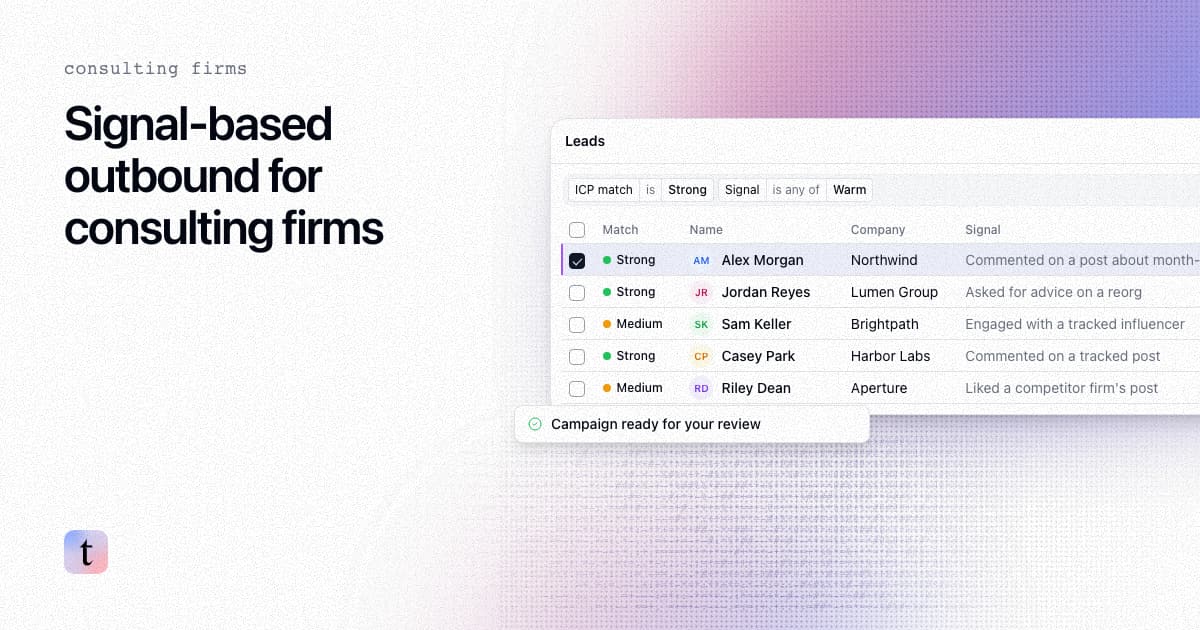
TL;DR: Signal-based outbound for consulting firms starts from something a buyer did in public on LinkedIn. That could be a comment about a pain you solve, a hiring post that matches your offer, or a post about a change in their business. You connect it to one specific consulting offer. Fit comes first, and the signal tells you what to say and when. In traxy, that loop is signal-based outbound on autopilot: discovery finds people who match your ICP and records the signal evidence available for each, you review a campaign test, and you confirm Launch before any outreach starts.
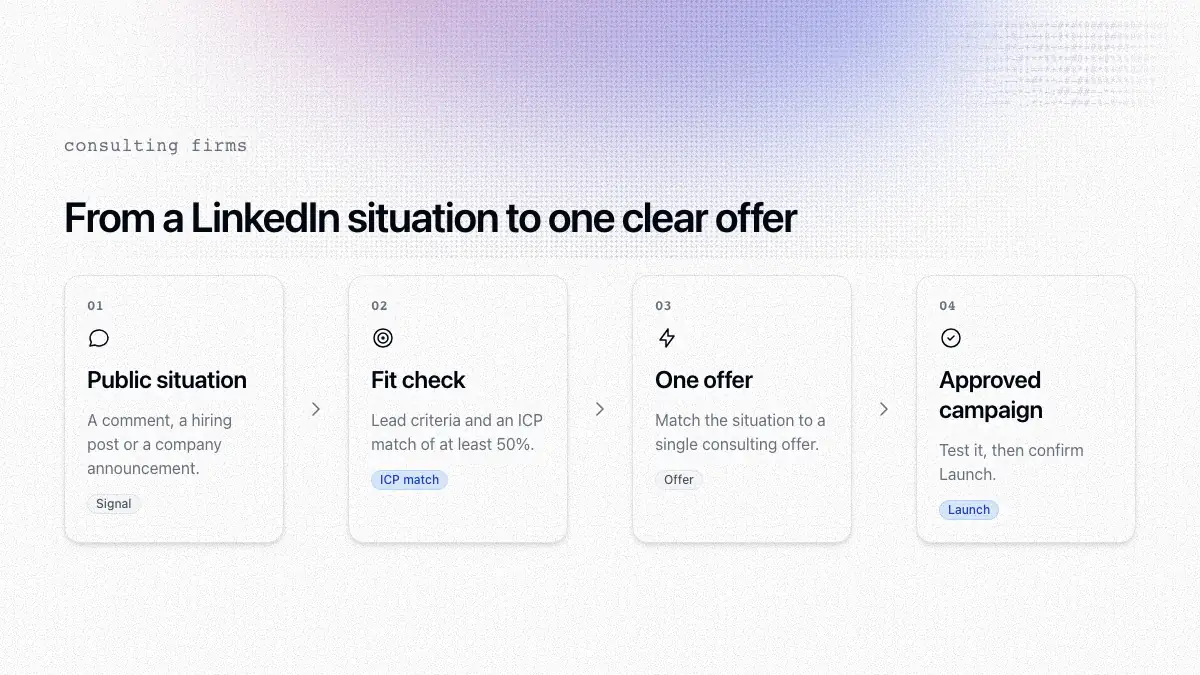
Last checked: November 9, 2026.
Why do consulting firms need a different outbound approach?
Consulting sells judgment. Deals are often large, buying groups can be small, and trust carries more weight than a feature grid. A partner or practice lead who opens with "I help companies with transformation" sounds like every other firm in the inbox.
A better first line names something the buyer already put in public: the problem they commented on, the team they are hiring, or the change they announced. On LinkedIn, filter for fit and evidence before list size.
Which LinkedIn situations map to consulting offers?
Build a short map from situation to offer, and keep only pairs you can defend in a first message.
LinkedIn situation | What you can say | Offer it can support |
|---|---|---|
A comment or post about a specific operating pain | Respond to the problem they named | A diagnostic, an advisory sprint, or retained support for that pain |
Hiring for a role your work would unblock | Reference the open role and the gap it leaves | Interim help, a process build, or enablement while the seat is open |
A new role as a likely buyer or sponsor | Congratulate them after checking the new title and company | A conversation tied to their new scope |
Engagement on a competitor's or influencer's post about your category | Use the topic as context, not as proof they want to buy | A second opinion framed around that topic |
A company post about a reorganization or a new market | Stay with what the post said | Strategy or implementation work that matches the stated change |
Do not infer budget, dissatisfaction or an open tender from a like. traxy's signal cheat sheet says to read the lead's source first and to avoid claiming a plan to purchase or inventing a project or budget.
How should a consulting firm set its ICP and signals?
Treat them as two separate inputs.
Lead criteria define who you sell to: roles, departments, seniority and locations, plus company size, industry and relevant niches (lead criteria). "Anyone who engages with consulting content" is not an ICP.
Signals describe the problems, topics and buying situations connected to your offer, specific enough to recognize in public activity (signals). A strategy firm might describe comments about stalled transformations. An operations consultancy might describe hiring for a first RevOps or COO seat. A niche expert might describe posts about a regulation or system they specialize in.
Qualification is based on fit: a person becomes a qualified lead only when they meet your criteria with an ICP match of at least 50% (qualification). Each lead also carries a signal label (Warm, Related, Activity or ICP match) that describes the strength of the evidence; ICP match means fit without another recorded signal. Start your outreach with high fit and a Warm signal.
How do you find those leads without posting every day?
Discovery runs look for people from your targeting and signals (discovery runs).
Tracking people and posts. Track the profiles of people at competing firms and category influencers, with a relationship such as competitor, influencer or custom, and track specific posts that attract your buyers. For an active profile, ongoing monitoring follows the five most recent posts published after you added it (Tracking).
Topic search. Use Social intent search, or ask trax to find posts about a problem your buyers raise and then work with a post's audience (work with trax).
Your own posting helps, but discovery does not depend on it. See do you need LinkedIn content for traxy and who to track on LinkedIn for leads.
How do you turn a consulting signal into a campaign?
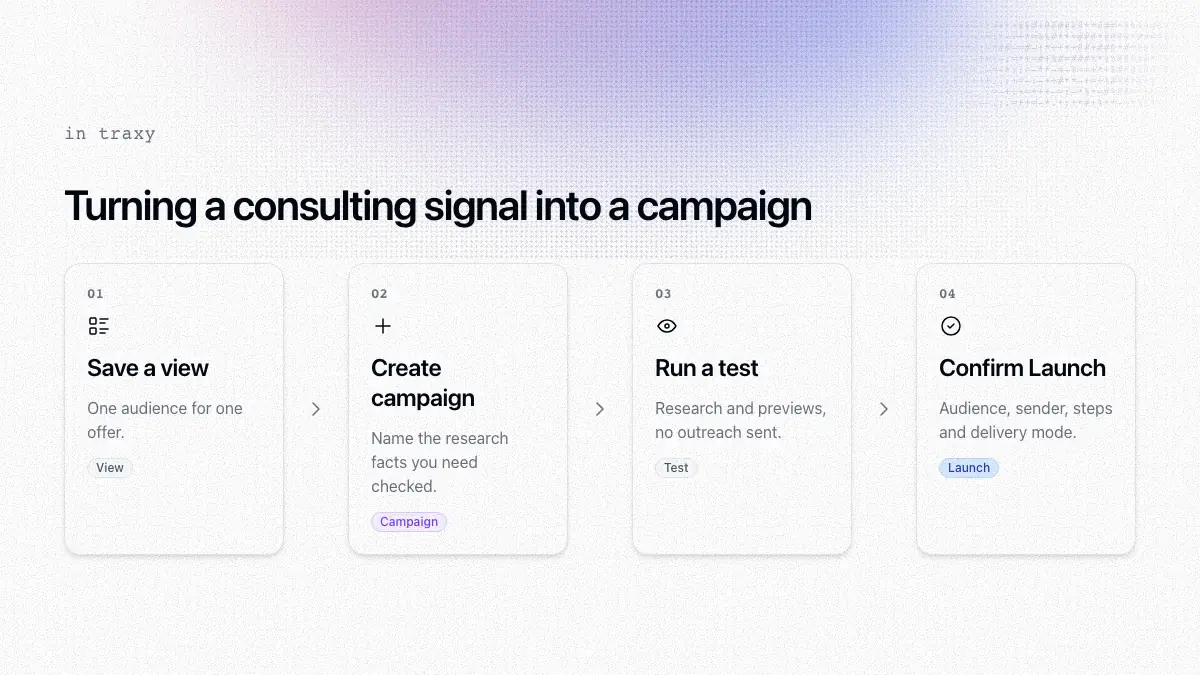
Filter leads by fit and signal, then save a shared view for one offer, for example "operations diagnostic for mid-market manufacturers."
Create a campaign for that view and that offer, and explain the research facts you need checked (create a campaign).
Run a test. A test prepares research and previews without sending outreach. Check whether the research supports each claim.
Open Launch and confirm it only when the audience, the sender or destination, the message steps and the delivery mode are right. If the delivery mode requires approval, review each message in the campaign's review queue (review and launch).
That is what signal-based outbound on autopilot means for a firm: discovery is automated, a test prepares research and previews, and a person confirms Launch. The signal-based outbound playbook covers the steps in more detail, and the agency playbook in the docs also recommends keeping each audience and campaign focused on one clear offer (agency playbook).
What should the first message sound like?
Short, specific and limited to what the source supports (outbound to signal-based leads). The examples below are fictional.
After a comment about a pain:
"Your note on Priya's post about month-end close taking two weeks matched what we see at other mid-size manufacturers. We run a short diagnostic on that gap. Open to a 20-minute walkthrough of how we scope it?"
After a hiring post:
"Saw you're hiring a head of RevOps. While that seat is open, we help teams keep forecasting and handoffs moving so the new hire inherits something usable. Worth a quick look?"
After a move into a buyer role:
"Congrats on the move to Northwind. In a new operations role, leaders often want a clear picture of where handoffs break in the first 90 days. Happy to share how we usually map that."
Avoid telling people they are "in market," "ready to buy" or "unhappy with their current advisor." A public post almost never supports those claims. For more first lines by signal type, see from a LinkedIn signal to a message.
What mistakes break consulting outbound?
One campaign for five offers. Partners sell different work. Split views and campaigns by offer.
Treating every engager as a buyer. Peers, vendors and job seekers comment too. Check fit first.
Borrowing software sales language. Consulting buyers hear "transform" constantly. Name the situation and the deliverable.
Skipping the test. Research that misreads a comment should be caught in review, not in a client's inbox.
Treating launch as sending. After you confirm Launch, delivery can still wait on sender limits and schedule.
If you are still deciding what kind of tooling fits a small firm, see what AI outbound is and whether intent data is worth it for small teams.
FAQ
Is signal-based outbound the same as LinkedIn automation?
No. Automation often means messaging a list on a schedule. Signal-based outbound starts from fit plus dated evidence and runs through a campaign a person approves.
Can a small consulting firm do this without a content team?
Yes. Track competitor and influencer profiles and posts that attract your buyers, and ask trax to find posts about the problems your buyers raise. Your own posts add reach but are not required for discovery.
How is this different from buying a list of consulting decision makers?
A list gives you titles. A signal gives you a reason to write this week, which matters more for high-ticket work than the number of rows.
Where should I start this week?
Write one offer, one ICP and three signal situations. Track five profiles or posts that attract those buyers. Save a shared lead view, run a campaign test on a small sample, and confirm Launch only when the previews match the evidence.
Next step
Pick the one offer your firm closes most often and write the three situations that make a buyer worth contacting now. Then start with traxy and see which of those situations show up in your market.
Keep reading
All Prospecting & Outreach guides
LinkedIn Prospecting (2026): How to Prospect on LinkedIn Step by Step, With Message Examples & Signals That Tell You Who to Contact First
How to prospect on LinkedIn step by step: profile, ICP, list building, message examples, signals, prospecting tools and every outreach guide we publish.
What is AI outbound? Research, campaign prep and orchestration with human approval
What AI outbound means: software finds leads, researches and prepares campaigns, and a person approves the launch. How it differs from AI SDR tools.
LinkedIn follow-up messages after post engagement: when to wait, what to say, and when to switch to email
How to follow up on LinkedIn after someone engaged with a post: what to say for comments and likes, when to wait, and when to switch to email.