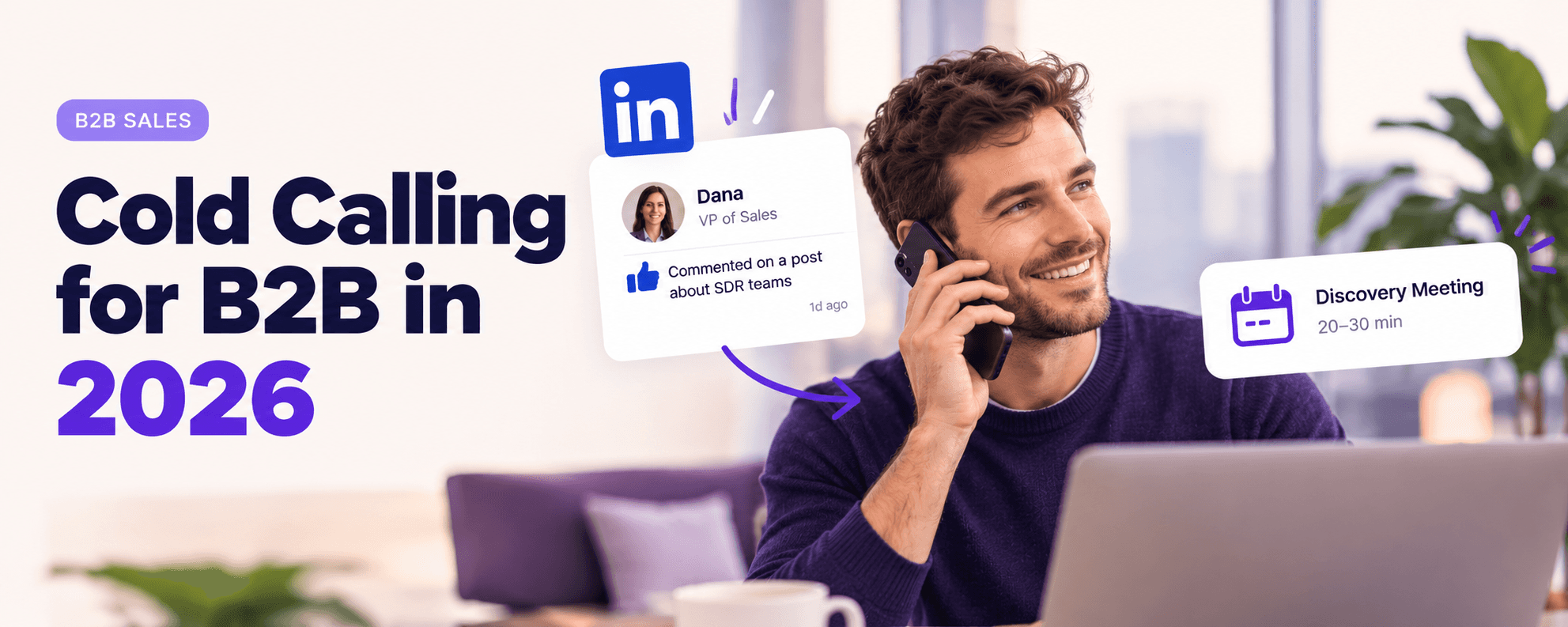
TL;DR: Cold calling is phoning a prospect who has had no prior contact with you, with the goal of starting a sales conversation and booking a meeting. B2B cold calling still works in 2026 when three things line up: the person fits your ideal customer profile, you have a specific reason to call them, and you reach them while that reason is fresh. The most reliable way to get all three is warm calling: call the people who are already engaging with your market on LinkedIn, enrich their direct number, and open by referencing what they engaged with.
What Is Cold Calling?
Cold calling is unsolicited outbound phone prospecting: a sales rep calls someone who has not asked to be contacted and has no existing relationship with the company. In B2B cold calling, the person on the other end is a professional being called about a work problem, usually a decision-maker or influencer at a company that matches your target market.
A cold call has one job. It is not there to close a deal or deliver a full demo. It is there to earn the next step, usually a 20 to 30 minute discovery meeting. Everything in a good cold call (the opener, the reason for calling, the questions) is designed to get a busy person to agree that a second conversation is worth their time.
Cold calling sits next to two related motions:
Warm calling: calling someone who has already interacted with you or your market, for example by engaging with your LinkedIn posts, attending your webinar or being referred by a customer.
Cold emailing and LinkedIn outreach: the written versions of the same first touch. For how those two compare, see LinkedIn vs cold email for B2B lead gen.
Why Cold Calling Feels Harder in 2026
The phone has not stopped working; the way most teams use it has. Three problems show up again and again.
Reps avoid the phone. In a 2026 survey of 153 sales leaders and reps by ValueSelling Associates and Selling Power, 38.9% of leaders named fear of the phone as the real obstacle to prospecting, and 46% said reps abandon cold calling too early. The same research found that cold calls were rated effective by 47% of respondents, up from 46% in 2018, so the channel itself held steady. (Summary on traxy News)
Lists have no timing. A purchased list tells you who fits your ICP on paper. It says nothing about who is thinking about your problem this week, so most dials land on people with no current reason to talk.
Generic openers get rejected. When a prospect cannot tell within a few seconds why you are calling them specifically, the call ends. Buyers now screen unknown numbers and filter anything that sounds scripted.
The fix for all three is the same: call fewer people, with a better reason, sooner. That is what the rest of this guide is built around.
How to Cold Call: A 5-Step Process
Build the call list from your ICP, not from a database export. Start with the company and role criteria that actually predict a deal: industry, headcount, seniority and the trigger that makes your product relevant. If you don't have that written down, use this ideal customer profile template first. A tight list of 40 well-matched prospects beats 400 loosely matched ones.
Find a specific reason to call each person. The strongest reasons are things the prospect did recently: commented on a post about the problem you solve, engaged with a competitor's content, changed roles, or their company announced hiring in the team you sell to. Write the reason in one sentence before you dial. This is what turns a cold call into a warm one, and it is the core of how to qualify B2B leads from buying signals.
Get a direct number. Switchboards and gatekeepers burn most of a calling block. Enrich the prospect with a direct dial or mobile number before the session so every dial has a chance of reaching the right person.
Open with who you are and why you're calling. Lead with your name, then the reason in plain language, then a question. Gong's analysis of cold calls found reps who state their reason for calling have a 2.1x higher success rate. Keep the pitch for later; the first 30 seconds are about relevance.
Earn the meeting, then follow up on another channel. Ask one or two questions about the problem, listen, and propose a specific next step with a date. If you reach voicemail or get a "not now", follow up the same day with a short LinkedIn message or email that repeats the reason for your call.
A B2B Cold Call Script You Can Adapt
The script below uses a fictional rep (Alex) calling a fictional VP of Sales (Dana). Swap in your own product and reason for calling; keep the structure.
1. Opener (name and permission to continue)
"Hi Dana, this is Alex from a sales-intelligence company. I'll be brief, and I'll tell you exactly why I'm calling."
2. Reason for the call (specific to her)
"You commented last week on a post about SDR teams missing in-market buyers. That's the exact problem we work on, so I wanted to ask you about it directly."
3. Problem question
"When a prospect engages with your team's content or a competitor's, how does that get to a rep today, if it does at all?"
4. Value in one sentence (only after she answers)
"We help teams like yours see which ICP-fit people are engaging on LinkedIn each day, so reps call the ones already paying attention instead of working a cold list."
5. The ask
"Would it be worth 20 minutes on Thursday to see what that looks like for your accounts?"
Common objections and short responses
Objection | Response that keeps the conversation open |
|---|---|
"Send me an email." | "Happy to. So it's useful and not generic, what's the one thing you'd want it to cover?" |
"We already have a tool for that." | "Makes sense. What does it catch well, and where do leads still slip through?" |
"Not a priority right now." | "Understood. What would need to change for it to become one? I can check back then." |
"How did you get my number?" | "From a B2B contact data provider. If you'd prefer I don't call again, I'll note that now." |
Cold Calling Tips Backed by Call Data
These cold calling techniques come from Gong's analysis of cold calls recorded on its platform:
State your reason for calling early. Reps who do it see a 2.1x higher success rate.
Skip "Did I catch you at a bad time?" Gong found that opener makes you 40% less likely to book a meeting, because it invites an easy no.
Try a familiar pattern-interrupt. Calls that opened with "How've you been?" had a success rate 6.6x higher than calls without it. Use it honestly and follow straight away with your reason for calling.
Plan for a real conversation. Successful cold calls averaged 5 minutes 50 seconds, nearly twice as long as unsuccessful ones.
Carry the conversation, but in longer turns. Reps talked about 55% of the time on successful calls, and their average monologue was 53 seconds versus 25 seconds on unsuccessful calls. Prospects respond to a clear, confident explanation, not rapid-fire questions.
Talk about "we", not just "I". Successful calls included 65% more use of "we", which frames the call around a shared problem.
Two process tips matter as much as any line in the script: block calling time on the calendar so it actually happens, and log the reason for each call so you can see which signals produce meetings.
Best Time to Cold Call
Gong's data points to Wednesday and Thursday as the best days to cold call. For time of day, there is no universal answer that holds across industries and regions, so treat it as something to test: run the same list across a few time windows for two to three weeks and compare connect and meeting rates in your own data.
The bigger lever is recency. A prospect who engaged with a relevant post this morning is easier to reach and more willing to talk than the same prospect a month from now. Calling within a day of a signal usually matters more than the exact hour you pick.
Warm Calling vs Cold Calling
Warm calling is calling a prospect who has already interacted with you or your market, so the call starts with context instead of an interruption. Cold calling starts from zero.
Cold calling | Warm calling | |
|---|---|---|
Who you call | ICP-fit contacts from a list, no prior interaction | ICP-fit contacts who engaged with you, a competitor or a relevant topic |
Reason for calling | General value proposition | A specific action the prospect took |
Timing | Whenever the list is worked | Shortly after the signal, while it is relevant |
Opener | Introduces you and your company | References what they engaged with |
List size | Large, to make up for low relevance | Smaller, filtered by fit and signal |
Best for | New markets with no engagement data yet | Teams with LinkedIn activity in their market |
Most teams don't have to choose. Warm calls go to the top of every calling block; cold calls fill the rest.
How Warm Calling With LinkedIn Signals Works
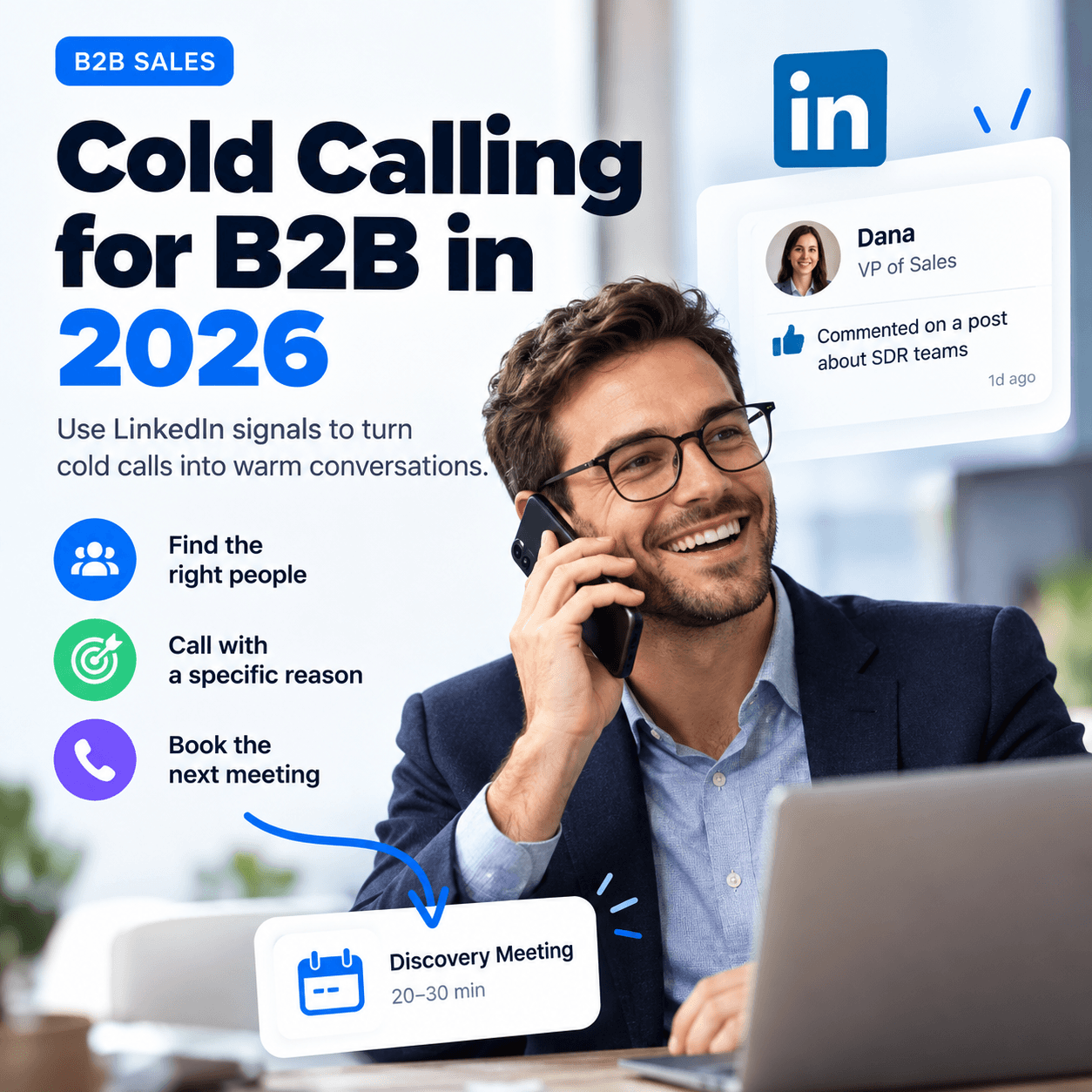
LinkedIn is where many B2B buyers show interest before they ever fill out a form: they comment on posts about a problem, react to a competitor's launch or follow industry voices. Those are public, timestamped LinkedIn engagement signals, and they make the best reason to call.
A warm calling workflow built on those signals has four steps:
Monitor the right profiles. Track your own team's posts plus competitors, industry creators and leaders at target accounts.
Filter engagers by ICP fit. Drop students, vendors and job seekers so only people who match your target accounts and roles reach a rep.
Enrich the phone number. Add a direct dial or mobile and a work email to the leads you want to call.
Route to the rep with context. Send each lead to Slack, the CRM or the dialer with what they engaged with and when, so the opener writes itself.
This is the process behind how to generate leads from LinkedIn engagement, applied to the phone. It also fits inside a broader ai lead generation strategy, where software handles the discovery and scoring and reps spend their time on conversations.
Is B2B Cold Calling Legal?
Yes, in most markets, as long as you follow the rules for the country you're calling into. This section is general information, not legal advice; check with counsel for your situation.
United States, Telemarketing Sales Rule: the FTC states that most calls between a telemarketer and a business are exempt from the TSR. The exception is B2B calls to sell nondurable office or cleaning supplies, which must follow the rule. (FTC)
United States, TCPA: telemarketing robocalls that use an artificial or prerecorded voice need the recipient's prior express written consent, and in February 2024 the FCC ruled that AI-generated voices count as "artificial" under the TCPA. Many B2B direct dials are mobile numbers, so live, manually dialed calls are the safe default. (FCC)
United Kingdom, PECR and UK GDPR: the ICO says that before making live B2B marketing calls you need to screen against both the Corporate Telephone Preference Service (CTPS) and the Telephone Preference Service (TPS), plus your own do-not-call list. Sole traders are treated like individuals, and a named business contact's details are personal data under UK GDPR. (ICO)
Whatever the market, honor opt-out requests immediately and keep your own suppression list up to date.
FAQ
What is cold calling?
Cold calling is phoning a prospect who has no prior relationship with you to start a sales conversation. In B2B, the goal of a cold call is usually to book a short discovery meeting, not to sell on the first call.
Is cold calling still effective for B2B in 2026?
Yes, when it is targeted. In ValueSelling Associates and Selling Power's 2026 research, cold calls were rated effective by 47% of sales leaders and reps, about the same as in 2018. The calls that work go to ICP-fit prospects with a specific, recent reason for the call.
What is the best time to cold call?
Gong's data names Wednesday and Thursday as the best days. Time of day varies by industry and region, so test a few windows against your own connect and meeting rates. Calling soon after a prospect shows a buying signal matters more than the exact hour.
What is the difference between warm calling and cold calling?
A cold call goes to someone with no prior interaction with you. A warm call goes to someone who has already engaged, for example by commenting on your LinkedIn post, engaging with a competitor's content or being referred, so you can open with that context.
How do you write a cold call script?
Keep it to five parts: introduce yourself, state the specific reason you're calling, ask one question about the problem, give one sentence of value after they answer, and ask for a specific meeting time. Prepare short responses to the three or four objections you hear most.
Is B2B cold calling legal?
In the US, most B2B calls are exempt from the FTC's Telemarketing Sales Rule, but TCPA consent rules still apply to robocalls, prerecorded and AI-generated voices. In the UK you must screen numbers against the TPS and CTPS before live marketing calls. This is general information, not legal advice.
Related reading
The Bottom Line
Cold calling isn't the problem; calling the wrong people at the wrong time is. Build a tight ICP list, find a real reason for every call, open with that reason and follow up across channels. Then move the best calls from cold to warm by starting with the people already engaging in your market. traxy tracks unlimited LinkedIn profiles, scans every hour for ICP-matching engagers, reveals phone and email on the leads you choose and pushes them to Slack or a webhook, so your next calling block starts with buyers who are already paying attention.