How to Implement an AI-Driven B2B Lead Generation Strategy (2026)
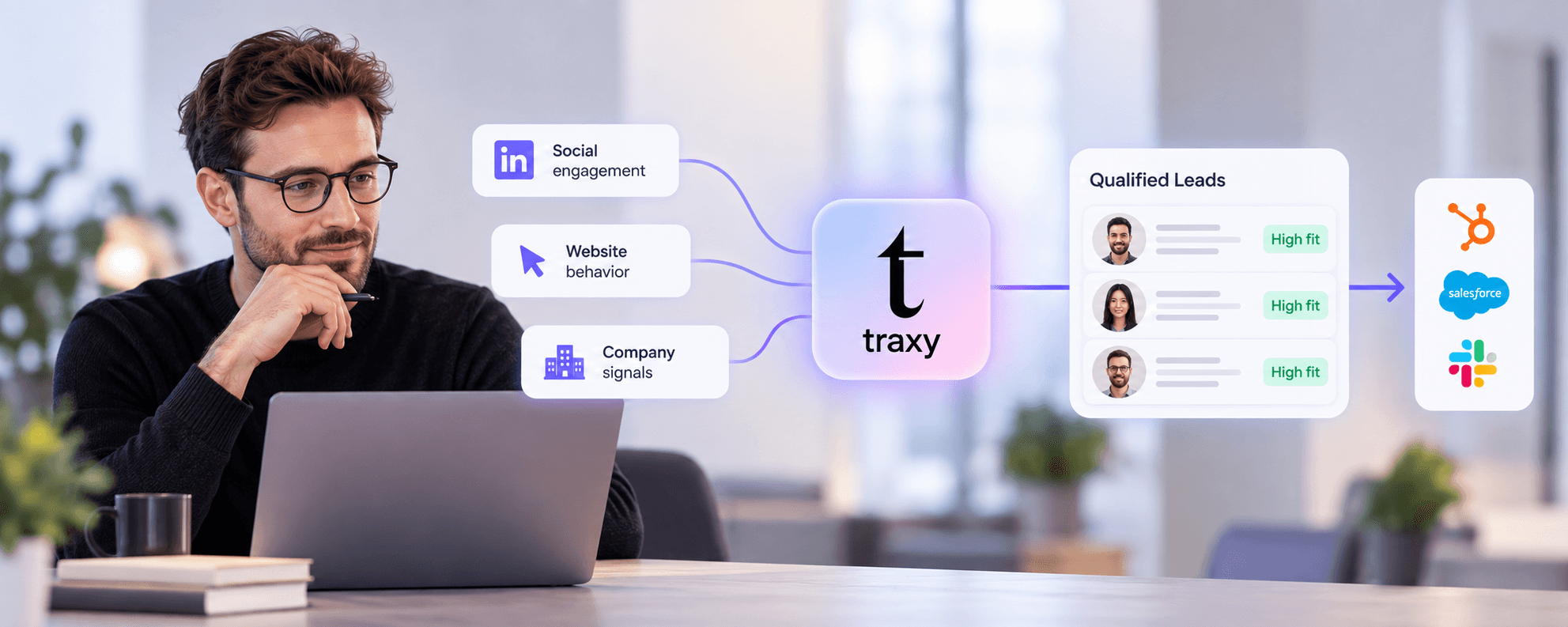
TL;DR: Implementing an AI-driven B2B lead generation strategy means replacing static contact lists with a live pipeline: an AI discovery layer monitors buying signals (social engagement, website behavior, firmographic triggers) in real time, scores each one against your ICP, and routes only the qualified matches to your CRM or reps. The build order that actually works is discovery → signal capture → ICP scoring → CRM routing → measurement — in that sequence, not all at once. Skipping straight to automation without the scoring and routing steps is the most common reason these strategies produce noise instead of pipeline.
What Is an AI-Driven Lead Generation Strategy?
An AI-driven lead generation strategy uses automated systems — rather than manual research or purchased contact lists — to continuously find, evaluate, and prioritize potential buyers based on observable behavior. Instead of a rep or SDR manually searching for prospects who might fit, an AI discovery layer watches for buying signals (engagement with content, website activity, firmographic changes) as they happen, matches them against a defined ideal customer profile (ICP), and surfaces a ranked, ready-to-contact list. The "AI" in the name refers less to a single chatbot feature and more to the ongoing pattern-matching and scoring work that used to require a human doing manual qualification.
The Problem With Most Lead Generation Strategies
Most B2B lead generation still runs on two aging assumptions: that a purchased contact list is a substitute for actual buying interest, and that a form fill is the first meaningful signal a prospect gives. Neither holds up well anymore. A static list tells you who might theoretically fit your ICP, not who's actually in-market today — so reps spend real hours on outreach to people with zero current intent. And by the time someone fills out a form, Gartner's own research puts B2B buyers 70-80% of the way through their purchase decision — the strategy is measuring the tail end of a decision that's mostly already been made. An AI-driven approach exists specifically to close that gap: catching intent earlier, from signals that don't require the buyer to raise their hand first.
How to Actually Build It: The Five-Step Sequence
The teams that get this right build it in order — each step depends on the one before it, and skipping ahead is what turns "AI-driven lead generation" into an expensive noise generator instead of a working pipeline.
1. Set up discovery
Define what a buying signal looks like for your business before choosing any tool. That usually means picking the source that matches where your buyers actually show intent — social engagement (likes, comments, shares on relevant content), website behavior (pricing page visits, repeat sessions), or firmographic triggers (funding, hiring, tech-stack changes). Trying to monitor everything at once from day one is the most common way this step stalls; pick the one or two sources that match your actual buyer behavior and expand later.
2. Capture the signal in real time
A signal that reaches you a week later is a signal that's already gone cold — by then, a faster-moving competitor has often already had the conversation. Whatever discovery source you chose in step 1, verify it refreshes in near real time rather than in a daily or weekly batch. This is the single most common place vendors overstate their capability, so it's worth testing directly rather than trusting the sales deck.
3. Score against your ICP
Raw signal volume is not useful on its own — a comment from a decision-maker at a target-fit account and the same comment from an unrelated account or a bot are not the same event, even though both look identical as "engagement." Define your ICP criteria explicitly (company size, industry, role, seniority) and make sure every captured signal gets scored against it automatically, before a human ever sees it. This is what turns a raw activity feed into a ranked, prioritized list.
4. Route qualified leads into your CRM
A qualified signal that sits in a separate dashboard is functionally the same as no signal at all — reps check the tools they already work from, not a fifth tab. Build the direct path from your scoring layer into HubSpot, Salesforce, Slack, or whatever your team actually uses daily, with enough context attached (who, what they did, when) that a rep can act without doing additional research first.
5. Measure and adjust
Track the full funnel, not just top-of-funnel volume: how many signals get captured, how many clear ICP scoring, how many convert to a rep conversation, and how many close. Volume at the top of that funnel is the easiest number to inflate and the least useful one to optimize for — a strategy that surfaces 10 well-matched, contactable buyers is doing its job better than one that surfaces 500 loosely-matched accounts nobody has time to work.
Old Way vs. AI-Driven Way
Manual / List-Based Lead Generation | AI-Driven Lead Generation | |
|---|---|---|
Source | Purchased contact lists, manual research | Real-time buying signals (social, web, firmographic) |
Timing | Static — no indication of current interest | Live — reflects behavior as it happens |
Qualification | Manual review by a rep or SDR | Automated ICP scoring before a human sees it |
Volume vs. fit | High volume, unknown fit until worked | Lower volume, fit-checked before delivery |
Delivery | Spreadsheet or list export | Routed directly into CRM/CRM-adjacent tools |
Rep's first action | Research the account, then decide whether to reach out | Reach out immediately, using the signal as context |
FAQ
How do data-driven lead generation solutions balance automation with accuracy for sales teams?
The balance comes from where automation is applied. Signal capture and initial ICP scoring can be fully automated safely, since they're pattern-matching against defined criteria. Accuracy holds up best when a human still reviews edge cases and periodically re-checks the ICP definition itself — full automation without any review tends to drift over time as the market or product changes.
Which AI platforms track social media to find potential buyers?
This category is generally called engagement-signal or social-intent monitoring: platforms that watch public activity (likes, comments, profile views) on LinkedIn and similar platforms, then match that activity against a defined ICP to surface named, contactable prospects — as opposed to platforms that only track website visitors or third-party research data.
Are there efficient platforms that automate finding high-intent buyers through social engagement signals?
Yes — this is a maturing category built specifically around treating social engagement as a first-class buying signal rather than a vanity metric. The main differentiator between platforms is less the "AI" claim itself and more whether the signal reaches a rep in real time with enough context to act on immediately.
What are the most effective ways to automate lead enrichment for high-intent prospects?
Enrichment works best when it happens automatically at the moment a signal is captured — pulling contact details, role, and company data onto a qualified lead before it reaches a rep — rather than as a separate manual step later. Waiting to enrich after the fact reintroduces the exact delay an AI-driven strategy is meant to remove.
Can AI sales agents act on this kind of data directly?
Yes, but only if the output includes identity, ICP fit, the triggering signal, and clean routing fields. An anonymous, account-level score gives an AI agent nothing concrete to act on; a named, scored, enriched lead does. This is the same requirement that makes the data useful to a human rep — an AI agent just has zero tolerance for ambiguity a person might work around.
Getting Started
None of this requires ripping out an existing sales stack — it requires sequencing. Start with the signal source that matches where your buyers actually show intent, get it flowing in real time, score it against a clearly defined ICP, and route only what clears that bar into the tools your reps already use. Teams that try to skip straight to "automated everything" usually end up with more noise, not more pipeline. If the piece you're missing is the discovery-to-CRM sequence itself — watching LinkedIn engagement, scoring it, and routing it automatically — that's the specific gap traxy is built to close.