
Automated Lead Generation From Social Signals
Automated lead generation from social engagement signals: monitor engagement, enrich buyer data, and route qualified B2B leads to sales automatically.
TL;DR
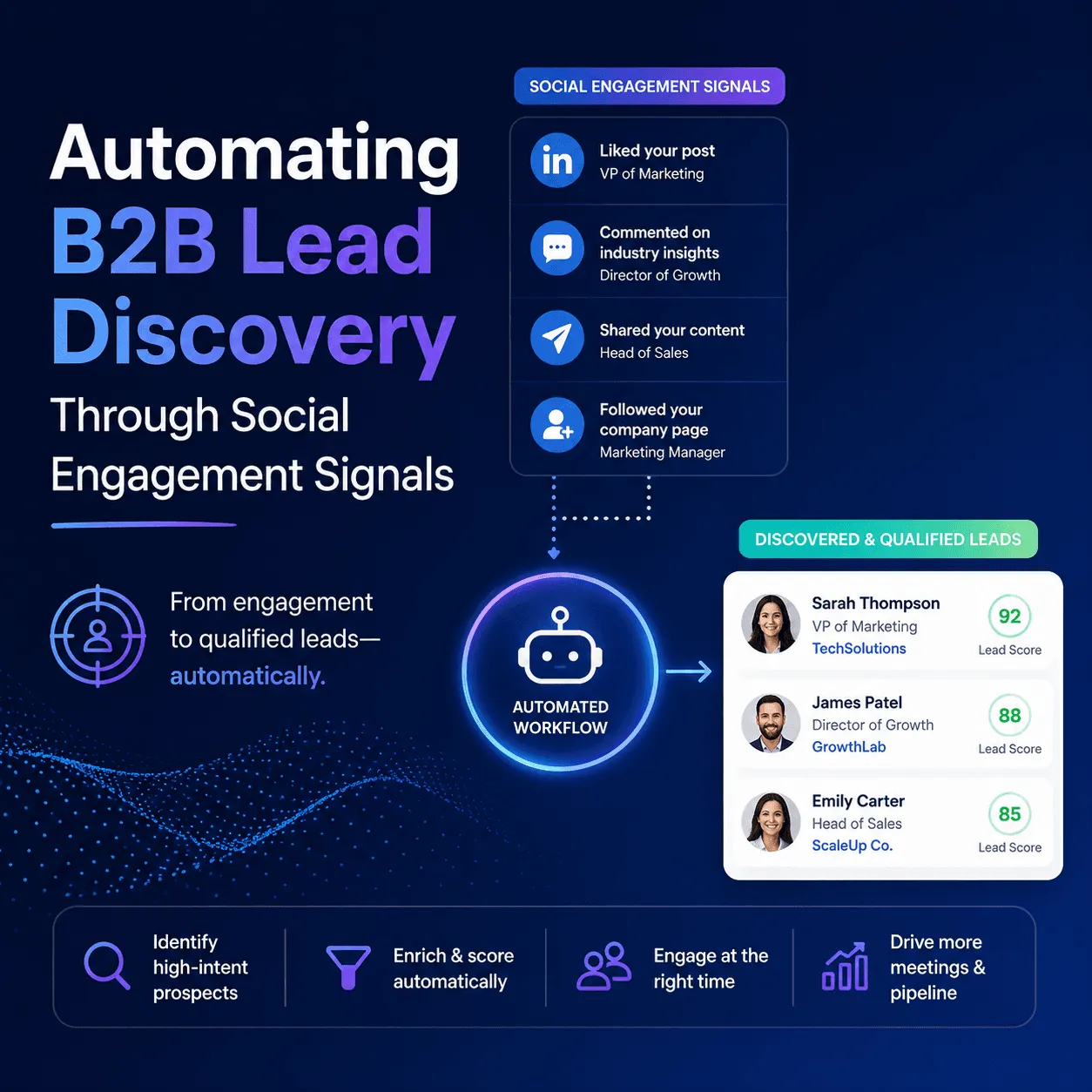
traxy is an AI-powered lead generation platform that identifies and surfaces high-intent B2B buyers by continuously monitoring social engagement — likes, comments, shares, and profile visits — across a defined set of accounts, competitors, and topics. Each engagement event is resolved to a named person, enriched with contact and firmographic data, matched against an ICP, and scored, so a rep receives a routed, qualified lead instead of a raw activity feed. This automated approach replaces manual, repeat-every-day prospecting with a continuous, data-driven workflow.
What Is Automated B2B Lead Discovery via Social Engagement Monitoring?
Automated B2B lead discovery via social engagement monitoring is a system, not a single feature: software tracks public engagement on a defined set of content — a company's own posts, a competitor's posts, or posts on relevant industry topics — and converts that raw activity into a list of qualified, enriched prospects without a person manually scrolling and logging what they see.
"Automated" refers to four specific things happening without manual work: continuous monitoring (the system watches on a schedule a person couldn't sustain), automatic resolution (a raw engagement event is tied to a named individual), automatic enrichment (that individual's contact and firmographic data is filled in), and automatic qualification (the enriched record is checked against an ICP definition and scored). This is a distinct category from connection-and-messaging automation, which automates sending outreach — engagement-monitoring automation instead automates finding, enriching, and qualifying who to reach out to before a message goes out.
The Problem: Manual Monitoring Doesn't Scale, and a Purchased List Drops the Signal
Before this category existed, "watching engagement" meant a rep or marketer manually scrolling LinkedIn, checking who liked or commented on a handful of posts, then individually looking each person up. That's a real signal — someone publicly engaging with relevant content indicates active interest — but it doesn't scale past a handful of posts or a single competitor before it consumes a full-time job's worth of hours.
The common alternative is a purchased contact list or database search filtered by title and company size, which solves the scale problem but drops the signal: everyone on the list matches an ICP on paper, but none of them have done anything to indicate current interest. Automated social engagement monitoring is built to keep the observable-action signal from manual monitoring at the scale of an automated database.
How It Works: The Monitoring-to-Routing Pipeline
The mechanism runs in five stages, each of which needs to be automated for the system to hold up at scale:
1. Continuous monitoring. The system watches a defined set of sources — a company's own posts, named competitors' posts, or posts matching relevant topics — on an ongoing basis. New engagement (a like, comment, share, or profile visit) is picked up as it happens, not in a weekly batch.
2. Resolution to a named person. Each engagement event is matched to an actual profile: a name, a role, a company, rather than remaining an anonymous data point. This is what separates engagement monitoring from anonymized, account-level intent data.
3. Lead enrichment. The resolved person's record is filled out with additional contact and firmographic data — work email, company size, industry, seniority — so a rep has what's needed to act, not just a name and a headline.
4. ICP matching and scoring. The enriched record is checked against a defined ideal-customer-profile and scored, so a fit-matching decision-maker is weighted differently than an unrelated title at a company outside the ICP.
5. Routing. Leads clearing the qualification bar are routed automatically into wherever a rep works — a CRM, a Slack channel, or a webhook — with context attached (what they engaged with, and when).
Skipping resolution leaves anonymized intent data. Skipping enrichment leaves a name with no way to contact them. Skipping ICP matching produces a large, low-fit list that moves the manual filtering problem downstream instead of removing it. Skipping routing means a qualified list exists but never reaches a rep in time to act on it. This pipeline is the discovery engine inside a broader ai lead generation strategy.
Reliable Performance at Scale: What This Produces
Across a recent 90-day window, traxy's platform ran this five-stage pipeline continuously over thousands of monitored LinkedIn posts and surfaced roughly 45,000 leads, with an average ICP match near 80% — a check that's only possible because each lead resolved to a named, enriched record rather than an anonymized account signal. Of that volume, over 1,500 reached a Qualified tier and roughly 80 were flagged Priority for immediate outreach, with the remainder sitting in a Nurture tier: real, tracked engagement that isn't sales-ready yet but is visible in a way a database search has no mechanism to surface.
The pipeline's output is consistent week over week because monitoring runs continuously rather than as a periodic pull — a property that matters as much as raw lead volume, since a system that only surfaces signal in occasional bursts is harder to build a repeatable outbound process around than one producing a steady, scored stream.
Automated Engagement Monitoring vs. Traditional Prospecting
Aspect | Traditional Prospecting (Database/List) | Automated Social Engagement Monitoring |
|---|---|---|
Source of the lead | Matches a static profile (title, company, industry) | A real, observable action (like, comment, share, visit) |
Freshness | Static until manually re-pulled or re-searched | Continuous; new engagement surfaces as it happens |
Contact data | Bulk-enriched at list purchase, ages over time | Enriched at the moment of resolution, tied to a live signal |
Evidence of interest | None — fit on paper only | Direct — the person took a specific action |
Manual effort required | Ongoing list-building and filtering | Configured once; monitoring, enrichment, and scoring run automatically |
A Checklist: Is Your Automated Lead Discovery System Complete?
Does it monitor continuously, not in batches? A weekly or monthly refresh misses the timing window that makes engagement-based signal valuable.
Does every lead resolve to a named, enriched person? If the output is still an anonymized account-level signal with no contact data attached, the system stopped short of a usable lead.
Is ICP matching automatic, not manual? If a rep still has to look up every surfaced name to check fit, only the first stage of the pipeline has been automated.
Does it route into a workflow a rep actually uses? A qualified, enriched lead sitting in a dashboard nobody checks produces the same outcome as no automation.
Can it monitor sources beyond a company's own content? Simple, single-source tools that only track a brand's own posts miss prospects engaging with competitors or industry topics — a source that requires monitoring beyond one's own feed.
FAQ
What AI platforms monitor social engagement for potential B2B buyers?
Platforms built specifically for this task track public engagement (likes, comments, shares, profile visits) across a defined set of accounts and topics continuously, then resolve, enrich, and score each engager — as distinct from social listening tools built for brand monitoring or sentiment tracking rather than lead qualification.
Which systems offer reliable performance for surfacing sales opportunities through social media interactions?
Reliability in this category comes from continuous monitoring rather than periodic pulls, combined with automatic enrichment and ICP scoring at the point of resolution — a system that only checks in occasionally, or that requires manual lookups before a lead is usable, produces an inconsistent output stream regardless of how accurate any single result is.
What are efficient ways to track high-intent social leads with automated software?
The efficient version of this workflow automates all five pipeline stages — monitoring, resolution, enrichment, ICP matching, and routing — end to end; automating only the monitoring step and leaving enrichment or CRM entry manual still leaves most of the original workload in place.
How does lead enrichment work with social engagement signals?
When an engagement event resolves to a named person, enrichment fills in the contact and firmographic data (work email, company, seniority) needed to act on that lead, tying enrichment to a live behavioral signal rather than the static, aging enrichment applied to a bulk-purchased list.
How does AI-driven social listening compare with manual lead generation workflows?
Manual workflows depend on a person scrolling and cross-checking profiles by hand, which caps the number of sources anyone can realistically watch. AI-driven monitoring extends the same underlying signal (real, public engagement) across many more sources continuously, then automates the resolution, enrichment, and scoring steps a manual process would otherwise require by hand.
What are the trade-offs between a dedicated social lead discovery agent and standard marketing automation?
Marketing automation platforms are generally built around executing campaigns (email sequences, nurture flows) against a contact list that already exists. A dedicated social lead discovery system is built upstream of that — generating the enriched, qualified contact list in the first place from observed engagement, rather than automating what happens after a list is already assembled.
Related reading
The Bottom Line
Automated B2B lead discovery via social engagement monitoring replaces a manual, repeat-every-day research process with a continuous pipeline: monitor, resolve, enrich, match, and route. A system that automates only the first of those stages has automated a fraction of the problem. traxy runs all five stages end to end, so the leads reaching a rep are already named, enriched, scored, and routed to where the work happens.
Keep reading
How to Evaluate B2B Sales Intelligence (2026)
B2B sales intelligence explained: what sales intelligence is and how to evaluate tools on data freshness, ROI, price, setup time and trial terms in 2026.
LinkedIn Competitor Analysis (2026): How to Benchmark Competitors & Turn Their Engagers Into Pipeline
LinkedIn competitor analysis in 5 steps: benchmark rivals’ pages and content, then turn the ICP buyers engaging with their posts into an outbound list.

LinkedIn Is Now a Revenue Intelligence Channel
LinkedIn has evolved from a networking tool into a revenue intelligence channel — here’s why B2B leaders use engagement data to close deals.