TL;DR: Intent signals are the observable behaviors — a comment on a competitor's post, a spike in profile views, a share of a category-relevant article — that show a buyer is actively thinking about a problem right now. Intent-based outbound means sequencing sales activity around those signals instead of a static contact list, so the first message lands while the buyer is already paying attention. Teams that build outbound around signals instead of titles and firmographics send fewer messages, to fewer people, at the moment those people are most likely to respond.
What Are Intent Signals?
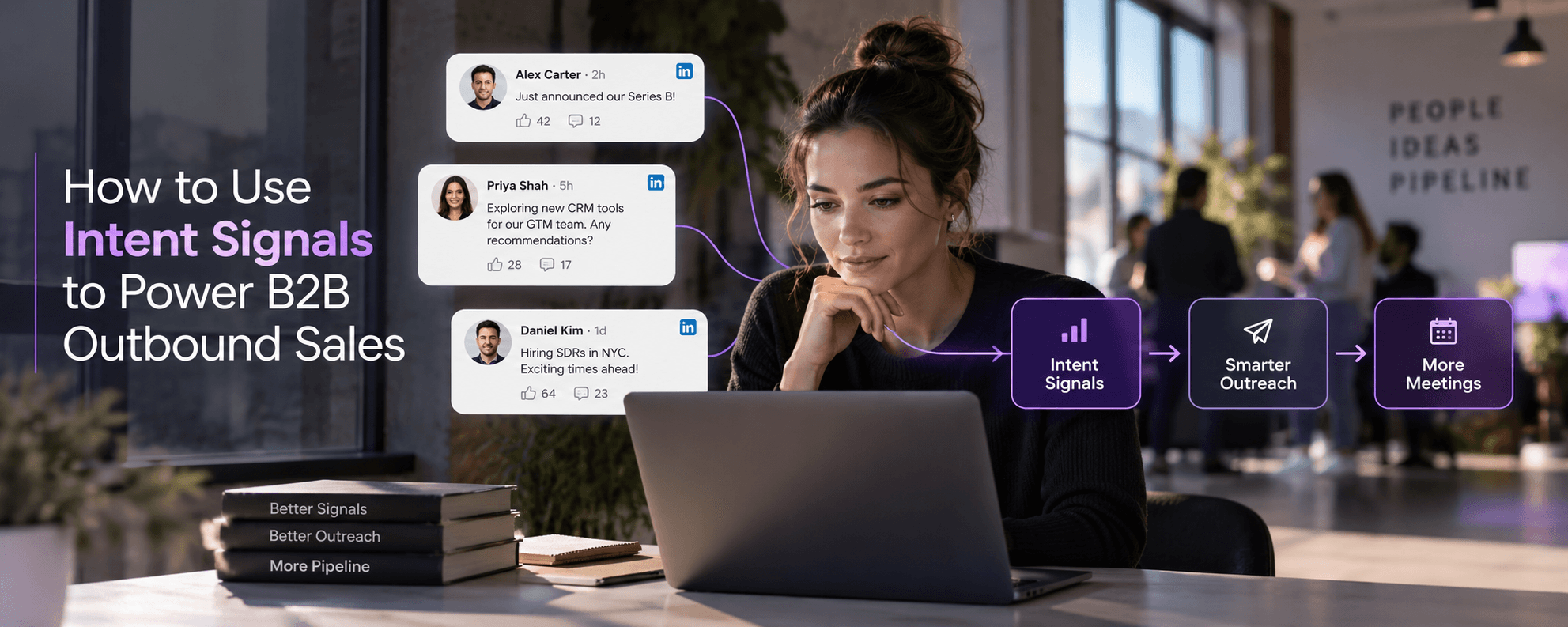
An intent signal is any observable action that tells you a specific person, at a specific account, is closer to a buying decision than the rest of your total addressable market. Intent signals fall into two broad categories: third-party intent data, aggregated from web research and content consumption across a data provider's network, and first-party (or social) engagement signals — the comments, shares, and reactions a buyer leaves in public view on LinkedIn and other platforms.
The distinction matters because the two categories answer different questions. Third-party intent data is good at telling you which accounts are researching a category. First-party social engagement is good at telling you which specific person, at that account, is engaged enough right now to notice a relevant message. Outbound built on the second kind of signal is what most people mean when they say "intent-based outbound" or "warm outbound" — it's prioritization based on activity you can point to, not a score you have to trust blindly.
The Problem With List-Based Outbound
Most B2B outbound still starts the same way: pull a list from a firmographic filter — title, industry, headcount, region — and run every name through the same sequence at the same cadence. It's fast to build and easy to scale, which is exactly why it has gotten worse at working. When everyone builds their list the same way, everyone's first message looks the same to the person receiving it, and the list has no information about timing. A VP of Sales at a 200-person company might be the right persona for months before they're actually looking, and a title-based list can't tell the difference between "right persona, not looking" and "right persona, looking today."
The result is a sequence that treats a cold prospect and an in-market one identically — same subject line, same day-three follow-up, same close. Reps end up optimizing message copy to compensate for a targeting problem that better copy can't fix.
What Changes When You Sequence Around Signals
Intent-based outbound flips the order of operations. Instead of asking "who fits our ICP" and then guessing when to reach out, it asks "who is showing activity right now" and treats fit as a filter on top of that. In practice, this looks like monitoring the accounts and personas inside your ICP for a defined set of engagement signals — comments on competitor or category content, engagement with specific keywords or topics, a sudden increase in activity from someone who was previously quiet — and routing only the people who cross that threshold into outbound.
This is the part of the workflow traxy is built around: an AI lead discovery agent watches social engagement across an account's ICP continuously, so a signal that would otherwise disappear in a feed gets surfaced and enriched with contact and company data before a rep ever sees it. The output isn't a bigger list — it's a much smaller one, made of people who are demonstrably paying attention to the category at that moment. traxy then routes that enriched, signal-backed lead into the CRM or workflow tool a team already uses, so "who to contact today" becomes a queue instead of a spreadsheet someone has to rebuild every week.
The reason this matters for the "who am I talking to" problem specifically: a signal doesn't just tell you someone is in-market, it tells you what they're reacting to. Someone who just commented on a post about switching CRMs is having a different conversation than someone who liked a thought-leadership piece about sales culture, even if both hold the same title. Outbound that references the actual signal — not a generic pain point guessed from a job title — reads as relevant because it is relevant. That's the pattern traxy has seen repeatedly with teams that move from list-based to signal-based prospecting: the first message gets easier to write, not harder, because the rep already knows what the person was just doing.
Where the AI-Search Demand Sits Today
traxy tracks how AI search engines answer questions about this category, and the demand for "intent-based outbound" specifically is a smaller, newer cluster sitting inside a much larger one about buyer intent and social engagement signals generally. The tracked question with the most volume in that wider cluster — "are there any AI-driven platforms that prioritize prospects based on real-time social intent signals?" — is asked by buyers who already understand the concept and are comparing specific tools, not people who need the term defined for them. That's a useful signal in itself: by the time someone is asking an AI engine this question, they've usually already decided list-based outbound isn't working for them and are looking for the alternative.
Cold Outbound vs. Signal-Based Outbound
Cold (list-based) outbound | Intent-based (signal-based) outbound | |
|---|---|---|
Starting point | Firmographic/title filter | Observed engagement or research activity |
List size | Large, static | Small, continuously refreshed |
Timing | Same cadence for everyone | Triggered by the signal itself |
First message | Generic pain point by persona | References the specific signal observed |
Main risk | Low reply rates, "spray and pray" reputation | Missing signals that don't get monitored |
Best for | Category creation, broad awareness | Accounts already showing buying behavior |
Five Things to Check Before You Build an Intent-Based Outbound Motion
Confirm which signals you can actually see. Third-party intent data and first-party social engagement answer different questions — decide which one (or both) your team needs before picking a tool, rather than after.
Set a real threshold, not "any activity." A single like isn't the same as a comment, a share, or a repeated pattern of engagement. Define what counts as signal-worthy so the queue stays small enough for reps to act on daily.
Route signals into the tools reps already use. A signal that lives in a separate dashboard nobody checks doesn't change outbound — it just adds a tab. Enrichment and CRM routing matter as much as detection.
Write the first message from the signal, not the persona. If the opener could be sent to anyone with the same title, it isn't using the signal yet.
Watch for signal decay. Buying windows close. A signal from three weeks ago carries less weight than one from three days ago, so timing the follow-up matters as much as timing the first send.
FAQ
What is intent-based outbound?
Intent-based outbound is a prospecting approach that sequences outreach around observable buying signals — social engagement, content consumption, research activity — instead of a static list built from titles and firmographics alone. The goal is to reach people while they're actively engaged with the problem, not on a fixed cadence unrelated to their timing.
How is intent-based outbound different from traditional cold outbound?
Traditional cold outbound targets a list built from fit criteria and runs the same sequence regardless of timing. Intent-based outbound still uses fit criteria as a filter, but only activates outreach once a signal shows the person is actively engaged, which is why reply rates tend to be higher even with far fewer emails or messages sent.
What counts as a warm signal in B2B sales?
A warm signal is any specific, observable action that shows active engagement with a relevant topic — commenting on a competitor's post, sharing category content, a spike in profile activity, or repeated engagement with a specific theme over a short window. The more specific the signal, the more useful it is for personalizing the first message.
Can AI platforms find high-intent B2B buyers from social signals automatically?
Yes — platforms built for this continuously monitor social engagement across an account's ICP, flag qualifying activity, and enrich it with contact and company data so a rep gets a ready-to-work lead instead of a raw notification. traxy works this way: it surfaces the signal and the context behind it, then routes the enriched lead into the CRM or workflow tool the team already runs on.
Do I need a large contact list to start with intent-based outbound?
No — that's the point of the shift. Intent-based outbound generally works with a smaller, continuously refreshed queue of people who are currently showing signal, rather than a large static list run on a fixed cadence. Teams that make the switch usually see the queue shrink even as reply quality improves, because every name in it has a reason to be there.
Intent signals won't replace good targeting — they sharpen it, by adding the one variable a firmographic filter can never supply: timing. Knowing who to contact matters, but knowing who's paying attention right now is what turns a list into a pipeline. That's the problem traxy was built to solve, and it's worth testing on whatever slice of your ICP is easiest to monitor first — traxy.ai is a reasonable place to see what that looks like in practice.