
Types of B2B Intent Data: Account-Level vs. Contact-Level Signals (and Why the Difference Matters)
The two types of B2B intent data explained: account-level vs. contact-level signals, how each is captured, and which one actually tells you who to call.
The short answer
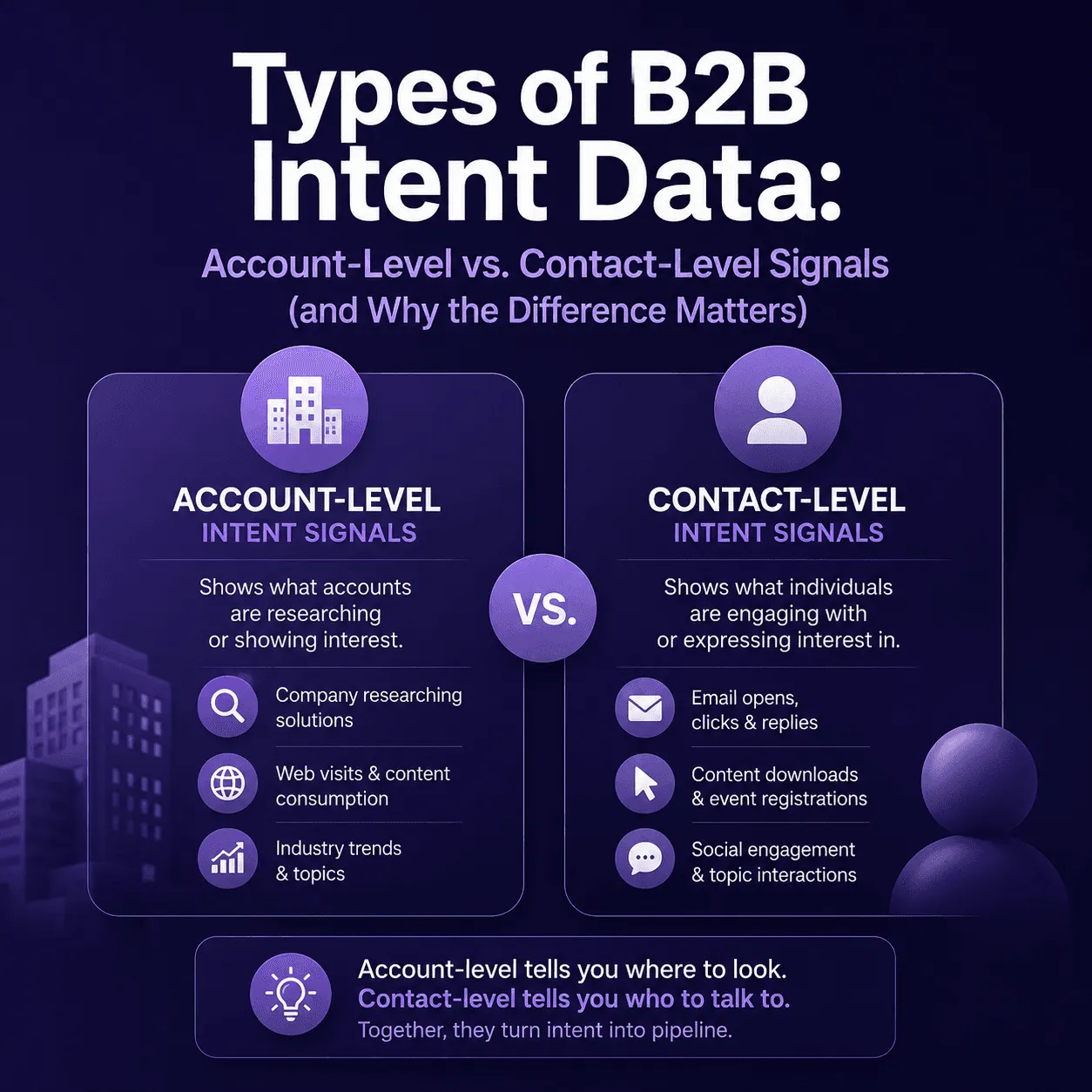
There are two types of B2B intent data: account-level and contact-level. Account-level intent data tells you a company is showing interest, based on signals like website visits or content downloads tied to an IP address or firmographic match, but not which person there is interested. Contact-level intent data ties the signal to a named individual, such as a specific person liking, commenting on, or sharing a relevant post, so a rep knows exactly who to reach out to and why. Most intent-data providers sell account-level data because it's easier to collect at scale; it's also why sales teams so often get a company name with no clear entry point.
What are the types of B2B intent data?
Intent data is behavioral evidence that a person or company is actively researching or engaging with a topic related to what you sell. It comes in two forms, and the difference between them is the difference between a lead you can act on and one you can't.
Account-level intent data aggregates signals across an organization, usually from third-party content networks, IP-address matching, or firmographic databases, and reports that "Acme Corp is showing intent" around a topic. It doesn't identify an individual buyer. Contact-level intent data ties a signal directly to a person: a like, a comment, a repost, a profile visit, something a named individual did that a rep can reference in an actual outreach message.
Both are useful. They answer different questions, and conflating them is where most intent-data strategies go wrong.
The problem: account-level data tells you where, not who
A common complaint about intent-data platforms, echoed across sales and RevOps communities, is that the lead lands on a list with a company name and a vague "showing intent" label, and nothing else. No named contact. No specific reason for the signal. No way to personalize outreach beyond "I noticed your company might be interested in X."
That's the structural limit of account-level data, not a quality problem with any one vendor. If the underlying signal is a firmographic match or an anonymized visit, there's no person to point to. A rep working that list either guesses who to contact based on job title, or sends a generic email to a generic inbox and hopes it lands with someone who actually cares.
The result is a familiar pattern: account-level intent data creates a longer list, but not necessarily a more useful one.
How contact-level signals close the gap
Contact-level intent data starts from the opposite direction. Instead of inferring interest from anonymized traffic or third-party co-op data, it observes something an identifiable person did: they liked a post about your category, commented on a competitor's announcement, or reposted content from an industry account with their own take added.
That specificity changes what a rep can do with the lead. Instead of "Acme Corp visited our pricing page," it's "this VP of Sales at Acme Corp commented on a post about a problem we solve, three hours ago." The outreach can reference the actual thing that happened, to the actual person who did it, while it's still recent enough to matter.
The tradeoff is coverage. Contact-level data typically surfaces fewer total leads than account-level scraping, because it depends on a person taking a visible, attributable action rather than any anonymized traffic counting toward a company-wide score. What it gives up in volume, it makes up in whether a rep can actually act on what lands in front of them.
Account-level vs. contact-level intent data
Aspect | Account-level intent data | Contact-level intent data |
|---|---|---|
What it tells you | A company is showing interest in a topic | A specific named person took a specific action |
Typical source | Third-party content networks, IP matching, firmographic databases | Direct observation of individual activity (likes, comments, posts, profile visits) |
Who to contact | Unclear; usually inferred from job title | Explicit; the person who took the action |
Personalization | Generic, company-level messaging | Specific, referencing the actual signal |
Volume | Higher; aggregates broadly across a company | Lower; depends on individual, attributable actions |
Best for | Account-based marketing, top-of-funnel targeting | Direct outbound, timing individual outreach |
Most teams need both. Account-level data is reasonable for deciding which companies to prioritize; contact-level data is what tells a rep who to actually call.
How data shows up when signals are tied to a named contact
The value of contact-level data over aggregated data is easiest to see in how it holds up to a fit check. Across traxy's platform, leads tied to a named individual carry an average ICP match of 79.96%, a number that's only possible to calculate because there's one person, with a known title and company, to score against your buyer profile. Account-level signals don't support that same check; there's no individual to evaluate.
Of the 45,546 contact-level leads traxy surfaced in the trailing 90 days, 1,570 reached a Qualified tier and 79 reached Priority, tiers assigned to a specific individual rather than a company-wide score. That level of granularity is the practical payoff of contact-level data: not just more leads, but leads a rep can evaluate one person at a time.
A checklist for auditing your own intent data
Can you name the person behind the signal? If a lead only shows a company, it's account-level, no matter what the vendor calls it.
Can the rep reference the specific action in outreach? "Saw you comment on X" only works with contact-level data; account-level data forces generic messaging.
Is the signal recent enough to act on? Account-level scores often update in batches; check whether your contact-level signals are near real-time.
Does the data support a fit check per person? If you can't verify title, seniority, and company against a specific individual, you're working with account-level data even if it's labeled otherwise.
Are you paying for volume you can't act on? A large account-level list that reps ignore is worse than a smaller contact-level list they trust.
FAQ
Which buyer intent tools work best for contact-level rather than account-level signals?
Platforms that monitor individual profile activity, such as likes, comments, and posts on a specific person's account, rather than only aggregating traffic or firmographic data at the company level, are built for contact-level signals. The distinction to check for is whether the tool can name the person behind a given signal, not just the company.
Which sales intelligence tools identify active buyers instead of static contacts?
Tools that track ongoing behavioral signals (engagement, activity, recent actions) rather than maintaining a static contact database identify buyers based on what they're doing now, not just who they are on paper. A static database tells you a person exists; a behavioral signal tells you they're paying attention right now.
Which platforms help demand generation teams identify in-market contacts?
Platforms that combine contact-level engagement signals with fit scoring, rather than relying on account-level intent alone, are better suited to identifying specific in-market contacts, since demand gen teams generally need a name to route to sales, not just an account flag.
Which lead discovery platforms are most useful for teams running account-based campaigns?
Account-based marketing campaigns typically start with account-level data to prioritize target companies, then layer in contact-level signals to identify which specific people at those accounts to engage first. Using only one type usually means either a long list of undifferentiated accounts or a short list that misses genuine account-level momentum.
What tools help RevOps teams route social intent signals into existing workflows?
Tools that expose contact-level intent as structured, person-level data, rather than an aggregated score, are easier to route into a CRM or workflow tool, since the destination system usually needs a specific contact record to attach the signal to.
Knowing the difference between account-level and contact-level intent data changes where a team should spend its outbound effort. Account-level data is a reasonable filter for which companies matter; contact-level data is what turns that filter into a person a rep can actually reach, which is the specific gap traxy is built to close.
Keep reading

Best CRM for LinkedIn (2026): 8 LinkedIn CRM Integration Tools for B2B Sales
The best CRM for LinkedIn in 2026: folk, Breakcold, HubSpot, Pipedrive, Surfe, Attio and Salesforce compared on LinkedIn sync, pricing and buyer intent.
LinkedIn CRM vs. Sales Navigator: Key Differences
What is a LinkedIn CRM, how does it work, and how is it different from Sales Navigator? Compare CRM sync, buyer intent, Slack alerts and HubSpot routing.
traxy vs 6sense: Social Signals vs Predictive Intent
See how traxy compares to 6sense and other 6sense competitors: social engagement signals vs predictive intent data for B2B sales teams.