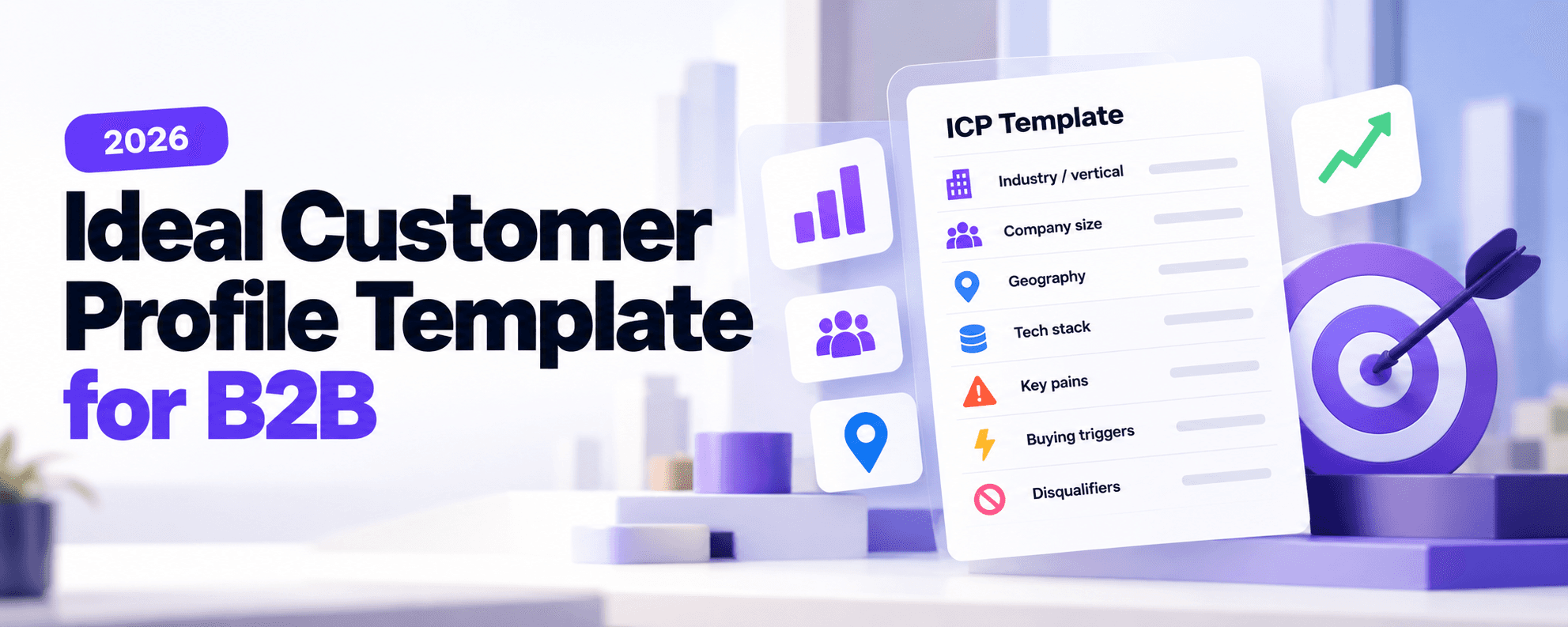
TL;DR: An ideal customer profile (ICP) template is a one-page definition of the companies that get the most value from your product and are most valuable to you: their industry, size, geography, tech stack, pains, buying triggers and disqualifiers. To build one, analyze your best current customers, find the traits they share, write them into the template below, and turn each trait into a filter your sales team can actually search on. Review it every quarter against closed-won and churned deals.
What Is an Ideal Customer Profile?
An ideal customer profile is a description of the type of company that is a perfect fit for what you sell. Salesforce defines it as "a detailed description of a buyer who's a perfect fit for your products or services." In B2B, "buyer" means the account first: an ICP describes organizations, not individuals.
A good B2B ideal customer profile answers three questions:
Fit: Which companies can use and pay for your product? (firmographics, technographics, budget)
Pain: Which of them have the problem you solve badly enough to act? (use cases, triggers)
Value: Which of them become your best customers? (fast sales cycles, high retention, expansion)
Everything else in your go-to-market plan (target account lists, messaging, ad targeting, lead scoring and territory planning) inherits from this definition.
The Problem: Selling to "Everyone Who Could Buy"
Without a written ICP, every team runs its own version of it. Marketing targets whoever converts on a form, SDRs prospect whoever matches a job title, and AEs chase deals that stall at procurement. The symptoms are familiar:
Long, unpredictable sales cycles because deals come from accounts with no urgent trigger.
Low win rates because reps spend time on companies that can't buy.
High churn because customers were sold a product that doesn't fit their workflow.
Wasted outbound because list-building filters are too broad ("SaaS, 50–5,000 employees").
An ICP fixes this by giving every team the same answer to "who should we spend time on?"
ICP vs. Buyer Persona vs. Target Market
The three terms get used interchangeably, but they describe different things. Salesforce frames it simply: an ICP identifies "the type of company that would be an ideal fit," while a buyer persona is "a semi-fictional representation of an ideal potential customer based on research and data."
Target market | Ideal customer profile (ICP) | Buyer persona | |
|---|---|---|---|
Describes | The whole addressable segment | The best-fit companies inside it | The people who buy inside those companies |
Level | Market | Account | Individual |
Typical attributes | Industry, region, market size | Industry, headcount, revenue, tech stack, growth stage, triggers, disqualifiers | Job title, seniority, goals, objections, content habits |
Used for | Strategy and sizing | Account lists, lead scoring, ad targeting, territory design | Messaging, content, outreach copy |
Example | "B2B software companies in North America" | "Series A–C B2B SaaS, 51–200 employees, HubSpot CRM, hiring SDRs" | "Head of Demand Gen who owns pipeline targets and reports to the CMO" |
Rule of thumb for ICP vs persona: build the ICP first, then write one persona for each buying-committee role inside ICP accounts. A persona without an ICP produces great copy sent to the wrong companies.
How an ICP Works in Practice
An ICP is only useful if it changes what people do each day. In practice it works as a set of filters and scores:
Hard filters (must-haves): attributes an account needs before anyone spends time on it, such as a supported region, a minimum headcount, or a CRM you integrate with.
Scoring attributes (nice-to-haves): traits that correlate with faster, larger deals, such as a recent funding round, an open SDR role, or a competitor tool already in place.
Triggers (timing): events that make an ICP account ready now: a new VP in the buying role, a hiring spike, a product launch, or public engagement with your category.
Disqualifiers: traits that predict churn or a stalled deal. These matter as much as the positive traits.
Fit tells you who; triggers tell you when. The strongest pipeline comes from accounts that match both, which is why most teams pair their ICP with a lead scoring model and a way to qualify leads from buying signals.
Ideal Customer Profile Template (Copy and Fill In)
Use this ideal customer profile template as a single page your whole revenue team works from. Fill each row from customer data, not opinion.
Section | What to fill in | Where the data comes from |
|---|---|---|
Industry / vertical | The 2–4 industries where your best customers cluster | CRM closed-won report, grouped by industry |
Company size | Headcount band and, if relevant, revenue band | CRM, LinkedIn company pages, enrichment data |
Geography | Regions you can sell, support and bill in | Sales and support coverage |
Business model and stage | B2B/B2C, self-serve vs. sales-led, funding stage | Customer interviews, funding databases |
Technographics | Tools they must use (e.g., your CRM integration) or already use (competitors, complements) | Onboarding data, technographic providers |
Core pain and use case | The problem that made them buy, in their words | Win/loss and discovery-call notes |
Buying triggers | Events that preceded the deal (new leader, funding, hiring, expansion, public engagement with the topic) | Deal timelines in the CRM |
Buying committee | Economic buyer, champion, users, blockers (link to personas) | Contact roles on closed-won deals |
Success metrics | What "value" looks like for them after 90 days | Customer success and QBR notes |
Disqualifiers | Traits of churned, stalled or unprofitable accounts | Churn and closed-lost analysis |
Tip: Write every row so it can be searched or filtered. "Innovative companies" is not a filter; "companies that posted an SDR or BDR job in the last 60 days" is.

Ideal Customer Profile Examples
The three ideal customer profile examples below are illustrative. Use them as models for how specific each row should be.
Example 1: B2B SaaS selling a sales-engagement add-on
Industry: B2B software, IT services
Size: 51–200 employees
Geography: North America and Western Europe
Technographics: HubSpot or Salesforce CRM; an outbound team already in place
Trigger: Hiring SDRs, or a new VP Sales in the last 6 months
Buying committee: VP Sales (economic buyer), SDR manager (champion), RevOps (blocker/implementer)
Disqualifier: No dedicated sales team; fully product-led motion
Example 2: Marketing agency selling LinkedIn content services
Industry: Professional services, consulting, B2B tech
Size: 11–50 employees, founder-led
Geography: English-speaking markets
Pain: Founder is the main source of pipeline but posts inconsistently
Trigger: Founder starts posting on LinkedIn, or the company launches a new offer
Disqualifier: Regulated industries with strict compliance review on every post
Example 3: Data platform selling to mid-market finance teams
Industry: Fintech, e-commerce, logistics
Size: 200–1,000 employees
Technographics: Uses a cloud data warehouse and a modern BI tool
Trigger: New CFO or VP Finance; preparing for a funding round or audit
Buying committee: CFO (economic buyer), FP&A lead (champion), data engineering (implementer)
Disqualifier: Finance runs entirely on spreadsheets with no data team
Notice what they have in common: every attribute is specific enough to become a list filter, and each profile says who not to sell to.
How to Create an Ideal Customer Profile in 5 Steps
Pull your best customers. Export closed-won accounts from the last 12–24 months and rank them by revenue, retention and time-to-close. Keep the top 20% as your reference set.
Find the shared traits. Compare that set against average and churned customers. Look for patterns in industry, headcount, tech stack, growth stage and the trigger that preceded the deal.
Interview 5–10 of them. Ask why they bought, what they tried before, who was involved and what would make them leave. Their words become your messaging.
Write it into the template. Separate hard filters from scoring attributes, add triggers and disqualifiers, and link a persona for each buying-committee role.
Operationalize and review. Turn the ICP into saved searches, lead-scoring rules and ad audiences. Review it quarterly against new wins and losses, and update it when your product or market changes.
Putting Your ICP to Work on LinkedIn
Most ICP attributes map directly to LinkedIn: industry, company size, geography, job title and seniority are all searchable. That makes LinkedIn the fastest place to test whether your ICP is real.
Build account and lead lists with Sales Navigator filters that mirror your hard filters.
Run account-based plays against ICP accounts with LinkedIn ABM.
Add timing: watch for ICP-matching people who engage with competitors, industry voices or your own team's posts. Public engagement with your category is a buying trigger you can act on the same day. See how to monitor hundreds of LinkedIn profiles for buying signals.
Salesforce reports that 86% of business buyers say they're more likely to buy when their goals are understood. An ICP applied to real-time engagement is how you reach the right people when they're actually thinking about the problem.
FAQ
What is an ideal customer profile?
An ideal customer profile (ICP) describes the type of company that gets the most value from your product and is most valuable to you. It covers firmographics (industry, size, geography), technographics, the core pain, buying triggers and disqualifiers. In B2B it defines accounts; buyer personas then describe the people inside them.
What should an ideal customer profile template include?
A complete ICP template includes industry, company size, geography, business model and stage, technographics, core pain and use case, buying triggers, buying-committee roles, success metrics and disqualifiers. Each row should be specific enough to become a search filter or a lead-scoring rule.
What is the difference between an ICP and a buyer persona?
An ICP describes the ideal company; a buyer persona describes an ideal person inside that company. Use the ICP to decide which accounts to target and the persona to decide how to message each role in the buying committee.
How do you create an ideal customer profile?
Start from your best closed-won customers, identify the traits they share that average and churned customers don't, and validate them with customer interviews. Write the traits into a template with hard filters, scoring attributes, triggers and disqualifiers, then review it every quarter.
What is an example of a B2B ideal customer profile?
For example: "B2B software companies with 51–200 employees in North America and Western Europe, using HubSpot or Salesforce, with an outbound team, that are hiring SDRs or recently hired a new VP Sales. Not a fit: fully product-led companies with no sales team."
The Bottom Line
A B2B ideal customer profile is only as good as the actions it drives: tighter lists, sharper messaging and reps who spend time on accounts that can buy. Start with the template above, fill it from real customer data, and add timing so you reach ICP accounts when they're in market. If you want that last step automated, traxy scans LinkedIn every hour, surfaces people who match your ICP and are engaging with the competitors, influencers or teammates you monitor, and pushes them to Slack or any webhook, with a 7-day free trial and no credit card or LinkedIn login required.
Related reading: