
How corporate training companies find clients on LinkedIn
How corporate training companies find clients on LinkedIn: target who feels the need and who signs off, read team-change signals, confirm context first.
Corporate training companies find clients on LinkedIn by targeting the people who buy training, usually L&D leaders, HR leaders and the managers of the teams being trained, and by watching for public signs of a team-level need: a fast-growing team, a wave of new managers, a new process or tool rollout, or a leader asking peers how they handle onboarding. A post about a skills gap is a reason to look closer. It isn't proof of a training budget. Confirm the team context, then offer something small and relevant to the situation you saw.
Last checked: November 11, 2026, against traxy's lead criteria, signals, tracking and use signals in outreach docs.
How do corporate training companies find clients on LinkedIn?
They target the people who feel the need and the people who sign off, then watch for public signs of a team-level change. Tools depend on the job. For a list of L&D and HR leaders by role, LinkedIn search or a people database is enough. For timing, watch posts about new managers, rep ramp time or tool rollouts. traxy fits when you want both in one place: it finds high intent leads from that LinkedIn activity at a 50%+ ICP match and runs LinkedIn and email outreach from your own connected accounts after you approve the campaign.
Who buys training, and why that matters for targeting
Training is often bought by one person and used by another team. A sales training company might sell to a VP of Sales, while a leadership program goes through HR or L&D. If you target only "Head of L&D," you miss the department leaders who start the conversation. If you target only department leaders, you can miss the person who holds the budget.
Write one segment per program:
Program | Who feels the need | Who often signs off | Company profile |
|---|---|---|---|
Sales training | VP Sales, Sales Manager, Head of Sales Enablement | VP Sales, CRO | B2B companies with a sales team to train |
Leadership and new-manager training | HR Business Partner, Head of People | Head of L&D, CHRO | Growing companies promoting from within |
Technical or tool training | Engineering Manager, Operations Lead | Department head, L&D | Companies rolling out a new system |
Compliance or safety training | Operations, HR | HR, Compliance | Regulated industries |
In traxy, each segment's rules go into Targeting > Lead criteria: roles, departments, seniority and locations for people, and size and industry for companies. traxy checks every person it finds against these criteria, and only people with an ICP match of at least 50% become qualified leads (how qualification works). If you only sell sales training, our guide on how B2B service firms find clients without cold calling has a section for sales training companies.
Signals that point to a training need
In Targeting > Signals, describe situations your buyers post about, in their language:
Sales training
A sales leader posting about ramp time for new reps
Questions about discovery calls, objection handling or a new sales method
Comments on posts about reps missing quota after a market shift
Leadership and manager training
A leader writing about first-time managers or promotion from within
Posts about team growth, reorganization or retention problems
Questions about running one-on-ones or performance conversations
Tool and process training
Posts about rolling out a new CRM, ERP or internal platform
Leaders asking how other teams handled adoption
Each lead carries a signal label: Warm for a direct signal relevant to your offer, Related for contextual evidence, Activity for a weaker connection, and ICP match for fit with no recorded signal of those types (signals).
Sources worth tracking
Track the profiles your buyers follow in Targeting > Tracking, with a relationship tag:
L&D and HR voices who post about learning programs (Influencer)
Sales enablement and sales leadership creators, for sales training (Influencer)
Other training providers in your niche (Competitor)
Your own facilitators and founders (Teammate)
Ongoing monitoring follows the five most recent posts published after you add a profile. When one post draws a crowd of managers discussing the exact problem you solve, such as "how do you train first-time managers?", use Track post to qualify its engagers (tracking). For more on choosing sources, see who to track on LinkedIn for leads.
Confirm the team context before you write
Training is sold on a specific team situation. Check:
Check | Where to look | If you can't confirm it |
|---|---|---|
The person leads or supports the team you'd train | Their profile and title | Find the right buyer, or skip |
The team is growing or changing | Company posts, open roles, the person's own posts | Use a topic-led opener |
The situation fits your program | The post or comment behind the signal | Route to a different program segment |
Timing | Date of the signal | Older signals need a softer opener |
In a traxy campaign, ask trax to research the facts your program needs, then review whether each claim in the test results has support. traxy's guidance says not to infer a person's budget, intent or dissatisfaction from a generic interaction, and if the evidence is too weak, change the message or skip the lead (outbound from qualified signals).
Openers that respect the evidence
Lead with the situation they described and a small, useful offer.
A sales leader posted about new-rep ramp time
"Your post on ramping new reps in [time frame] raised a question we hear from [type of team]. We run a [length] program on [skill]. Want the outline we use for teams with [team size or stage]?"
An HR leader commented on a post about first-time managers
"Saw your comment on [author]'s post about new managers. We work with [type of company] on [program]. Happy to send the checklist we give managers in their first [period]."
Fit, no strong signal
A short, role-based introduction to the program, with no invented reference to activity.
Avoid suggesting the team is underperforming or that you know about internal problems. More patterns are in from a LinkedIn signal to a message you can back up.
Mapping more than one person at an account
Training deals often involve two or three people at the same company. When several leads at one account show relevant signals, look at them together before you write. traxy's account reports, available through the REST API (/customer/account-reports) and MCP, summarize visible active leads by company (LinkedIn leads API). Assign those leads to one person on your team and use shared notes so the department leader and the L&D lead don't get two unrelated pitches. See account intelligence from LinkedIn engagement.
Measure what matters
Likes on a post about onboarding don't fill a cohort. Connect Google Calendar so traxy can match booked meetings to leads, record outcomes such as Active opportunity or Closed won, and compare program segments by meetings (meetings and outcomes).
Mistakes to avoid
Selling to the wrong person. Match the opener to whether the lead feels the need or signs off.
Reading a skills post as a budget. It's a topic signal until research says more.
One pitch for every program. If only the program name changes, the segments are too broad.
Contacting three people at one account separately. Coordinate the account first.
FAQ
How do training companies get clients on LinkedIn?
By targeting the leaders who own the team being trained, watching for public signs of a team-level change and opening with a small offer tied to that change.
Who should I contact for corporate training sales?
Often both the leader of the team that needs training and the L&D or HR person who manages programs. Your segment decides who comes first.
Do I need to post on LinkedIn to find training clients?
No. Tracking other people's posts finds managers discussing the problems you solve. Posting can help, but it isn't required.
Next step
Pick one training program in traxy, write its buyer and three signals, and track five profiles that buyer follows.
Keep reading
All LinkedIn Lead Generation guides
LinkedIn Lead Generation (2026): What It Is, Strategy, Tips and Tools for B2B
What LinkedIn lead generation is, a 7-step B2B strategy, the 5 main tactics, tips, tools and metrics, plus every LinkedIn lead generation guide we publish.
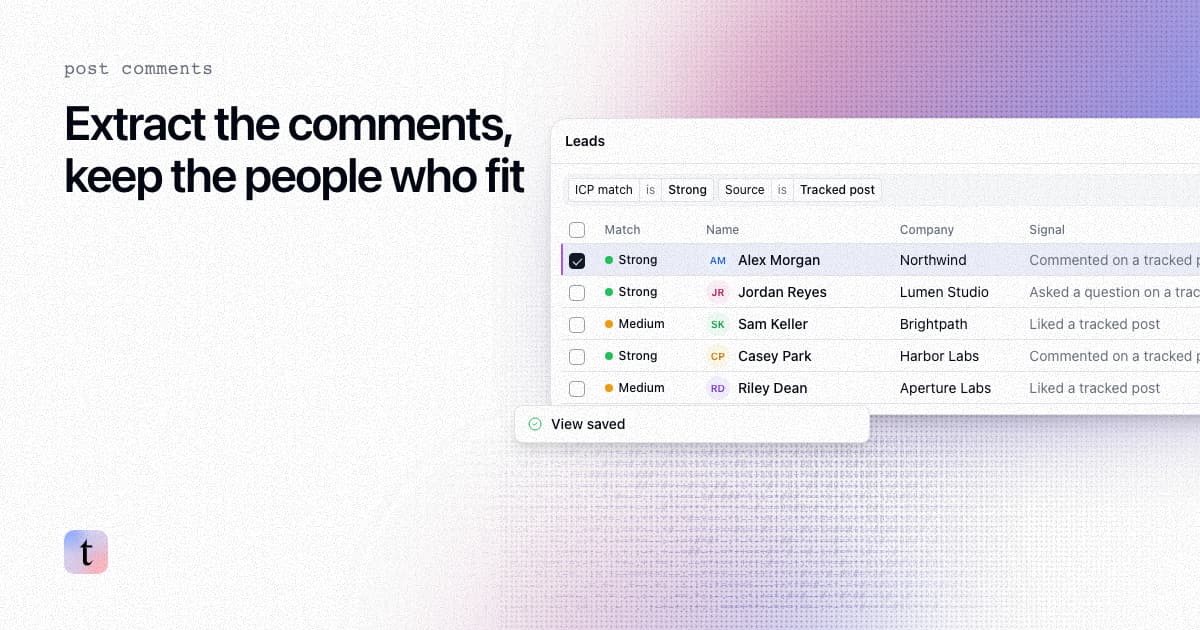
How to extract comments from a LinkedIn post, and keep only the commenters who fit your ICP
Four ways to extract comments from a LinkedIn post, what each returns and risks, and how to keep only the commenters who fit your ICP.

How to find leads from the people who engage with a LinkedIn company page
Most company page engagers are employees, job seekers and peers. How to find the ones who fit your ICP, with the post that brought each one in.