
Signal-based outbound agency or software? How to choose, and what to ask before you sign
Signal-based outbound agency or software? Compare build-in-your-stack agencies, done-for-you agencies, self-serve tools and Managed, plus questions to ask.
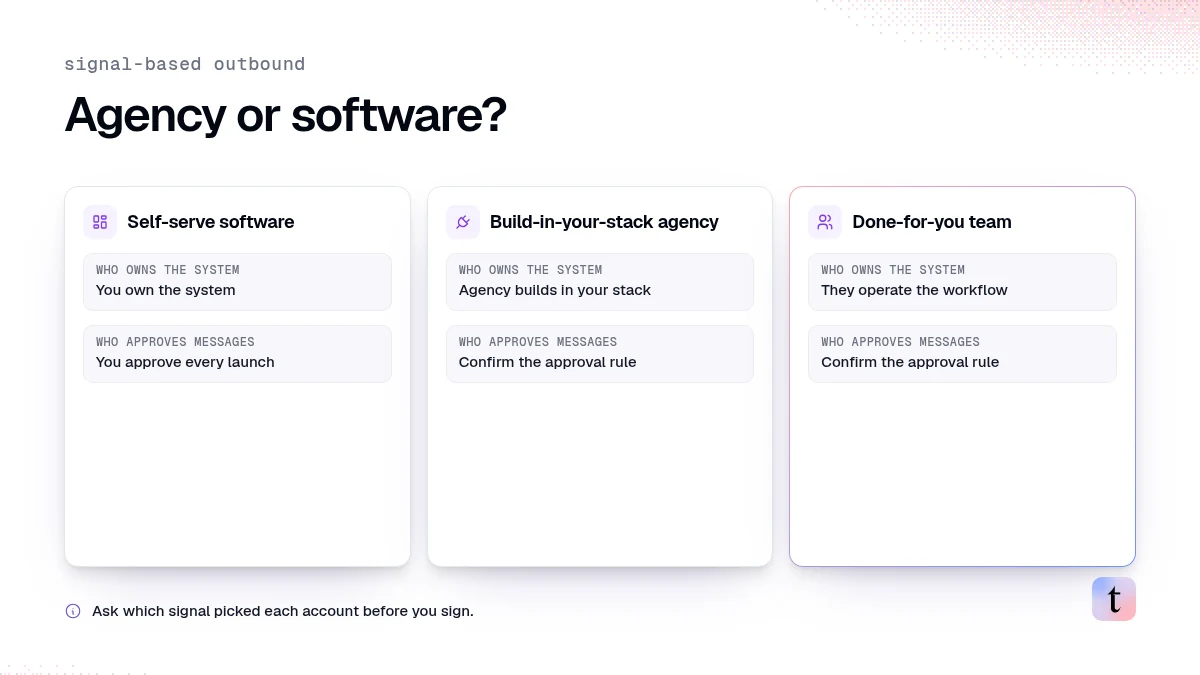
Hire a signal-based outbound agency when you lack the time or people to run targeting, research and sending yourself, and you want someone accountable for results. Use software when you have one person who can own the workflow for a few hours a week. Either way, ask the same question: for each account contacted, which signal triggered it, where is the source, and who approved the message? If an agency or tool cannot show that, it is running list-based outbound with a new label.
Last checked: November 6, 2026.
Two ranked lists compare signal-based outbound agencies. OneGTM's list (getaob.com, updated November 4) compares 11 agencies. RevSculpt's list compares six. Both are written by agencies that rank themselves, and both say so. RevSculpt puts the problem plainly: "signal-based" is now on almost every outbound agency's homepage, and for some agencies signals decide every account, while for others they are one input next to volume.
This guide is for founders and growth leads trying to decide between an agency, a tool, or a mix of the two.
What a signal-based outbound agency does
A signal-based outbound agency contacts an account because something happened there: a hire, a funding round, a leadership change, a post about a problem, a comment on a competitor's post. Traditional outbound starts from a filtered list and mails all of it on a schedule.
The agencies on the current lists fall into two models (getaob.com):
Build in your stack. The agency sets up the signal layer, the scored account list and the sequences inside your CRM and tools, then hands them over. You keep the system.
Done for you. The agency runs signal-triggered campaigns on a retainer. It handles data, sending, copy and usually reply handling and booking.
A third option is software you operate yourself, where the tool finds the leads and prepares the outreach and a person on your team approves it.
When software is enough
Choose self-serve software when:
You know your buyer well enough to write lead criteria in a paragraph.
Someone on your team can spend a few hours a week reviewing leads and approving campaigns.
Your signals are visible in public activity: LinkedIn posts, comments, engagement with competitors or influencers, people asking for recommendations.
You want to see every source before a message goes out.
In traxy, you describe who you sell to in Lead criteria and the problems and topics that matter in Signals. traxy finds people who match, qualifies them at an ICP match of at least 50% (qualification), and keeps the source beside each lead. You set the templates, trax prepares the campaign steps, and you approve the audience, sender and messages before launch (review and launch). The website calls this signal-based outbound on autopilot.
When an agency makes sense
Choose an agency when:
Nobody on your team can own outbound week to week.
You need sending infrastructure, domains and deliverability set up from scratch.
You want a team accountable for meetings, not only for a working system.
Your best signals live in sources that need custom work, such as public filings or permits. Blueprint GTM, on the getaob list, is described as working backward from best customers to public data like that.
The trade-off is control. In a done-for-you setup, the agency usually writes and sends. You see results later, and you see the reasoning only if you ask for it.
A middle path: software, operated for you
Some teams want the tool's visibility and someone else's hours. traxy offers this as Managed: the traxy team builds and operates your outbound workflow on traxy. Responsibilities are split on the page:
traxy runs lead sourcing and targeting setup, research and message workflows, and campaign operations.
You bring your offer and ideal customer, feedback on targeting and messages, and the sales conversations that follow.
The difference from a typical agency is that the workflow runs in software you can see, with the source and research kept beside each lead.
Seven questions to ask any signal-based outbound agency
Use these on every sales call, including ours.
Which signals do you use, and which ones book meetings for companies like mine? RevSculpt writes that in its own campaigns a regulatory deadline or a disclosed incident booked meetings, while a new executive hire on its own rarely did. Ask for that level of honesty.
Can I see the source for each account you contacted? A link to the post, job listing or announcement, with a date.
How do you check fit before acting on a signal? A funding round at a company outside your market is noise.
Who approves messages before they send? You, them, or nobody.
Whose accounts and domains do you send from, and what happens to them when we stop?
How do you handle suppression? Current customers, open deals, competitors, unsubscribes.
What do you hand over at the end? Lists, sequences, signal definitions, access.
Questions to ask any signal-based outbound software
Where do leads come from: a contact database, public engagement, your uploaded list, or several?
Does the tool show the evidence for each lead, with a date?
Is fit scored separately from the signal? In traxy they are separate: signal labels (Warm, Related, Activity, ICP match) describe signal strength, and the ICP match score describes fit (Signals).
Can you test a campaign without sending? A traxy campaign test prepares research and previews and sends nothing (create a campaign).
What stops outreach? In traxy, replies, unsubscribe requests and hard bounces stop active outreach, and Do not contact suppresses people you should not message (sequences, do not contact).
How to compare the options side by side
Self-serve software | Agency, built in your stack | Done-for-you agency | traxy Managed | |
|---|---|---|---|---|
Who runs it day to day | Your team | Agency, then your team | Agency | traxy team |
Who owns the system after | You | You | Usually the agency | Confirm on the call |
Where signals come from | The tool's sources | Agency's build, often Clay | Agency's data | traxy discovery and research |
Who approves messages | You | Depends on contract | Usually the agency | Approach reviewed with you |
Time you spend | A few hours a week | Heavy at first, then ongoing | Feedback and sales calls | Feedback and sales calls |
Check every cell against the contract or the product docs ahead of signing. Prices and terms change, so confirm them on a call.
Common traps
Signal theater. The agency names signals on its homepage but sends to a firmographic list. Ask to see five contacted accounts and the signal behind each.
Overclaiming in copy. "Saw you're looking for a solution" sent to someone who liked a post. Engagement shows relevance, not readiness to buy. traxy's guidance says not to infer budget, intent or dissatisfaction from a generic interaction (outbound from qualified signals).
No exit plan. You stop paying and lose the lists, domains and learnings.
Volume as a proxy. More messages per month says nothing about whether the right people got them.
Which should you pick?
Start with software if you have an owner and a clear buyer. Add an agency or Managed when the owner runs out of hours, or when you need infrastructure and sending handled from day one. If you already pay an agency, ask them the seven questions above and compare the answers with what a tool shows you for the same accounts.
For a list of the tools themselves, see best signal-based outbound tools. For the process, see the signal-based outbound playbook.
FAQ
What is a signal-based outbound agency?
An outbound agency that contacts accounts because of an event or activity, such as a hire, funding, a leadership change or relevant LinkedIn engagement, rather than mailing a static list on a schedule.
Is signal-based outbound better than cold outbound?
It gives you a reason to reach out and a smaller, more relevant audience. It still needs a fit check and honest copy. A signal at a company outside your market is not a lead.
Does traxy offer done-for-you outbound?
Yes. traxy Managed is the option where the traxy team builds and operates your outbound workflow on traxy, and you bring the offer, feedback and sales conversations.
Can I start with software and move to an agency later?
Yes. Keep your lead criteria, signal definitions and saved audiences documented so any team can pick them up.
Next step
Write your buyer in one paragraph and list three signals that should trigger outreach. Then run them in traxy for a week, or talk to us about Managed if nobody on your team has the hours.
Keep reading
All Prospecting & Outreach guides
LinkedIn Prospecting (2026): How to Prospect on LinkedIn Step by Step, With Message Examples & Signals That Tell You Who to Contact First
How to prospect on LinkedIn step by step: profile, ICP, list building, message examples, signals, prospecting tools and every outreach guide we publish.
Best AI SDR for lead generation: which ones find the leads, and which only send to a list you bring
Choose an AI SDR by its lead source: where leads come from, how fit is checked, what evidence you see per lead and who approves each message.

Ethical LinkedIn outreach: cite only what the evidence supports, suppress do-not-contact, and stop on reply
Ethical LinkedIn outreach: cite only what the evidence supports, suppress do-not-contact, stop on reply, and keep a human on review before launch.