
Gojiberry alternatives (2026): signal-led prospecting tools compared by where leads come from and who approves the message
Gojiberry alternatives compared by lead source, fit check, channels and who approves messages: traxy, lemlist, Valley, BeReach and OutreachGenie.

The best Gojiberry alternative depends on which part of Gojiberry you want to replace. For leads found from LinkedIn engagement and public posts, with the source beside each lead and your approval before anything sends, look at traxy. For multichannel sequences with built-in intent agents, look at lemlist. To run LinkedIn prospecting from Claude, look at a LinkedIn MCP server such as BeReach or OutreachGenie. For a person approving drafts by default, Valley positions itself that way.
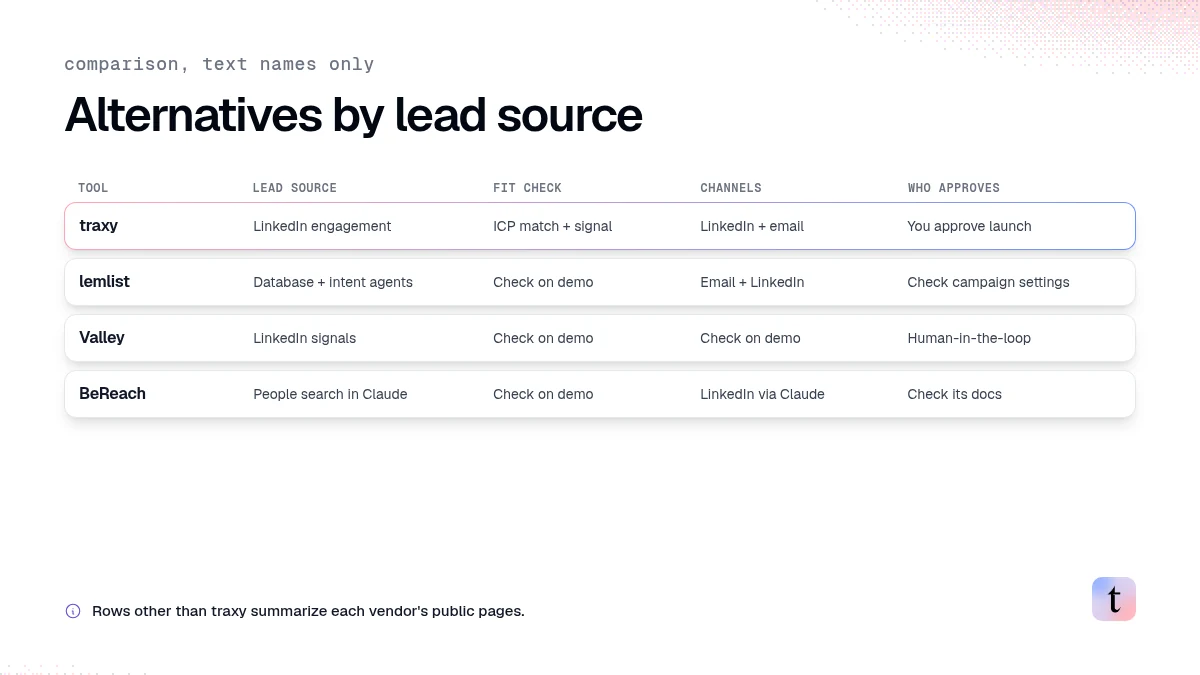
Last checked: November 6, 2026. Competitor details come from each company's own site or the dated sources linked. Pricing is left out on purpose because it changes often. Check each vendor's pricing page.
What Gojiberry does
Gojiberry's homepage describes it as an AI sales agent that "finds high-intent prospects and contacts them for you." You enter your website, and the agent detects buying and social signals, scores prospects against your ideal customer, and reaches out across email and social. Signal examples shown on the page include competitor engagement, following your company, and being active in your space.
A review published October 30 by ZenMode (which competes with Gojiberry and says so) lists these capabilities, citing Gojiberry's site:
Warm leads sourced from signals and lookalikes, with lead scoring
Website visitor identification
LinkedIn and email from one workflow, with a unified inbox
Email and phone enrichment
HubSpot, Pipedrive and Attio integrations, an API and an MCP connection
An autopilot mode and a copilot mode where you review messages before they send
If that full package fits you, Gojiberry may be the right tool. People look for alternatives when one part does not fit: they want more control over who gets contacted, they want to see why each lead was chosen, they only need one piece of the workflow, or they want to work from an AI client.
How to compare Gojiberry alternatives
Ask the same five questions of every tool:
Lead source. A contact database, public LinkedIn engagement, website visitors, your own list, or a mix?
Evidence. Can you open a lead and see the post, comment or event behind it, with a date?
Fit check. Is fit scored separately from the signal?
Approval. Who approves the message before it sends, by default?
Channels and destinations. LinkedIn, email, your CRM, a webhook, an AI client.
Gojiberry alternatives at a glance
Tool | Where leads come from | Fit vs signal | Channels | Default approval |
|---|---|---|---|---|
traxy | LinkedIn engagement on tracked people, posts and companies, Social intent search, discovery runs from your targeting | Separate: ICP match score and signal label | LinkedIn and email sequences, routes to Slack, webhooks, Clay, n8n, Zapier, MCP clients | You approve the launch, and message approval depends on delivery mode |
lemlist | Its contact database, your CRM or CSV, intent signal agents | Per its site, agents score and segment with lead context | Email, LinkedIn, calls, WhatsApp, SMS | Check its campaign settings |
Valley | LinkedIn signals | Check on a demo | Confirm channel access on a demo | Valley describes itself as human-in-the-loop |
BeReach | People search from Claude, with "why now" signals such as raised, hiring, posting | Check on a demo | LinkedIn, run from Claude | Check its docs |
OutreachGenie | Prospect lists you build in its workspace, worked from Claude, ChatGPT, Claude Code or Codex | Notes on why someone fits, added per prospect | LinkedIn via a Chrome companion | Review proposed changes before applying |
Rows other than traxy summarize each vendor's own public pages as of November 6, 2026.
1. traxy: when you want engagement-led leads and the source behind each one
traxy finds people from LinkedIn activity you choose to watch. In Tracking, you add profiles with a relationship (competitor, teammate, influencer, investor or custom), specific posts, and companies. For an active profile, monitoring follows a managed window of its five most recent posts published after the profile was added, and for an older post you use Track post and Find leads (Tracking). Social intent search searches engagement by topic, such as people asking for recommendations.
Every person is checked against your lead criteria and needs an ICP match of at least 50% to become a qualified lead (qualification). Each lead carries a signal label, Warm, Related, Activity or ICP match, that tells you how strong the evidence is, separate from fit (Signals).
For outreach, you set the templates and trax prepares the campaign steps. A test prepares research and previews without sending anything, and you approve the audience, sender, steps and delivery mode at launch (review and launch). If your team works elsewhere, route a saved view to Slack, a webhook, Clay, n8n or Zapier, or connect Claude or Codex through MCP (integrations).
Pick traxy if you want to know why each lead is on your list and you want to approve launches yourself. Skip it if your main need is website visitor identification, which is outside what the traxy docs describe.
2. lemlist: when the sequence is the center of your workflow
lemlist's homepage describes finding ICP leads in its database or from your CRM or CSV, intent signal agents that "suggest, track, and act on high-intent events," enrichment agents that pull context from LinkedIn, websites and CRM data, and campaigns across email, LinkedIn, calls, WhatsApp and SMS with a unified inbox.
Pick lemlist if you already run multichannel sequences and want signals added to them. If the lead source matters more to you than the sequencer, see best signal-based outbound tools.
3. Valley: when you want drafts a person approves
Valley's own guide to AI SDRs says it is deliberately not an AI SDR. It places itself in the "human-in-the-loop" group, where software does targeting, research and drafting and a person approves what goes out.
Pick Valley if you want approval by default.
4. BeReach and OutreachGenie: when you want to work from Claude
Both offer a LinkedIn MCP server. BeReach's page describes a remote server for Claude with 33 tools covering people search, "who decides at a company," and "why now" signals such as who raised, hires or posts. OutreachGenie's page says Claude works with records saved in its workspace, does not browse LinkedIn directly, and runs LinkedIn-side steps through a Chrome companion in your browser.
traxy also connects to Claude, Codex and other MCP clients through OAuth, so you can list qualified leads, read their signals and update targeting from the chat (connect Claude, MCP tools). Campaigns and sending stay in the traxy app.
Questions to ask on any demo
Show me five leads and the evidence behind each one.
What happens when a lead fits but has no signal?
What stops outreach: replies, unsubscribes, bounces, a suppression list?
Which LinkedIn account sends, and what limits apply?
What do I keep if I cancel?
FAQ
What is the best Gojiberry alternative?
For engagement-led leads with visible sources and your approval at launch, traxy. For multichannel sequencing with intent agents, lemlist. For LinkedIn prospecting run from Claude, a LinkedIn MCP server. Test two with the same buyer description and compare the first 20 leads.
Does traxy identify website visitors?
The traxy docs do not describe website visitor identification. traxy finds people from LinkedIn engagement, posts, tracked companies and Social intent search.
Does traxy send messages automatically?
You approve each campaign launch. Depending on the delivery mode, messages can also wait in a review queue for approval. Replies, unsubscribe requests and hard bounces stop active outreach (sequences).
Is engagement the same as purchase intent?
No. Engagement shows relevance. traxy's guidance says not to infer budget or intent from a generic interaction, and to reference only what the source supports.
Next step
Describe your buyer once, then run the same description through two tools. Open the first 20 leads in each and count how many you would message. Start with traxy and see who is already engaging in your market.
Keep reading
All Prospecting & Outreach guides
LinkedIn Prospecting (2026): How to Prospect on LinkedIn Step by Step, With Message Examples & Signals That Tell You Who to Contact First
How to prospect on LinkedIn step by step: profile, ICP, list building, message examples, signals, prospecting tools and every outreach guide we publish.
Best AI SDR for lead generation: which ones find the leads, and which only send to a list you bring
Choose an AI SDR by its lead source: where leads come from, how fit is checked, what evidence you see per lead and who approves each message.
Ethical LinkedIn outreach: cite only what the evidence supports, suppress do-not-contact, and stop on reply
Ethical LinkedIn outreach: cite only what the evidence supports, suppress do-not-contact, stop on reply, and keep a human on review before launch.