
Someone liked your client's case study post. Now what?
A like alone rarely means intent. Reach out when the person fits the ICP and the post is close to a buying decision, and mention the topic, not the like.
A like alone rarely means someone wants to buy. Act when two things line up: the person fits your client's ideal customer profile, and the post they liked is close to a buying decision, such as a case study, a results breakdown or an offer post. Reach out within a day or two, mention the topic instead of the like, and offer something useful. The person whose post it was, or their sales rep, should usually send the message.
Is a LinkedIn like a buying signal?
On its own, no. Hardly anyone likes a post and then sends a message saying they want to buy. A like tells you a person noticed a topic. It does not tell you about budget, authority or timing.
A like becomes worth acting on when it comes with two other facts:
Fit. The person's role, company size and industry match who your client sells to.
Post type. The post was about results, a customer, an offer or how the client works with customers.
Repeat engagement adds weight. Someone who fits and has engaged with three of your client's posts this month is a stronger reason to reach out than a single like.
Which posts make a like worth acting on?
A bottom-of-funnel LinkedIn post is a post about results, offers, pricing or how you work with clients. Engagement on it from someone who fits the ideal customer profile is a better reason to reach out than engagement on a general opinion post.
Post type | Who it usually attracts | Act on a like? |
|---|---|---|
Case study or customer story | Buyers comparing options, plus peers | Yes, if they fit |
Results breakdown ("what we changed and what happened") | Buyers with the same problem | Yes, if they fit |
Offer or "how we work" post | People sizing up the service | Yes, if they fit |
Industry opinion | Peers and the founder's network | Only on repeat engagement |
Personal story | Friends, network, other founders | Rarely |
Hiring or culture post | Job seekers and employees | No |
For a B2B founder, opinion posts build reach. Case study and results posts are where buyers tend to show interest without asking for anything.
How do you find who liked one specific post?
If you run content for clients, set this up once per client in traxy:
Follow the client's profile. Add the founder and any executives who post. Ongoing checks follow the five most recent posts published after a profile is added (track people, posts and companies).
Add older posts by link. If the case study went out before you started, add that post by its link and review the candidate scope before you confirm.
Set the client's lead criteria. Roles, company size, industry and niche keywords for the client's buyers (lead criteria). A person qualifies at an ICP match of at least 50 percent.
Open the post and review its qualified leads. Each lead shows role, company, ICP match and the signal. The Signals tab shows the evidence and, where available, a link to the source (review qualified leads).
Save the post's leads as a view. A view saved while a post's lead scope is selected keeps that scope (saved views). Name it after the post, for example "Case study: onboarding results".
Example prompts in trax:
"Show me the qualified leads from this post: {case study post link}."
"Which of our client's posts this month brought in the most leads with a Warm signal?"
How soon should you reach out?
Within a day or two of the engagement. The topic is still fresh for them, and the case study is still near the top of the client's profile if they click through. A week later, the same message is weaker.
If the client's team works in Slack, route the saved view to a client channel so their sales rep sees new people as they qualify (route leads to other tools). Slack can also post repeat-engagement events, which are new activity from a lead who already qualified (Slack).
What do you say without being creepy?
Mention the topic and skip the like. "Saw you liked my post" puts the focus on what you were watching. A line about the problem the case study solved puts the focus on them.
The three openers below are examples, not results. Slots are in braces.
After a like on a case study post:
"Hi {first_name}, we recently helped {customer_type} with {problem}. I wrote up what we changed. If {problem} is on your list at {company}, happy to send the two-page version."
After a like on an offer or "how we work" post:
"{first_name}, quick one. We put together a short breakdown of how we run {service} for {company_type} teams. Want me to send it over?"
After repeat engagement on several posts:
"Hi {first_name}, you've been in a few of the conversations on {topic} lately. I'd be glad to share what we're seeing with {company_type} teams. Useful?"
Each one ends with an ask the person can answer with one word. Each one stays inside what the evidence supports.
When should you not reach out?
Low fit. A like from someone outside the ICP is not a lead, however senior they are.
Peers and competitors. Other agencies, consultants and vendors engage with case studies to learn. Mark them as a bad fit with a reason.
Existing customers. Mark them as Client so they stay out of outreach lists.
People who asked not to be contacted. Add them to Do not contact (do not contact).
Your client's own employees. Add the client's domain to the blocklist so staff do not enter discovery.
Who should send the message, the client or the agency?
Usually the person whose post it was, or their sales rep. The prospect saw that person's name on the post. A message from someone else at the company, with no link to the post, loses most of the context.
For agencies, this is where the value of the content becomes visible to the client. The agency finds the people who fit and hands them over with the post that brought each one in. The client's team sends the message. The client's CRM records meetings and revenue, and the agency reports them as the client's numbers. For the reporting side, see how a LinkedIn content agency proves ROI.
FAQ
Should I message everyone who likes my LinkedIn post?
No. Message people who fit, on posts close to a buying decision. Leave the rest.
Should I mention that they liked my post?
Mention the topic instead. A message about the like usually lands badly.
What if they liked two or three posts?
Repeat engagement from someone who fits is a stronger reason to reach out than one like.
Is a comment better than a like?
A comment usually gives you more context to work with. Fit still decides whether to reach out.
Can traxy alert me only for likes on case study posts?
Save a view scoped to the case study post and route that view to Slack. Each post you want watched needs its own view.
Related reading
Running LinkedIn content for clients? See how agencies use traxy.
Keep reading
All LinkedIn for Agencies guides
LinkedIn for Agencies: The Complete Guide (2026)
LinkedIn for agencies: how to run multi-client lead generation, content operations, automation, and signal-based prospecting at scale in 2026.
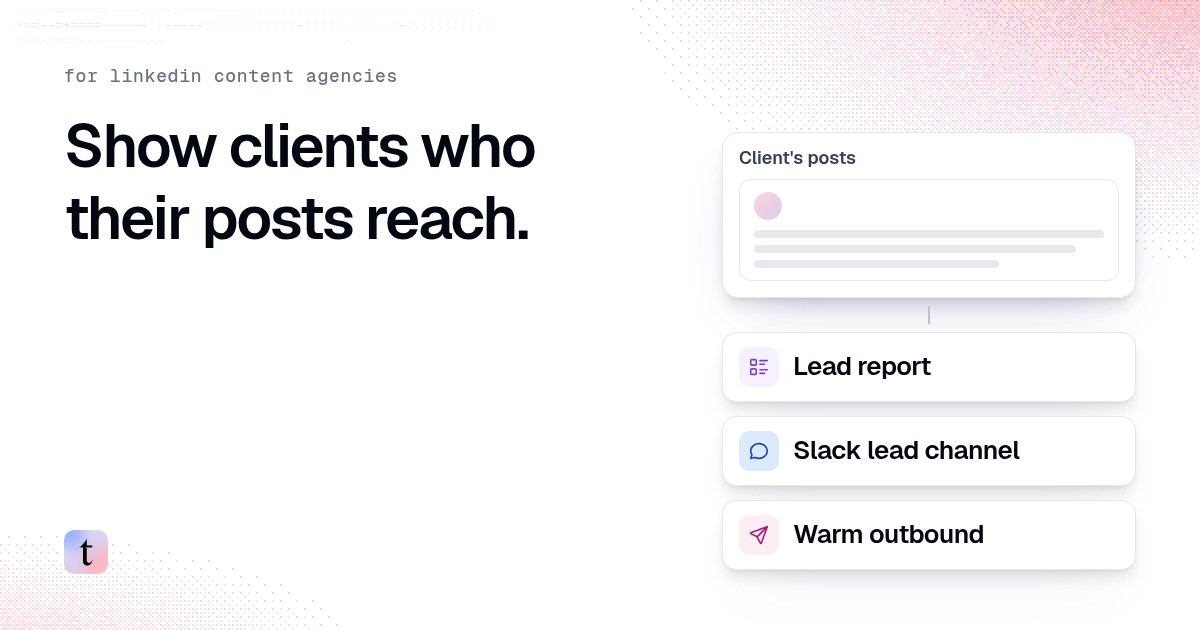
How LinkedIn content agencies use traxy: client lead reports, Slack alerts and warm outbound
Three things a LinkedIn content agency can add to a retainer: a monthly lead report, a Slack channel for the client's sales team, and warm outbound.
How to send a client's LinkedIn leads to their sales team in Slack
Connect Slack in the client's traxy workspace, save a shared view, route it to the client's channel, send a test and name one owner for every alert.