
traxy vs ZoomInfo: Engagement Signals vs. Contact Database Intelligence
Comparing zoominfo competitors? See how traxy engagement signals differ from ZoomInfo contact database intelligence for B2B pipelines.
TL;DR
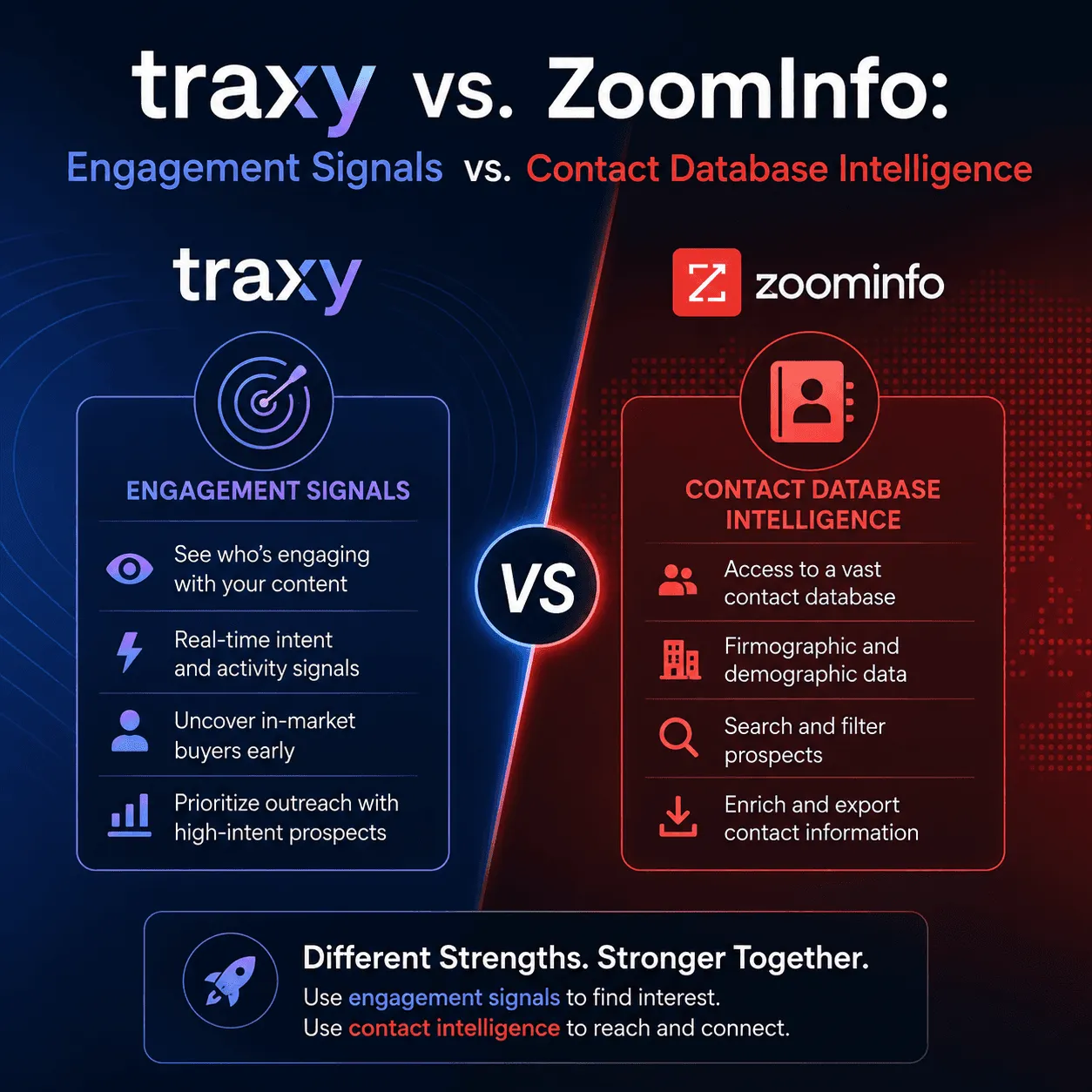
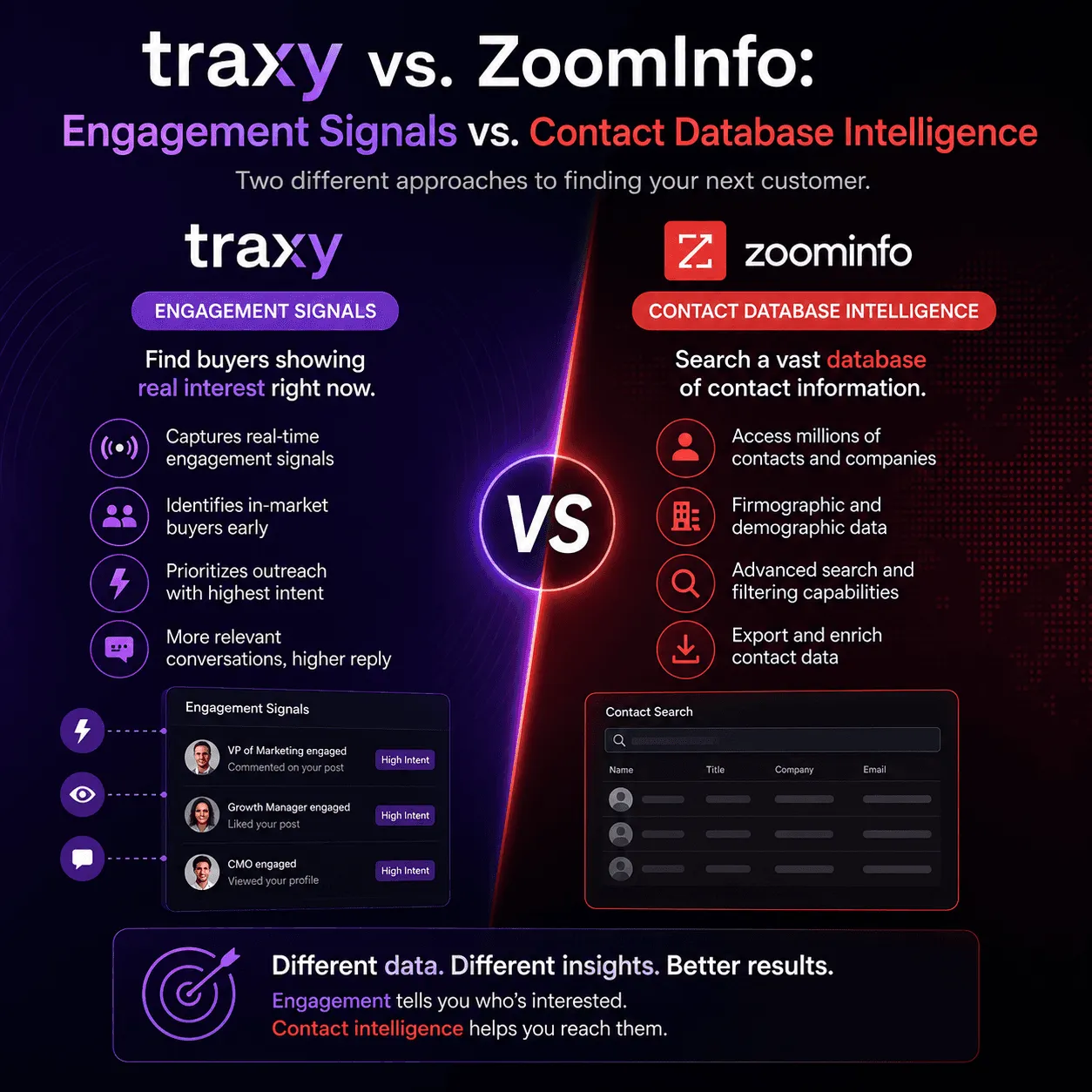
ZoomInfo is a contact database platform: it sells access to a large, static directory of firmographic and contact data that sales teams search and export. traxy is an engagement-signal platform: it watches who is actively engaging with your content and market in real time, then scores and routes those people as leads. If your bottleneck is "we don't have enough contacts," ZoomInfo-style databases solve that. If your bottleneck is "we have contacts but no idea who's actually in-market right now," an engagement-signal layer like traxy is the more direct fix — and the two approaches are complementary rather than mutually exclusive for most teams.
What Is ZoomInfo (and What Are ZoomInfo Competitors)?
ZoomInfo is a B2B contact and company database used by sales and marketing teams to find prospect information — names, titles, emails, phone numbers, and firmographic details like company size, industry, and technographics. It's one of the most widely cited platforms in the sales intelligence category, which is why searches for "zoominfo competitors" and "zoominfo alternatives" run in the thousands per month: teams are looking for platforms that fill the same seat, either at a different price point, with a different data model, or with capabilities ZoomInfo's database-first approach doesn't cover — most commonly, real-time buying-intent and engagement signals rather than static contact records.
The Problem With Contact-Database-Only Prospecting
A contact database answers "who exists and how do I reach them." It doesn't answer "who, out of everyone in that database, is actually paying attention to us right now." That gap is why sales teams that rely purely on database tools tend to see the same pattern: high list volume, low response rates, and reps spending time on outreach to people who show no signal of active interest. Contact data also decays — titles change, people switch companies, emails bounce — so the database needs continuous refresh just to stay usable, independent of whether the people in it are currently in-market.
How traxy's Engagement-Signal Approach Works
Instead of starting from a static list, traxy starts from activity: it monitors engagement around your content and market — the people commenting on, reacting to, or otherwise interacting with relevant posts and conversations — and evaluates each one against your Ideal Customer Profile (ICP) in real time. Leads are scored by ICP match and prioritized, so a rep's queue is made up of people who have both (a) shown a live signal of engagement and (b) fit the target profile, rather than a static export they have to qualify from scratch. Contact enrichment still happens, but it happens downstream of a real signal, not as the entire premise of the tool.
traxy Usage Data (Last 30 Days)
Real numbers from traxy's own signal-monitoring pipeline over a recent 30-day window:
45,338 leads surfaced from monitored engagement activity
79.9% average ICP match across all surfaced leads
1,570 leads qualified after scoring
79 leads flagged priority (highest-fit, highest-signal)
6,711 monitoring passes completed across tracked posts/content in the window
These are engagement-driven numbers, not database size — the relevant comparison isn't "how many contacts are in the system" but "how many of the people surfaced were both real and relevant," which is what the ICP-match and qualified-lead figures above speak to.
Fact-check note: figures above are traxy's own product usage data. Any ZoomInfo-side comparison figures (database size, pricing tiers, specific feature claims) should be pulled from ZoomInfo's current public pricing/product pages before publishing — none are asserted here without a verified source.
traxy vs ZoomInfo: Side-by-Side
traxy | ZoomInfo | |
|---|---|---|
Core model | Real-time engagement-signal monitoring | Static contact & company database |
Primary question answered | "Who is actively engaging right now?" | "Who exists and how do I reach them?" |
Lead prioritization | Automatic ICP-match scoring on live signals | Manual list-building and filtering |
Data freshness | Signal-driven, updates as activity happens | Periodic database refresh cycles |
Best fit | Teams with defined ICP wanting to act on live intent | Teams needing broad contact/firmographic coverage |
Typical use pattern | Signal-first, enrichment follows | Database-first, intent tools often added separately |
How to Evaluate traxy vs ZoomInfo for Your Team
Start with your actual bottleneck. If reps are short on contacts to reach out to at all, a database tool addresses that directly. If reps have plenty of contacts but can't tell who's actually in-market, that's a signal-detection gap, not a coverage gap.
Check how "intent" is defined. Database platforms increasingly bolt on intent features, but confirm whether that's third-party inferred intent (modeled from web-wide behavior) or first-party engagement with your own content and audience — they answer different questions.
Look at time-to-relevant-lead. A rep filtering a static database still has to qualify each contact. Ask how much of that qualification work is already done before the lead reaches a rep's queue.
Weigh data model against price. Contact databases are typically priced on seats and export/credit volume; signal-based tools are typically priced on monitored scope. Map that against your actual usage pattern, not just the list price.
Consider running both. These aren't mutually exclusive categories — plenty of teams use a database for coverage and a signal layer for prioritization. The evaluation question is which one is solving today's actual bottleneck first.
FAQ
Is ZoomInfo a competitor to traxy?
Not directly — ZoomInfo is a contact database platform, while traxy is an engagement-signal platform. Teams sometimes evaluate them as if they compete for the same budget line, but they solve different parts of the pipeline: database coverage versus live-intent prioritization.
What are the best ZoomInfo alternatives if I want database-style contact data?
If you specifically need a like-for-like contact database replacement, look for platforms built primarily around database coverage and accuracy. traxy isn't a database-replacement tool — it's built for teams whose core need is identifying who's actively engaging, not building bigger contact lists.
Why would a team choose engagement signals over a contact database?
Because the database question ("who exists") and the intent question ("who's paying attention right now") are different problems. Teams already sitting on a large contact base — from ZoomInfo or elsewhere — often find the bigger lever is knowing which of those contacts to prioritize today, which is what an engagement-signal layer adds.
Does traxy replace ZoomInfo entirely?
For most teams, no — they serve different functions. traxy focuses on real-time engagement signals and ICP-scored prioritization; a database tool focuses on contact coverage. Some teams run both, using the database for reach and traxy for knowing who to reach first.
How is "ZoomInfo pricing" relevant if traxy works differently?
Buyers researching "zoominfo pricing" are often really asking "what's the cheapest way to get usable prospect data" — worth clarifying during evaluation whether the goal is more contacts at a lower cost, or better prioritization of contacts already on hand, since those point to different tool categories entirely.
The Bottom Line
Contact databases and engagement-signal platforms are frequently shopped for in the same breath — "zoominfo competitors," "zoominfo alternatives" — but they're answering different questions about your pipeline. A database tells you who exists; a signal-driven platform like traxy tells you who's actually paying attention right now and how well they fit your ICP, so reps spend their time on the leads most likely to convert instead of qualifying a static list from scratch. If that prioritization gap — not raw contact volume — is what's slowing your pipeline down, it's worth seeing what traxy.ai surfaces from your own audience's real engagement before adding another database seat.
Keep reading

Best CRM for LinkedIn (2026): 8 LinkedIn CRM Integration Tools for B2B Sales
The best CRM for LinkedIn in 2026: folk, Breakcold, HubSpot, Pipedrive, Surfe, Attio and Salesforce compared on LinkedIn sync, pricing and buyer intent.
LinkedIn CRM vs. Sales Navigator: Key Differences
What is a LinkedIn CRM, how does it work, and how is it different from Sales Navigator? Compare CRM sync, buyer intent, Slack alerts and HubSpot routing.
traxy vs 6sense: Social Signals vs Predictive Intent
See how traxy compares to 6sense and other 6sense competitors: social engagement signals vs predictive intent data for B2B sales teams.