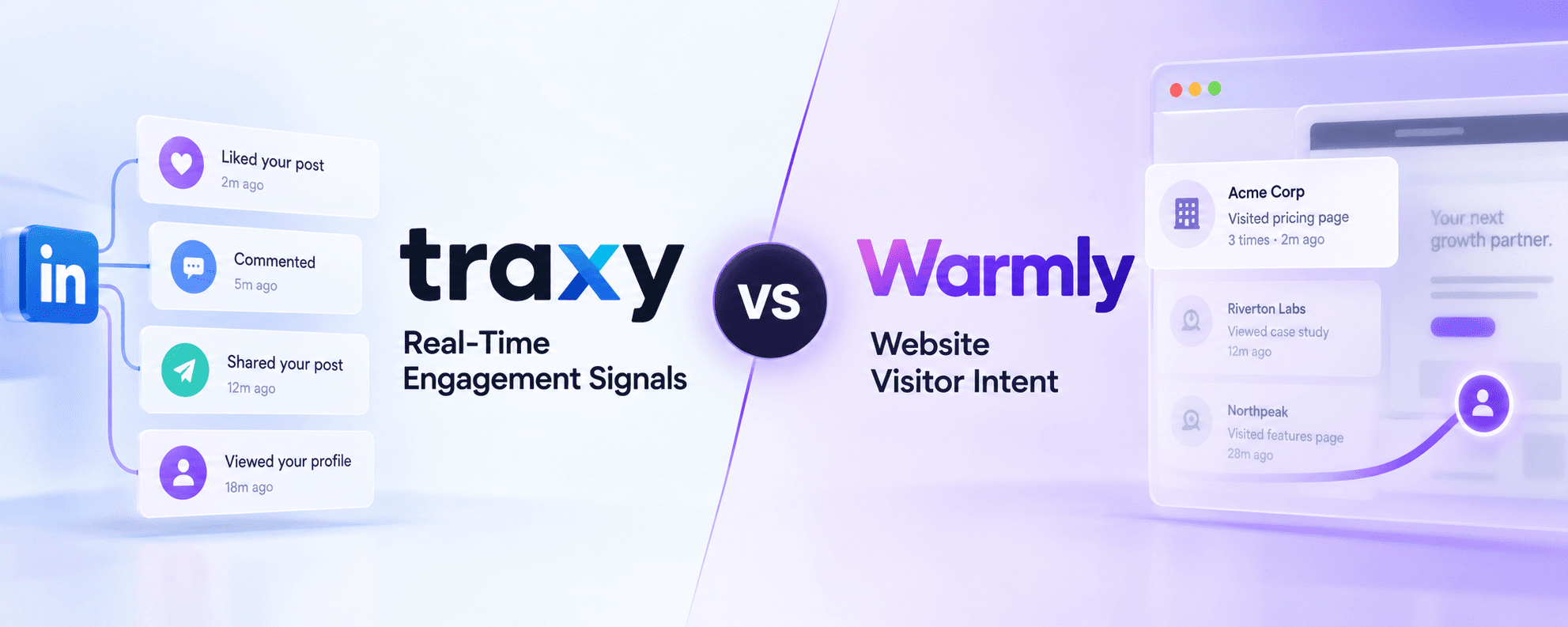
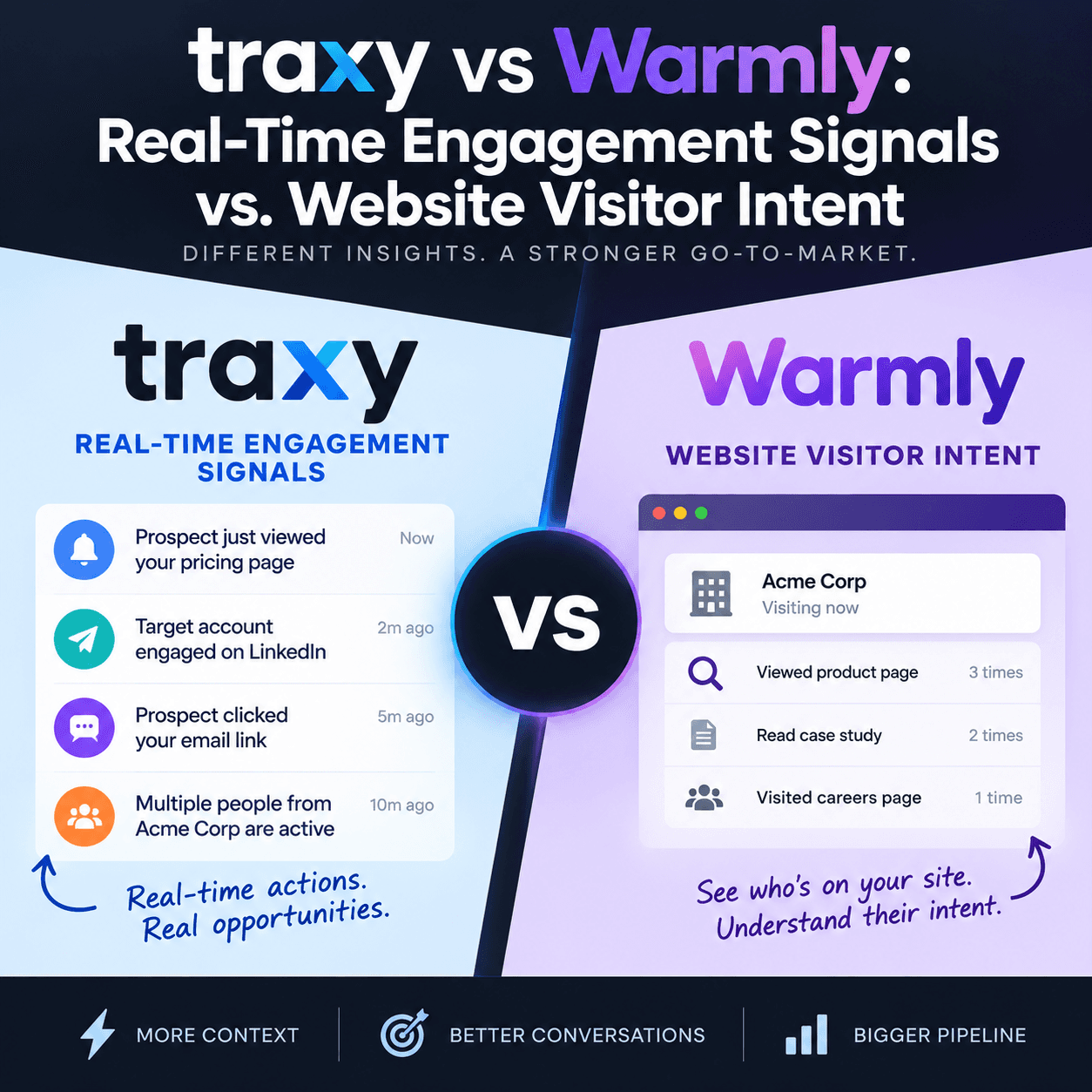
traxy vs Warmly: Real-Time Engagement Signals vs. Website Visitor Intent
TL;DR: Warmly and traxy both promise real-time buyer intent, but they start from different signals. Warmly builds its intent score around your own website traffic — who's on your pricing page right now — layered with LinkedIn ad engagement and third-party research data from Bombora. traxy builds its signal around LinkedIn activity itself: the likes, comments, and profile views that show someone is already paying attention to your brand before they ever land on your site. If your buyers show up on LinkedIn before they show up on your website, traxy surfaces that intent earlier. If your motion depends on inbound website traffic (demo requests, pricing-page visits), Warmly's stack is built for that.
What Is Warmly?
Warmly is a buyer-intent and website-visitor-identification platform. It combines three layers of signal — 1st-party website behavior (page views, return visits, pricing-page hits), 2nd-party social activity (LinkedIn ad engagement, profile views), and 3rd-party research data (Bombora topic surges, job postings, technographic changes) — into a single real-time score. When enough signals "converge" on the same account, Warmly's AI agents trigger engagement automatically: on-site chat, email sequences, rep Slack alerts, or ad retargeting.
What Is traxy?
traxy tracks LinkedIn engagement in real time — who's liking, commenting on, and viewing your posts and profile — and turns that activity into qualified, contact-level leads for your sales team. There's no pixel to install and no dependency on existing website traffic; the signal comes from the platform your buyers are already active on.
The Problem With Most Intent Data
Most intent-data tooling was built around two things: website traffic and third-party research reports. Both have a lag problem. Third-party data (Bombora surges, G2 comparisons) is typically batch-processed and reported at the company level — by the time a rep sees "Acme Corp is researching CRM software," the buying committee has often already narrowed its shortlist. Website-based signals solve the speed problem but only work if you have enough inbound traffic to score in the first place, which is a real constraint for teams selling into audiences that live on LinkedIn — agencies, B2B services firms, and sales tooling companies whose buyers are more likely to engage with a post than to visit a pricing page unprompted.
How Each Platform Actually Works
Warmly's model is signal convergence: a visit to your pricing page might score +25 points, a return visit +15, a content download +10. When multiple signal layers activate for the same account within the same window — say, a pricing-page visit plus a Bombora research surge plus a LinkedIn ad click — Warmly treats that as a buying indicator and triggers its AI agents to engage within, per its own documentation, seconds to minutes.
traxy's model starts one step earlier in the funnel. Instead of waiting for a prospect to land on your website, it monitors LinkedIn engagement — likes, comments, shares, profile views — against your defined ICP, attributes that activity to a named contact, and routes it to your sales team as a qualified lead. For teams whose buyers research and engage socially long before they ever visit a vendor's site, this catches intent that a website-only or pixel-based system would miss entirely.
traxy vs Warmly: Feature Comparison
traxy | Warmly | |
|---|---|---|
Primary signal source | LinkedIn engagement (likes, comments, profile views, shares) | Website behavior + LinkedIn ads + Bombora research data |
Requires a website pixel | No | Yes |
Attribution level | Person-level (LinkedIn identity) | Person-level (identified site visitors) |
Third-party research data (e.g. Bombora) | No — LinkedIn-native only | Yes |
Engagement trigger | Routes qualified contact to sales/CRM | AI agents auto-engage via chat, email, rep alert, or ad retargeting |
Best fit when | Buyers engage with your brand on LinkedIn before visiting your site | You have meaningful inbound website traffic to score |
Setup | Connect LinkedIn account(s) — no pixel | Install pixel, connect Bombora + LinkedIn Ads (~1 week per Warmly) |
Note: Warmly's own published pricing is listed as "growth-stage" without public tiers as of this writing — worth a fresh check before this comparison goes live, since that detail changes fastest.
How to Evaluate a Buyer-Intent Tool for Your Team
Identify where your buying signal actually happens first. If prospects engage with your LinkedIn content or profile well before they ever visit your website, a website-first tool will miss the earliest and often highest-intent window.
Check whether you have enough inbound traffic to make pixel-based scoring worthwhile. Website visitor identification is only as good as the volume of visitors you're identifying.
Decide if you need person-level or company-level attribution. "Acme Corp is in-market" is a weaker signal for a rep to act on than "Sarah Chen, VP Marketing at Acme, engaged with your last three posts."
Measure the lag between signal and outreach. Weekly batch reports and daily digests both lose ground against real-time signal-to-rep speed.
Weigh new infrastructure against what you already have. A pixel, ad account, and CRM workflow setup is a real lift; a tool that plugs into LinkedIn activity you're already generating is not.
FAQ
What is buyer intent data?
Buyer intent data is any signal that shows a person or company is actively researching or evaluating a solution in your category — website visits, content downloads, third-party research activity, or social engagement like LinkedIn likes and comments. The value of intent data depends on how quickly it reaches a rep and how precisely it's attributed to an actual person.
Are there AI-driven platforms that prioritize prospects based on real-time social intent signals?
Yes. traxy is built specifically around this: it monitors LinkedIn engagement in real time and scores prospects against your ICP as the engagement happens, rather than relying on a batch report. Warmly also operates in real time, but its primary signal layer is website and ad behavior rather than social engagement, with LinkedIn activity as a secondary (2nd-party) layer.
How reliable are LinkedIn engagement signals for predicting purchase intent?
LinkedIn engagement — comments, profile views, repeated post interaction — correlates with active research behavior because it requires deliberate action from a real, identifiable person, which makes it harder to misattribute than an anonymous website session. It's strongest as an early-stage signal that someone is paying attention to your category, and works best combined with ICP fit rather than used alone.
Which tools are alternatives to Common Room for contact-level social intent?
traxy and Warmly are both frequently considered alongside Common Room for contact-level intent, though they weight signals differently: Common Room and Warmly both blend multiple signal layers with website and product data, while traxy is built specifically around LinkedIn engagement as the primary source.
Does Warmly replace my existing intent data provider?
According to Warmly's own product documentation, it's designed to unify signals from existing sources (like Bombora) rather than fully replace them — it layers real-time scoring and automated engagement on top of the research data you already have. traxy, by contrast, doesn't require an existing intent-data stack to work, since its signal comes directly from LinkedIn activity.
Which One Fits Your Team?
Neither approach is wrong — they're built for different starting points. If your pipeline already runs on meaningful website traffic and you want to unify that with third-party research data and automated outreach, Warmly's signal-convergence model is built for exactly that. If your buyers are already telling you they're interested through LinkedIn activity — before a single pricing-page visit — that's intent sitting in plain sight, and it's the specific gap traxy is built to close.