TL;DR
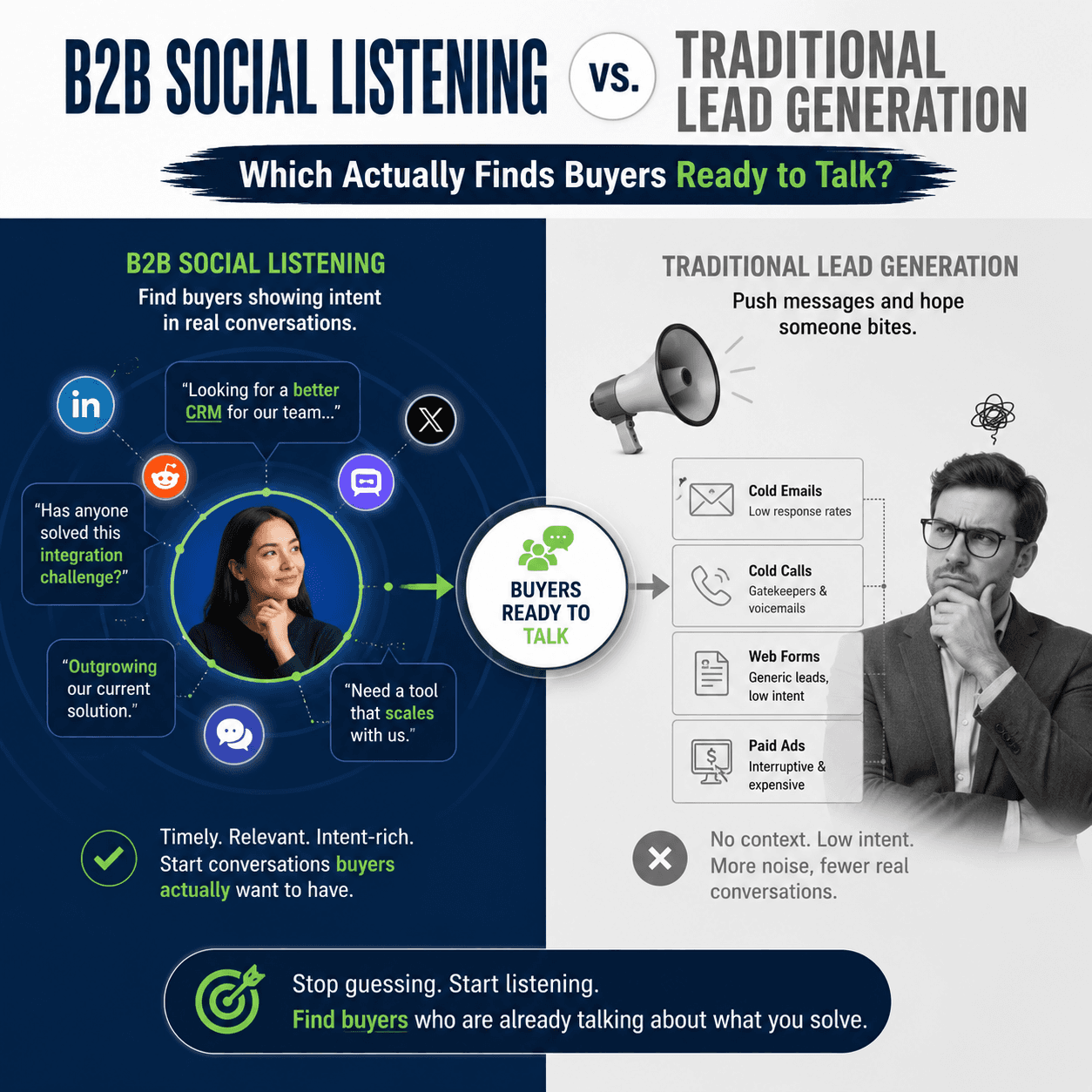
B2B social listening tracks who's actively engaging with relevant content right now — likes, comments, reposts, shares — and treats that behavior as a live buying signal. Traditional lead generation instead starts from a static list (a purchased database, a firmographic filter, a title-based search) and reaches out regardless of whether anyone on it has shown any recent interest. The practical difference shows up in response rates: industry benchmarks put average cold email reply rates around 3.1%, while outreach following a real engagement signal on LinkedIn runs closer to 10%. Social listening doesn't replace a database — it adds a timing layer that tells a team who to prioritize inside one.
What Is B2B Social Listening?
B2B social listening is the practice of monitoring public social activity — posts, comments, likes, shares, and mentions — to identify people and accounts showing active interest in a problem, category, or competitor, then using that activity to prioritize outreach. It's distinct from general "social media monitoring," which tracks brand mentions and sentiment for marketing and PR purposes. Social listening for sales narrows the lens to a specific job: catching the moment someone in your target market raises their hand, even informally, so a rep can reach out while the interest is still fresh.
In B2B specifically, that usually means watching LinkedIn activity around a competitor's posts, an industry topic, or a company's own content, then routing the people who engage — not just the people who fit a target list — into a prioritized queue for outreach.
The Problem: Static Lists Don't Know When Someone's Actually Interested
Traditional B2B lead generation is built around acquiring a list: buy a database, filter it by title and company size, and start reaching out. That approach answers one question well — "does this person fit our ICP?" — and answers a second, more important question not at all: "is this person paying attention to this problem right now?"
The result is a familiar pattern. A rep works through a list of a few hundred fit-matched contacts with no signal of active interest, and the vast majority never respond, because most of them aren't thinking about the problem this week. Cold email benchmark data backs this up directly: the average reply rate across B2B cold email campaigns in 2026 sits around 3.1%, with the bottom 10% of senders getting under 0.5% and even top-decile senders topping out around 8–12% — and that's with a verified, well-targeted list. A purchased or unverified list performs meaningfully worse; industry data puts reply rates on purchased lists as low as 0.8%, roughly a sixth of what a verified list gets.
None of this means fit-based lists are worthless — they still define who's in-market. What it means is that fit alone can't tell a rep when to reach out, and "when" turns out to matter almost as much as "who."
What Actually Changes With Social Listening
Social listening flips the sequencing. Instead of starting with a list and hoping for a response, it starts by watching for behavior — a comment on a competitor's post, a like on a piece of category content, a repost with commentary — and only then checks whether the person behind that behavior fits your ICP. The signal comes first; the fit filter comes second. That ordering is why the outreach that follows tends to land differently: it's not "we found your name on a list," it's "we saw you engaging with this exact topic."
The mechanics are straightforward. A social listening tool monitors a defined set of sources — a competitor's LinkedIn page, a set of industry hashtags or keywords, a company's own posts — for engagement events. Each event gets attached to the profile that generated it, enriched with firmographic and contact data, and scored for fit and recency before it ever reaches a rep. What a rep receives isn't a raw list anymore; it's a short, ranked queue of people who are both a fit and demonstrably paying attention right now.
This is also where social listening and traditional lead generation stop being competitors and start being complements. A fit-based list still defines the addressable market. Social listening decides which small slice of that market is worth a rep's time this week — and, just as usefully, it surfaces people who wouldn't have been on any purchased list at all, because they engaged with a competitor's post rather than matching a firmographic filter.
What the Industry Data Shows
Response-rate data is the clearest place the gap between the two approaches shows up. Reported 2026 benchmarks put average cold email reply rates at roughly 3.1%, while B2B outreach that follows a real LinkedIn engagement signal — a like, comment, or share on relevant content — runs closer to 10%, based on aggregated outbound benchmark data comparing channel performance. That's roughly a 2x difference in the rate at which a message gets a response, without changing who's on the receiving end — the difference is entirely in whether the outreach follows a real, recent behavior or not.
Personalization narrows but doesn't close that gap on its own. Highly personalized cold email can lift reply rates to around 18%, roughly double the 9% seen on generic cold email — but that level of personalization is expensive to do at scale without something to personalize around. A real engagement signal is exactly that raw material: "I saw you comment on [topic]" is a stronger, cheaper-to-produce personalization hook than research assembled from a firmographic profile alone.
traxy's own platform data adds a live, verified data point here, even though it comes from a lead-qualification study rather than a response-rate study: across a trailing 30-day window, monitoring 3,332 posts surfaced 38,784 raw engagement-based leads, of which 1,521 (roughly 3.9%) cleared qualification criteria and 76 reached priority (rep-ready) status — with qualified leads averaging an 80% ICP match. That funnel shape, a small high-fit slice carved out of a large raw-signal pool, is what a working fit-and-recency filter is supposed to produce on top of any signal source, and it lines up with the industry pattern above: raw signal volume isn't the constraint on social listening, filtering it well is.
Social Listening vs. Traditional Lead Generation: Side-by-Side
Traditional Lead Generation | B2B Social Listening | |
|---|---|---|
Starting point | A static list: purchased database, firmographic filter, title search | Live engagement activity: likes, comments, reposts, mentions |
Primary question answered | "Does this person fit our ICP?" | "Is this person paying attention to this problem right now?" |
Typical reply rate | ~3.1% average cold email; as low as 0.8% on purchased lists | ~10% following a real LinkedIn engagement signal |
Personalization hook | Built from firmographic research (title, company, industry) | Built from the specific content the person engaged with |
Freshness | List can be weeks or months old by the time it's worked | Signal is hours or days old when acted on |
Best at | Defining and sizing the addressable market | Timing outreach to real, current interest |
Weak point | No sense of timing; treats every fit-matched contact identically | Needs a fit filter layered on top, or it's just noisy attention data |
Neither column is a complete answer on its own. A list with no signal layer wastes rep time reaching people who aren't paying attention. A signal feed with no fit filter buries a rep in engagement from people who were never going to buy. The strongest setups run social listening as a prioritization layer on top of a fit-defined addressable market, not as a replacement for having one.
How to Evaluate Whether Social Listening Fits Your Motion
Check how concentrated your buyers are on social platforms. Social listening works best when your target buyers are actually active and vocal on LinkedIn (or another monitored platform). If your ICP rarely posts or engages publicly, there's less signal to listen for, and a fit-based list will carry more of the weight.
Look at how stale your current lists get before they're worked. If reps are routinely calling into lists that are weeks old, a listening layer that surfaces same-day activity will likely move the needle more than adding yet another data source to the list itself.
Confirm someone owns triage, not just collection. Raw engagement events without a fit-and-recency filter just become a second unworked list. The value is in the qualification layer between "signal fired" and "rep reached out," not in the signal feed by itself.
Weigh signal type, not just signal volume. A comment or a repost with commentary carries more intent than a passive like — a listening setup that treats all engagement types the same will over-prioritize low-intent activity.
Decide whether you're replacing or layering. Social listening rarely replaces the need for a defined, fit-matched target list — it decides which part of that list to work first. Teams expecting it to eliminate list-building entirely tend to be disappointed; teams using it to sequence an existing list tend to see the reply-rate lift.
FAQ
Is social listening the same as social media monitoring?
No. Social media monitoring is generally a marketing and brand function — tracking mentions, sentiment, and share of voice for a company's own brand. Social listening for sales narrows that same underlying activity (posts, comments, likes) to a specific commercial purpose: identifying individual buyers showing active interest so a rep can prioritize outreach to them.
Does social listening replace traditional lead generation?
No — it complements it. A fit-based list or database still defines who's in your addressable market. Social listening adds a timing and prioritization layer on top, surfacing which people in (or adjacent to) that market are showing real interest right now, rather than treating every fit-matched contact as equally worth a rep's time.
Why do LinkedIn engagement signals get better response rates than cold email?
Outreach that references a specific, recent action the person actually took — commenting on a post, engaging with a competitor's content — reads as relevant and well-timed rather than generic, which is the same reason heavily personalized cold email also outperforms generic cold email. A real engagement signal effectively hands a rep that personalization hook for free.
What's the difference between social listening and a "buying signal" tool more broadly?
Social listening is one category of buying signal, focused specifically on public social engagement. Broader buying-signal or intent-data tools also incorporate other behaviors — website visits, content downloads, third-party intent data from research consumption elsewhere on the web. Social listening is narrower but tends to be higher-confidence, since the engaging person is identifiable rather than inferred from anonymized account-level activity.
Is social listening worth it for a small sales team without dedicated SDRs?
It can be, if the setup does the fit-and-recency filtering automatically rather than handing a rep a raw activity feed to sort through manually. For a small team, the value is less about volume and more about making sure the handful of hours available each week go toward the few people who are both a fit and actively engaged, instead of being spread evenly across a cold list.
Traditional lead generation will keep defining who's in the addressable market — that part isn't going away. But treating every name on a list as equally worth a rep's attention, regardless of whether anyone's actually paying attention this week, is the gap social listening is built to close, which is the specific problem traxy focuses on: turning real-time LinkedIn engagement into a prioritized, enriched queue instead of another list to work cold.
Related reading
Best Social Listening Tools for B2B Sales Prospecting in 2026
How to Qualify B2B Leads From Buying Signals: A Step-by-Step Framework (2026)