
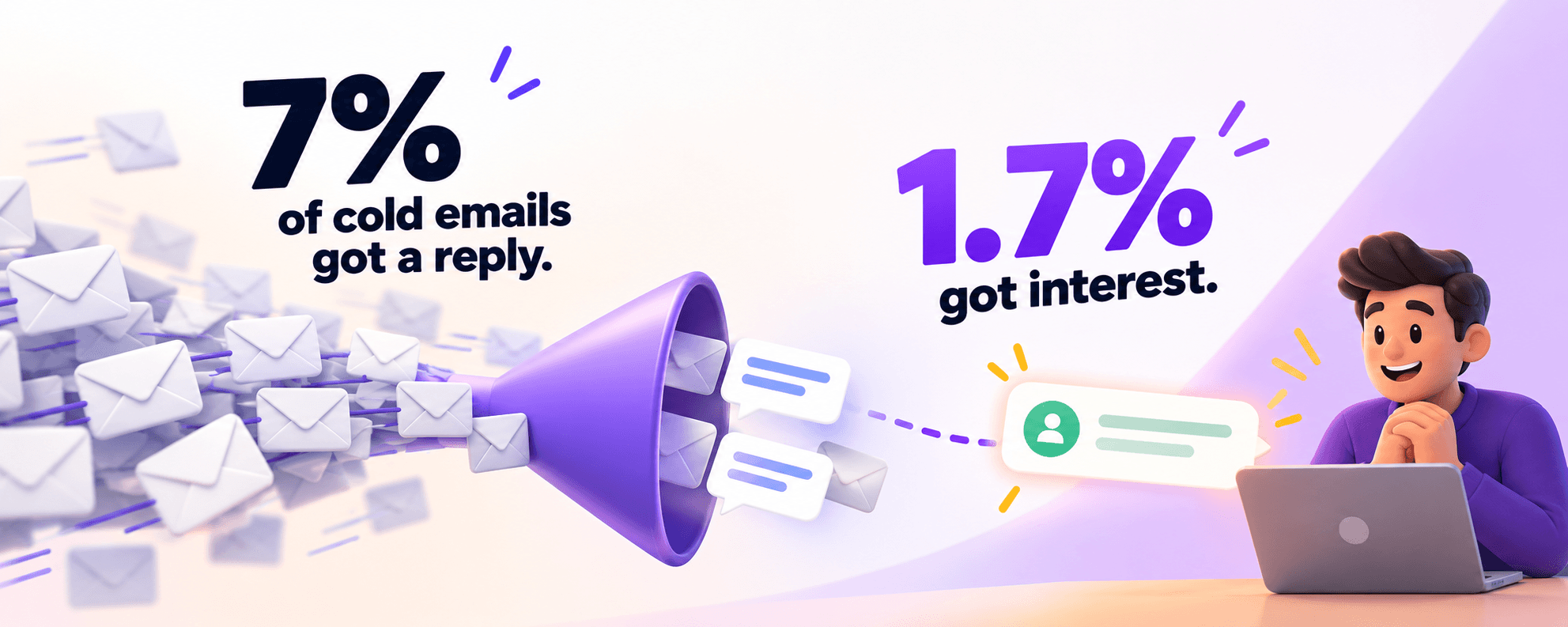
7% of Cold Emails Got a Reply. 1.7% Got Interest — New Outbound Benchmarks Separate Activity From Pipeline
A 7.0% cold email response rate sounds healthy. Only about 1.7% of those emails produced genuine interest. That gap is the headline finding of Konsyg's "B2B Outbound Benchmarks 2026," published October 1, 2026, which analyzed the outsourced sales firm's own campaigns across the US, UK and Europe.
The numbers
Konsyg reviewed 56,604 calls and 87,015 emails from its campaigns, spanning cold calling, email, LinkedIn and multi-channel sequences. Key figures from the report:
Calls: 56,604 calls produced 23,849 recorded connections — a 42.1% observed connection rate.
Email: 87,015 emails generated 6,099 responses — a 7.0% response rate.
Interest: across campaigns with comparable data, the observed interest rate was about 1.7%.
Meetings: three published appointment-setting programs produced 146 qualified appointments, at a reported cost per sales opportunity of $460–$520.
Konsyg is careful to flag variance. One campaign targeting the US, UK, EU and APAC logged a far lower connection rate, and the report contrasts its 42.1% with Belkins' 2026 study of more than 175,000 cold calls, which reported a 9.9% connection rate per dial. Definitions differ — "connection" in an agency's managed lists is not the same as a raw dial — so read the figures as a campaign sample, not an industry average.
Replies are not interest; booked is not held
The report's most useful contribution is methodological. Konsyg argues teams should keep replies and interest as separate metrics, because a response rate counts "not now" and "remove me" alongside real conversations.
It makes the same point about meetings: "A campaign that books 40 meetings and holds 36 is behaving very differently from one that books 40 and holds 22. The top-line number is identical. The result is not." Its recommendation is to report show rate — meetings held divided by meetings booked — next to every meeting count.
The report also cites external UK data in which email-only outreach produced a 1.4% reply rate, rising to 3.2% when a LinkedIn connection was added and 4.8% when email, LinkedIn messaging and voice notes were combined.
What it means for SDR teams
Every number in the funnel gets better when the person on the other end already knows who you are. The multi-channel lift Konsyg cites is a familiarity effect: a LinkedIn touch makes the email less cold.
The higher-leverage version is to start with people who have already raised their hand. A prospect who engaged with your content this week is more likely to reply with interest and more likely to show up to the meeting. Intent signals on LinkedIn tell you who those people are; a full guide to B2B buyer intent signals covers how to rank them.
traxy shows which ICP buyers are engaging with your LinkedIn content and routes them to your reps in Slack or your CRM, so outreach starts warm. Start free with 200 credits a month.
Sources: Konsyg, "B2B Outbound Benchmarks 2026: What Konsyg Is Seeing Across US, UK and European Campaigns" (October 1, 2026); Belkins 2026 cold calling study, as cited by Konsyg.