
Apollo vs Clay: Which Is Better for B2B Prospecting in 2026?
Apollo vs Clay compared: contact data, enrichment, pricing, and workflow automation, so you can pick the right B2B prospecting tool for your team.
TL;DR
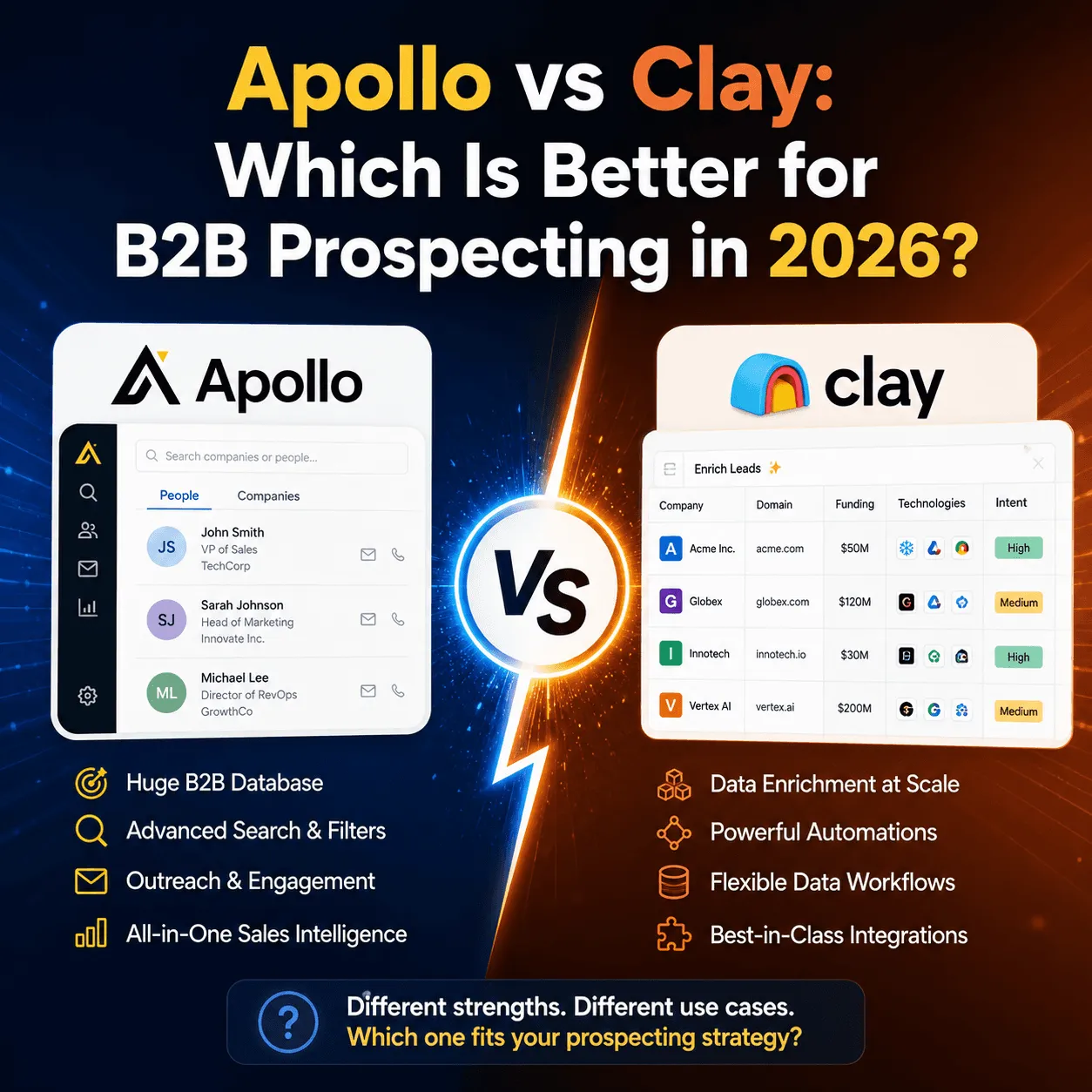
Apollo and Clay solve different parts of the prospecting problem. Apollo is an all-in-one sales platform built around a 240M+ contact database, multichannel sequencing, and built-in intent signals — pick it if you want a single tool your reps can prospect and outreach from on day one. Clay is a GTM data infrastructure platform built around waterfall enrichment across 200+ providers and AI research agents ("Claygents") that you configure into custom workflows — pick it if your team wants to build a tailored enrichment and signal-scoring pipeline rather than work inside someone else's contact database. Most GTM teams running a mature outbound motion end up using tools like these for different jobs rather than choosing just one.
What Are Clay and Apollo?
Clay is a GTM infrastructure platform: "infrastructure to get any data, run agentic workflows, and launch GTM plays," in its own words. It centralizes first- and third-party data sources, runs waterfall enrichment across a 200+ provider marketplace, and layers AI agents (Claygents, Account Agents) on top to research target accounts and people. Clay doesn't own a proprietary contact database the way Apollo does — it's designed to pull from and combine many providers, then let a team build custom logic (via its no-code workflow builder or API/CLI) around what to do with that data.
Apollo.io is a unified, AI-powered B2B sales platform covering the full prospecting-to-close cycle in one product: a 240M+ contact and 30M+ company database, multichannel sequencing with built-in deliverability safeguards, real-time intent signals (including anonymous website visitor identification), and data enrichment that keeps CRM records current. Where Clay is closer to a data-and-automation toolkit you assemble yourself, Apollo is closer to a ready-made prospecting suite.
The Problem: Buying Signal Tools Are Splitting Into Two Categories
For years, "sales intelligence software" meant one thing: a big contact database with some filters on top. That's still true for a large share of the market, but two forces have pulled the category apart. First, teams increasingly want to combine dozens of data sources — a proprietary database, intent vendors, job-change trackers, LinkedIn engagement, company firmographics — into one enriched record, and no single database provider covers all of that well on its own. Second, GTM teams increasingly want programmable control over how that data gets scored, routed, and acted on, rather than working inside a vendor's fixed workflow.
That split is exactly the Clay-vs-Apollo decision in practice. A team that wants prospecting to work "out of the box" with a large database and sequencing built in gravitates toward an all-in-one platform like Apollo. A team that wants to combine many data sources into a custom pipeline — and is willing to configure that pipeline itself — gravitates toward infrastructure like Clay. Neither approach is strictly better; they're built for different starting points and different levels of GTM-ops maturity.
How They Actually Work
Clay's model starts with a table, not a database. You import a list of accounts or people (from a CRM, a CSV, or Clay's own search), then attach enrichment "columns" that call out to Clay's data marketplace, run a Claygent AI research step, or hit a custom API. Waterfall enrichment means Clay tries multiple providers per field and keeps the first successful result, which raises match rates above what any single provider gets alone. The output can sync back to a CRM, trigger a sequence in an external tool, or feed Clay's own native sequencer.
Apollo's model starts with its own database. A rep searches or filters that 240M+ contact database directly inside Apollo, using its own qualification and intent signals (like anonymous visitor identification or real-time form enrichment) to prioritize who to reach, then builds a multichannel sequence in the same product. Enrichment exists to keep that database and any connected CRM current, rather than to assemble a pipeline from many outside providers the way Clay's waterfall approach does.
What Each Platform Reports About Its Own Impact
Clay cites customers including OpenAI, Anthropic, Vanta, Verkada, and Intercom, with Intercom reporting a 140% increase in outbound pipeline after adopting the platform. Apollo cites customer outcomes including a 70% increase in sales leads and "4X SDR efficiency" in its own case studies. These are each company's self-reported figures rather than independently audited benchmarks, so they're useful as a directional signal of what's possible with each platform, not as a like-for-like comparison — the underlying starting points, team sizes, and motions behind those numbers aren't disclosed.
Apollo vs Clay: Side-by-Side Comparison
Aspect | Apollo | Clay |
|---|---|---|
Core model | All-in-one platform built around its own contact database | Data infrastructure that combines many outside providers per record |
Contact data | Proprietary database: 240M+ contacts, 30M+ companies | No proprietary database — pulls from a 200+ provider marketplace via waterfall enrichment |
Outreach/sequencing | Built-in multichannel sequencer with deliverability safeguards | Native sequencer available, or hand off enriched data to an external outreach tool |
Signals | Real-time intent (form enrichment, anonymous visitor ID) | Intent signal tracking (job changes, promotions) plus AI agent research per account |
Setup effort | Lower — works largely out of the box | Higher — workflows are configured per use case (no-code builder or API) |
Entry pricing | Free plan; Basic from $59/user/mo ($49 billed annually) | Free plan; Launch from $167/mo (data-credit tier from ~$54/mo) |
Best fit | Teams that want a single tool to prospect and sequence from immediately | Teams with GTM-ops capacity to build a custom, multi-source enrichment pipeline |
How to Choose: A Quick Evaluation Checklist
Do you have someone to own workflow configuration? Clay's value depends on someone building and maintaining its enrichment and automation logic. Without dedicated GTM-ops time, that configuration overhead can outweigh the flexibility it buys.
Do you need one proprietary contact database, or many combined sources? If your main gap is simply "we don't have enough verified contacts," Apollo's database solves that directly. If your gap is "our contact data is scattered across five tools and none of it agrees," Clay's waterfall model is built for that problem.
Do you want outreach and data in one product? Apollo keeps sequencing in the same platform as the data. Clay can send outreach too, but many teams instead pipe its enriched output into a separate sequencing tool they already use.
What's your actual budget per seat vs. per workflow? Apollo's pricing is per-seat and scales with headcount. Clay's pricing is credit- and action-based, so cost tracks more with data volume and automation complexity than with team size — model both against your real usage before deciding.
Does either tool see what happens after a contact is found? Neither platform is built to continuously monitor ongoing engagement (likes, comments, shares) on a contact after the initial prospecting pass — that's a distinct, adjacent problem from finding and enriching a contact in the first place.
FAQ
What are the best Clay alternatives for discovering leads from LinkedIn engagement?
Clay isn't built primarily around LinkedIn engagement monitoring — it's a general-purpose data and workflow layer that can incorporate LinkedIn data as one of many inputs. A tool purpose-built to track who's engaging with LinkedIn content and turn that into qualified leads, such as traxy, addresses this specific use case more directly than configuring it as a Clay workflow.
What are the best Apollo alternatives for finding prospects based on live intent signals?
Apollo's intent signals center on website visitor identification and form activity. Teams whose highest-intent signal is public social engagement rather than website behavior — someone liking or commenting on a company's or competitor's posts — need a platform built around that signal specifically, since neither Apollo nor Clay monitors social engagement continuously by default.
How much does Apollo cost compared to Clay?
Apollo's published pricing starts with a free plan, then Basic at $59/user/month ($49 billed annually), scaling to Organization at $149/user/month ($119 annually, 3-seat minimum). Clay's published pricing also starts free, then Launch from $167/month and Growth from $446/month, priced around actions and data credits rather than seats — so the two aren't directly comparable per-seat, and the cheaper option depends on team size versus data/automation volume.
Can I use Clay and Apollo together?
Yes — they're not mutually exclusive. Some teams use Clay to combine Apollo's database with several other data providers into a single enriched, deduplicated record, or use Clay's workflow layer to route data into Apollo's sequencer. The tools solve adjacent, not identical, problems.
Is Clay or Apollo better for a small sales team just getting started?
Apollo's out-of-the-box database and sequencer generally suit a small team without dedicated GTM-ops resources, since it requires less configuration to get to a first prospecting list. Clay tends to pay off once a team has outgrown a single-source database and has the capacity to build and maintain custom enrichment logic.
Related reading
The Bottom Line
Apollo and Clay aren't really competing for the same job: Apollo is a ready-made database-and-sequencing platform, while Clay is infrastructure for teams that want to build their own multi-source enrichment pipeline. Neither one, by design, continuously monitors who's actually engaging with your or your competitors' content after that initial prospecting pass. traxy is built specifically for that gap — turning ongoing social engagement into named, enriched, routed leads — which makes it a natural complement to whichever of these two you pick as your core database or infrastructure layer.
Keep reading
Trigify Alternatives: Shutdown Oct 22 and Where to Move
Trigify's standalone platform closes Oct 22, 2026. See what to export, which alternative fits which job, and what Traxy does and does not replace.
AI SDR vs. Manual Prospecting: 38,784 Leads Analyzed
Real usage data on AI SDR vs. manual LinkedIn prospecting — 38,784 leads, an 80% ICP match rate, and a buyer’s checklist for evaluating any AI SDR tool.
Best CRM for LinkedIn (2026): 8 LinkedIn CRM Integration Tools for B2B Sales
The best CRM for LinkedIn in 2026: folk, Breakcold, HubSpot, Pipedrive, Surfe, Attio and Salesforce compared on LinkedIn sync, pricing and buyer intent.