
Buyer Intelligence vs. Intent Data: What’s the Difference (and Why B2B Sales Teams Confuse Them)
Buyer intelligence vs. intent data: what the difference actually is, why sales teams mix them up, and how to tell which one your tools give you.
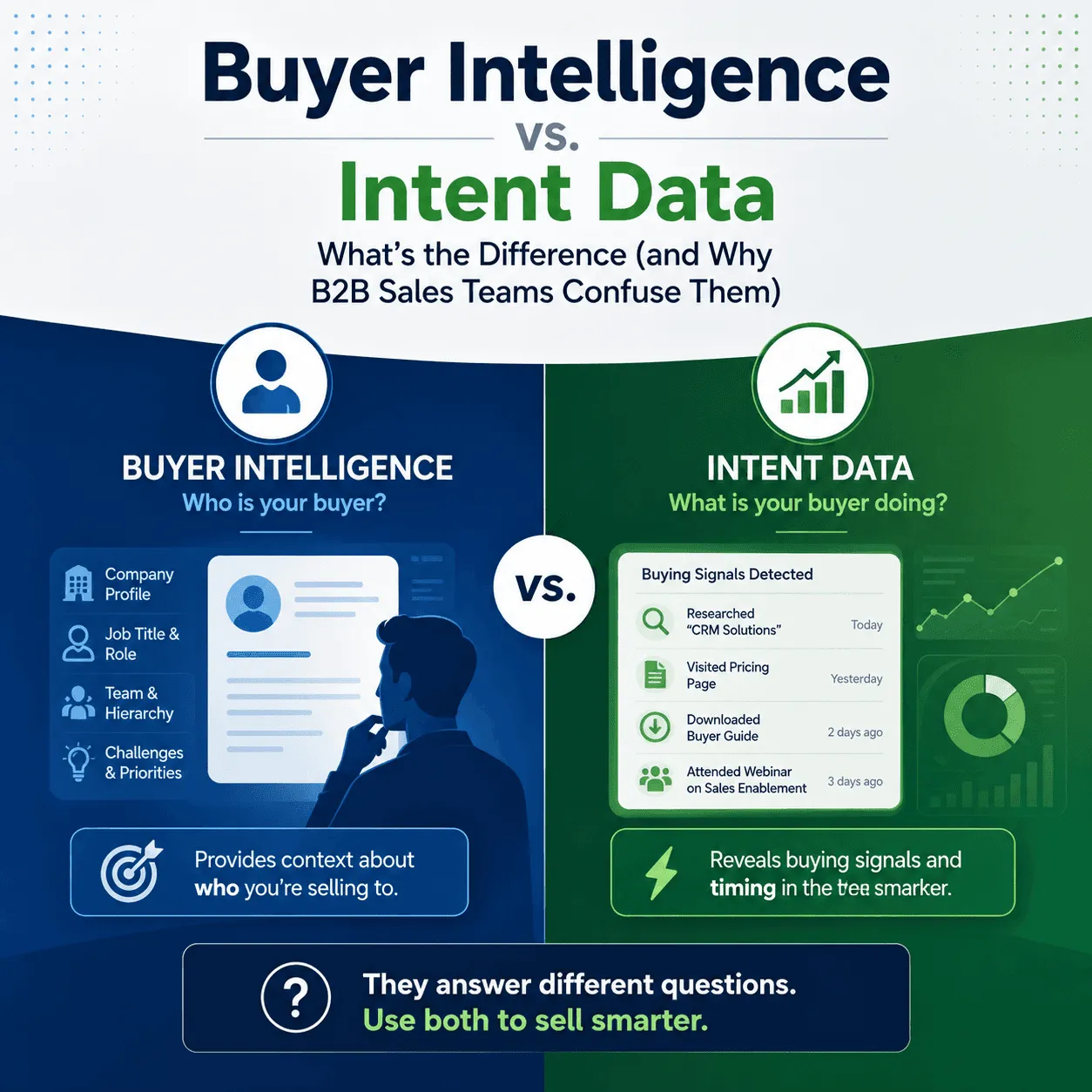
Buyer intelligence and intent data are not the same thing, even though the terms get used interchangeably in vendor marketing. Intent data tells you that someone at a company is researching a topic — an anonymous, account-level signal that can't tell you whether it's the economic buyer or an intern rage-clicking G2 at midnight. Buyer intelligence goes further: it connects firmographic, behavioral, technographic, and relationship signals into a real-time view of specific, named people — who they are, what changed, and why it matters right now. If your tooling can only tell you an account "looks hot," that's intent data. If it can tell you a VP just joined from a customer, three of their new colleagues opened product workspaces, and pricing-page visits spiked this week, that's buyer intelligence.
What Is Buyer Intelligence?
Buyer intelligence is the practice of combining multiple signal types — firmographic data (company size, industry, funding stage), behavioral data (website visits, content engagement, social activity), technographic data (what tools a company already runs), and relationship data (who on your team already knows someone there) — into a single, real-time view of the actual people involved in a buying decision.
The term has picked up momentum as sales ops and RevOps teams push back on tool sprawl: buying yet another point-solution intent vendor that reports the same vague, account-level signal as the last one. Buyer intelligence is positioned as the answer to that sprawl — not another isolated signal source, but a synthesis layer that connects the signals a team already has access to into something a rep can act on without stitching it together by hand.
The distinction matters because "intent data" and "buyer intelligence" get used as if they're synonyms in a lot of vendor copy, but they describe two different things: one is a category of raw signal, the other is a layer of context built on top of — and beyond — that signal.
The Problem: Intent Data Tells You Something Happened, Not Who or Why
A typical intent data alert reads something like: "Someone at Acme Corp is researching project management software." That's usually the entire signal. It doesn't say who — the actual economic buyer, an intern doing early-stage research, or someone comparing tools for a completely unrelated reason. It doesn't say why now, or which of the six to ten people typically involved in a modern B2B deal is the one worth calling.
That gap shows up constantly in how sales ops teams describe their own stacks: adding another intent vendor often just adds another anonymous "this account looks hot" alert to a pile of similar alerts, without making it any clearer who to contact or what to say to them. It's a familiar failure mode — a list of accounts "showing intent" that requires a rep to do a manual research pass before they can even draft an email, which undercuts a large part of the reason to buy signal data in the first place.
What Actually Changes: From Isolated Signal to Connected Context
Buyer intelligence changes the unit of output. Instead of a single signal type reported in isolation ("this account visited your pricing page"), it correlates multiple signal types about the same real people and surfaces the combination: a specific VP who just joined a customer account, several of their new colleagues creating product workspaces, and a spike in pricing-page visits from that account, all inside the same week.
That shift — from one anonymous data point to a connected, person-level narrative — is what turns "this account looks hot" into "here's who to call, and here's what to say." It requires pulling from more sources than any single intent feed typically covers (firmographic databases, technographic scanners, engagement tracking, relationship graphs) and resolving all of it back to named individuals instead of an anonymized account-level score.
For engagement-based platforms specifically, this means the raw signal — someone liking, commenting on, or sharing a relevant LinkedIn post — only becomes buyer intelligence once it's matched against firmographic and role data to confirm the person fits an ICP, and weighed alongside other context (do other signals point to the same account right now?) rather than treated as a standalone alert.
The Data: What This Looks Like at the Platform Level
To make the distinction concrete: across a recent 90-day window, traxy's platform processed engagement activity from thousands of monitored LinkedIn posts and surfaced over 45,000 leads from that activity, with an average ICP match near 80% — a check that's only possible because each lead resolves to a named person, not an anonymous account-level signal. Of that volume, roughly 1,500 reached a Qualified tier and under 100 were flagged Priority for immediate outreach.
That funnel — from raw engagement, to a named and ICP-matched person, to a qualified shortlist — is the practical difference between an intent signal and buyer intelligence: one produces a list of accounts to investigate, the other produces a person, a reason, and a moment to act.
Buyer Intelligence vs. Intent Data
Aspect | Intent Data | Buyer Intelligence |
|---|---|---|
What it tells you | An account is showing interest in a topic | A specific named person, with context on why now |
Signal sources | Usually one type — third-party content co-op or web-traffic inference | Multiple correlated sources: firmographic, behavioral, technographic, relationship |
Resolution | Account-level; the individual is typically anonymous | Person-level; resolved to a named, ICP-matched individual |
Output | A list of accounts "showing intent" | A ranked list of specific people with a reason to reach out |
Best for | Broad account-based prioritization | Direct outreach and rep-level action |
Most teams don't need to pick one permanently. Intent data is a reasonable filter for which accounts deserve attention; buyer intelligence is what turns that filter into someone a rep can actually call.
A Checklist: Is Your Tooling Giving You Intelligence or Just Data?
Can you name the person, not just the account? If the output is a company name with no individual attached, it's intent data, regardless of what the vendor calls it.
Does it correlate more than one signal type? A single-source feed (only web traffic, or only firmographic match) is a data source; combining several into one view is what makes it intelligence.
Is the signal fresh enough to act on before the moment passes? Batch-reported, weekly-refresh intent data is frequently stale by the time a rep sees it.
Does it explain "why now," not just "what happened"? A useful buyer-intelligence output pairs the signal with context — a role change, a related action from a colleague, a timing cue — not just a raw event.
Does it route into a workflow your reps already use? Intelligence that lives in a dashboard nobody checks is functionally the same as no intelligence at all.
FAQ
Which sales intelligence tools identify active buyers instead of static contacts?
Tools built around continuously monitoring behavioral and relationship signals — rather than maintaining a static contact database — identify buyers based on what they're doing right now. A static database tells you a person exists; a buyer-intelligence layer tells you they're actively engaged and worth prioritizing today. For a framework to compare these tools, see our guide to evaluating b2b sales intelligence.
Which buyer intent tools work best for contact-level rather than account-level signals?
Platforms that resolve engagement (likes, comments, shares, profile activity) to a named, ICP-matched individual — instead of aggregating anonymized traffic to a company-wide score — are built for contact-level rather than account-level signal.
What tools help RevOps teams route social intent signals into existing workflows?
Tools that expose buyer intelligence as structured, person-level records — a name, a role, a reason, a timestamp — are easier to route into a CRM or sequencing tool than an aggregated account-level score, since the destination system needs a specific contact to attach the signal to.
How reliable are LinkedIn engagement signals for predicting purchase intent?
Engagement signals are a strong leading indicator when paired with ICP fit — a decision-maker who matches your target profile engaging with relevant content is a meaningfully stronger signal than an unqualified person doing the same thing. Reliability comes from combining the signal with fit data, which is the core move that separates buyer intelligence from raw intent data.
Are there AI-driven platforms that prioritize prospects based on real-time social intent signals?
Yes — this is the practical use case for engagement-based buyer intelligence specifically. These platforms continuously monitor public social activity, match it against ICP criteria, and surface a prioritized, named list, rather than relying on periodic, anonymized third-party reports.
Related reading
The Bottom Line
Intent data and buyer intelligence aren't competing categories — one is raw material, the other is what a rep can actually work with. The category is shifting toward the latter because "this account looks hot" was never the hard part; knowing who to call, and why today, was. If your team already has visible engagement signal — on your own content or a competitor's — and no reliable way to turn it into a named, prioritized list, that's the specific gap traxy is built to close.
Keep reading
AI SDR vs. Manual Prospecting: 38,784 Leads Analyzed
Real usage data on AI SDR vs. manual LinkedIn prospecting — 38,784 leads, an 80% ICP match rate, and a buyer’s checklist for evaluating any AI SDR tool.
Best CRM for LinkedIn (2026): 8 LinkedIn CRM Integration Tools for B2B Sales
The best CRM for LinkedIn in 2026: folk, Breakcold, HubSpot, Pipedrive, Surfe, Attio and Salesforce compared on LinkedIn sync, pricing and buyer intent.
Best LinkedIn Engagement Tracking Tools Compared (2026)
Compare the best LinkedIn engagement tracking tools and LinkedIn analytics tools in 2026: traxy, Shield, Taplio, Sales Navigator and more, side by side.